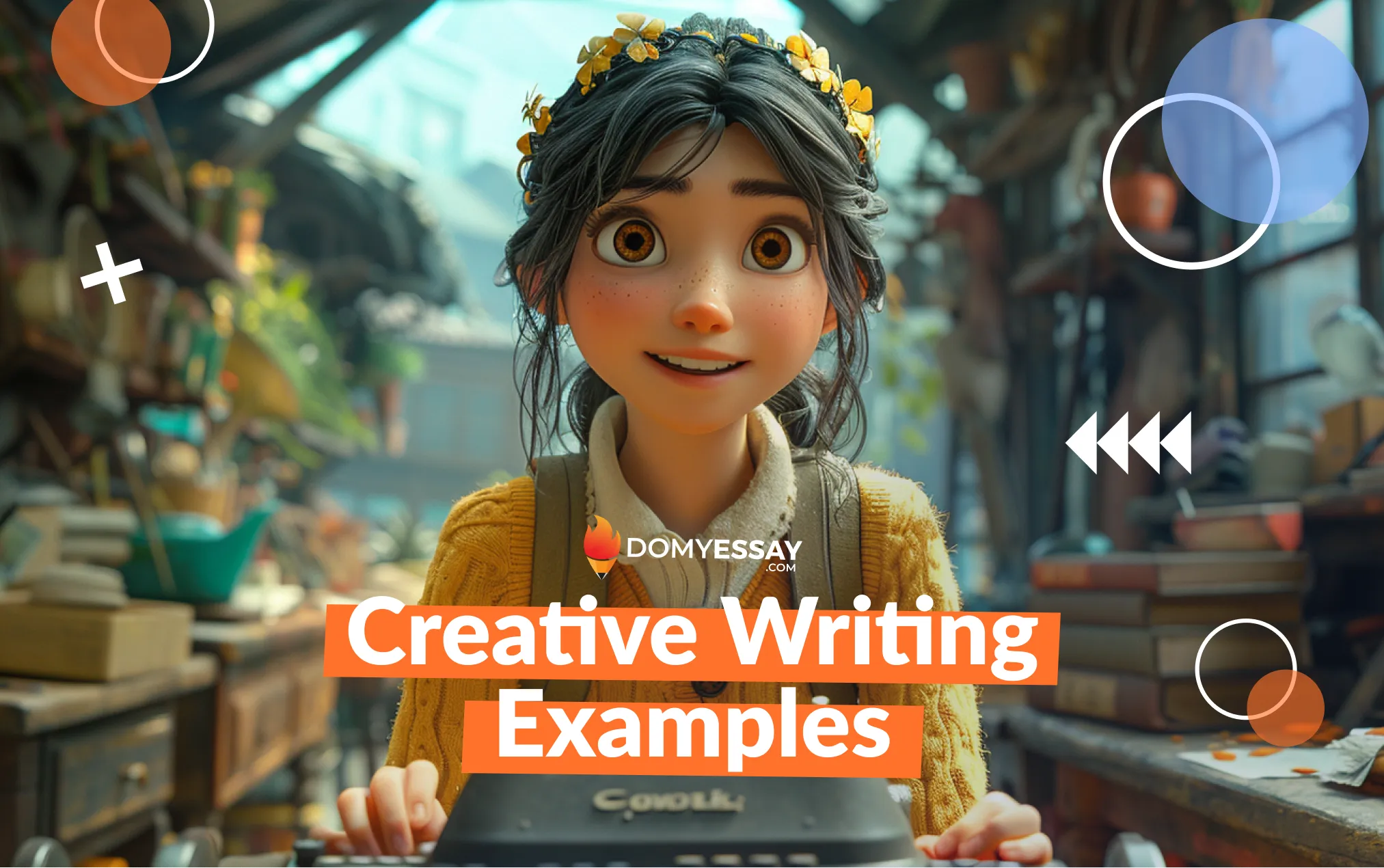
Is the whole idea of crafting a creative piece just too intimidating for you? We get it: writing one is a whole different beast compared to your usual expository essays and research papers.
Fret not: we’ve brought together 13 examples of creative writing to show you there’s nothing to be afraid of. From poems and song lyrics to flash fiction, they’ll introduce you to the variety of formats and styles creative writing encompasses.
Don’t feel like scrolling down to get to the examples? Don’t worry! We put them right after the introduction! You’ll find our experts’ advice on creative writing after them. Check it out, or peruse our creative writing prompts for students to kickstart your brainstorming!
13 Inspiring Creative Writing Examples
Let’s get straight to the 13 creative writing examples for students that perfectly illustrate the diversity of styles and formats.
Creative writing isn’t your cup of tea?
Let our professional wordsmiths take that assignment off your plate from the get-go or refine the draft you’ve already written.
Fiction Writing Examples
Short stories, novels, and flash fiction are the staples of fiction. Here are three examples of creative writing to illustrate their distinctive differences.
1. Short Story
What is it? A short story is a brief work of prose that revolves around a self-contained event and can be consumed in a single sitting.
Example:
When the power went out, Mara finally heard her father crying in the dark kitchen. She stood in the hallway, holding the apology she’d practiced for years. By morning, the lights returned, and the house was quiet again, but something fragile had shifted.
This scene captures one charged moment where emotional tension peaks and subtly resolves.
Why it works: The whole story focuses on a single event, without throwing tons of backstory at the reader. At the same time, it evokes a certain mood by focusing on that encounter.
2. Flash Fiction
What is it? Think of flash fiction as the briefest piece of fiction possible. It tells stories within as few as 100 words, 50 words, or 280 characters.
Example:
The voicemail said, “I made it home safe.”
It was time-stamped three hours after the crash.
Two lines hint at a larger tragedy without directly stating it.
Why it works: The second line is a twist on the first one, immediately reframing it. What’s left unsaid sparks the imagination.
3. Novel
What is it? A novel is a lengthy work (usually 50,000+ words long) that follows a chain of events and focuses on sustained character evolution.
Example:
At twenty, Elias believed leaving town meant freedom. At forty, returning showed him what he’d abandoned and what he could still repair. Each chapter pulled him closer to forgiveness, not just of others, but himself.
This excerpt suggests a long-term journey shaped by time, regret, and growth.
Why it works: As hinted in the excerpt, the novel focuses on Elias’ gradual journey toward forgiveness. The events themselves span two whole decades, giving enough space for exploring the character’s evolution.
Poetry Writing Examples
Poetry has its many conventions and techniques, but you can also break them as freely. Let’s take a look at two diametrically opposed types of poems.
1. Free Verse Poetry
What is it? Free verse poems follow no specific rhyme or meter, with the imagery flowing freely.
Example:
The city exhales at dusk —
windows flicker like tired eyes,
and I carry your name
loose in my pocket.
The poem relies on sensory images and metaphor to convey quiet longing.
Why it works: Like most free verse poems, this one strikes a chord with its free emotional flow. The author also makes good use of sensory details to paint a vivid image.
2. Structured Poem (Haiku)
What is it? A structured poem follows a strict set of rules that dictate the rhyme, meter, and rhythm.
Example:
Autumn bus stop waits
cold metal bench, no footsteps —
last leaf misses home.
This haiku uses the 5–7–5 syllable structure to capture a brief seasonal moment.
Why it works: Due to its size and structural constraints, every word in a haiku has to be chosen carefully. This haiku does it well, painting a picture without deviating from the structure.
Nonfiction Creative Writing Examples
As our experts in narrative writing services know well, nonfiction pieces can be as engaging and impactful as works of fiction.
1. Personal Essay
What is it? A personal essay is an essay that explores the author’s ideas, beliefs, or experiences using storytelling techniques and a first-person narrative.
Example:
I used to think silence meant agreement, until I noticed how often I stayed quiet to keep the peace. Writing this now, I see how that habit shaped my friendships and my sense of self.
The passage reflects inwardly on a pattern of behavior and its emotional consequences.
Why it works: The essay reads like a candid confession from the author, with the first-person voice putting the reader into their mindset from the get-go.
2. Memoir
What is it? A memoir is typically a novel-sized work that focuses on the author’s personal experiences throughout the years.
Example:
My grandmother’s kitchen smelled like cardamom and smoke. Years later, I can’t recall her exact words, but I remember how safe I felt sitting at that table.
This excerpt uses a sensory memory to evoke a relationship from the past.
Why it works: The author isn’t trying to get everything factually accurate, instead opting for sharing an emotional truth.
3. Narrative Nonfiction
What is it? Narrative nonfiction recounts the events that actually happened using storytelling tricks and other staples of fiction writing.
Example:
When the river broke its banks in 2019, the town had twelve minutes to react. Sirens wailed as neighbors ran door to door, turning disaster into a story of collective survival.
The passage frames a real event as a dramatic scene with momentum.
Why it works: This excerpt immediately sets the stakes and puts the reader right into the thick of the action, creating a sense of emergency.
Script & Performance Writing Examples
The following types of creative writing have one thing in common: they are meant to be performed for an audience.
1. Screenplay
What is it? A screenplay is a script that tells a story through a visual medium (movie, TV show, video game).
Example:
INT. BUS STOP – NIGHT
Rain streaks the glass. A woman checks her phone; no signal. Headlights approach, then pass. She exhales, alone again.
The scene relies on setting and action to convey mood rather than internal thoughts.
Why it works: The excerpt shows what screenplay writing is all about: setting the scene and providing the must-include visual details. At the same time, there’s room for interpretation.
2. Stage Play
What is it? A stage play is a script meant for live performances. It advances the story primarily through spoken dialogue.
Example:
ANNA: You said you’d come back.
MARK: I did. Just later than you hoped.
ANNA: That’s always been the problem.
The exchange reveals conflict through what characters say and what they avoid saying.
Why it works: This snapshot of the dialogue moves the plot forward, all while creating tension between the two characters.
3. Speech
What is it? A speech is a spoken monologue delivered to educate, entertain, motivate, or persuade the audience.
Example:
We are not here because the path is easy. We are here because choosing it together makes us stronger than fear.
The lines appeal to shared values and collective resolve.
Why it works: As our experts in the write me a speech department pointed out, the use of “we” is a powerful way to engage the audience by including them in the narrative.
Song Lyrics & Experimental Writing Examples
Finally, hybrid formats and song lyrics are also a form of creative writing. Here’s what they look like in practice.
1. Song Lyrics
What is it? Song lyrics consist of verses and choruses and use rhythm and melodic language to convey emotion.
Example:
I keep driving past your street,
same red light, same old beat —
tell myself I’m almost free,
then the chorus pulls me back to you.
The lines suggest longing through repeated actions and a recurring refrain.
Why it works: The rhyme, while not obligatory in song lyrics, makes this verse all the more memorable.
2. Experimental Writing
What is it? Also known as hybrid writing, experimental writing breaks away from the established conventions and tenets of structure and format.
Example:
Inbox (3 unread):
— Don’t forget who you were.
— Meeting moved to Monday.
— Are you still there?
Footnote: I was. I am. I might be again.
The piece blends emails and commentary to suggest identity fragmentation.
Why it works: This is a prime example of experimentation with the form. Information is conveyed through email subject lines and comments, but it’s so meager that it creates a mystery regarding the character’s sense of self.
Creative Writing 101: What Is It?
Creative writing is a somewhat peculiar beast: it’s defined primarily by what it’s not instead of what it is. The usual definition of creative writing goes like this: Creative writing is a form of writing that deviates from the norms of professional, technical, academic, or normal writing.
This breaking of norms and the freedom that comes with it is what makes creative writing so original and expressive.
If you get a creative writing assignment in academia, its point is usually to provide an outlet for self-expression or hone your craft.
Unlike academic or technical writing, creative pieces don’t aim to transmit factual information or debate a specific topic. Instead, creative writing is a means of expressing yourself and putting whatever is on your mind into words. It can also help you connect with the reader and elicit an emotional response from them.
Reviewing personification examples in poetry can help make your creative writing more vivid.
The Many Types of Creative Writing
Considering the admittedly vague definition of creative writing, the variety of its types shouldn’t come as a surprise to you. It encompasses both fiction and non-fiction, with formats as diverse as poems, screenplays, song lyrics, short stories, and whole novels.
Here are the five types of creative writing that you should know:
- Fiction. Fiction spans everything from novels and short stories to flash fiction and novellas. These forms have one thing in common: they tell a story drawn from the author’s imagination.
- Poetry. Poems are a form of rhythmic writing with their own particular style. That style is usually defined by the rhyme scheme and other techniques like assonance, alliteration, and sound symbolism.
- Nonfiction. Personal essays, memoirs, and narrative nonfiction fall under this category. These pieces focus on actual events, people, and experiences or the author’s beliefs and thoughts.
- Scripts. Screenplays and plays are written for a specific medium: theater stage, film, TV show, or video game. They include the dialogue, visual cues, and directions for performers.
- Hybrid forms. Hybrid forms mix and match genres, styles, and media to break away from conventions and create something fresh and unique. For example, a novel can develop the narrative with photographs.
How to Excel at Creative Writing: 5 Techniques to Know
If you’re new to creative writing (or you’re a veteran who just wants to brush up on the basics), these five techniques are the most crucial tools in your toolkit:
- Show, don’t tell. This is the golden rule: don’t merely state a fact; show it through sensory details, dialogue, or actions.
- Imagery. As a writer, you have the power to paint a mental picture for readers using nothing but words. Go back to our screenplay example to see imagery in action.
- Voice. The voice is what makes your writing feel like it’s coming from a specific person. Compare the narrative nonfiction example’s voice with that of a memoir.
- Dialogue. Like in the stage play example, dialogue can drive the plot forward. Develop your ability to have every character speak in their own unique voice, too.
Structure. A good story flows naturally, without impromptu ramblings or unnecessary details. So, organize your piece in an outline before writing.
Your creative writing piece refuses to come together?
Our experts can turn your half-finished drafts and notes into impactful stories told in the format and style of your choosing.
In Closing
We hope our examples have inspired you to try your hand at creative writing or, at least, have steadied it. For our parting advice, we’d like to say one thing: practice does make perfect. Creativity isn’t an innate trait. It’s a muscle you have to train if you want to come up with fresh ideas on a dime.
So, open that document and start typing, even if it terrifies you. Go through several drafts if you must. And if you ever need a hand with polishing one of them, remember that DoMyEssay experts are always just one short form away.
- What is Creative Writing? (2025, June 6). SNHU. https://www.snhu.edu/about-us/newsroom/liberal-arts/what-is-creative-writing
- Feder, M. (2023, December 7). What is creative writing? University of Phoenix. https://www.phoenix.edu/articles/liberal-arts/what-is-creative-writing.html
- Overview of Creative Nonfiction - Purdue OWL® - Purdue University. (n.d.). https://owl.purdue.edu/owl/subject_specific_writing/creative_writing/writers/creative-nonfiction-basics/index.html
- Fiction Basics - Purdue OWL® - Purdue University. (n.d.). https://owl.purdue.edu/owl/subject_specific_writing/creative_writing/writers/fiction_writing_basics/index.html
- A guide to creative writing. (n.d.). Agnes Scott College Website. https://www.agnesscott.edu/center-for-writing-and-speaking/handouts/guide-to-creative-writing.html