A descriptive essay lets readers see, hear, and feel a subject as if they were standing next to it. The topic decides how far you can get. “A fish market an hour before it opens” gives you plenty to work with, while “my favorite place” gives you almost nothing.
The 150 descriptive essay topics below are grouped by subject and grade level.
What makes a good descriptive essay topic?
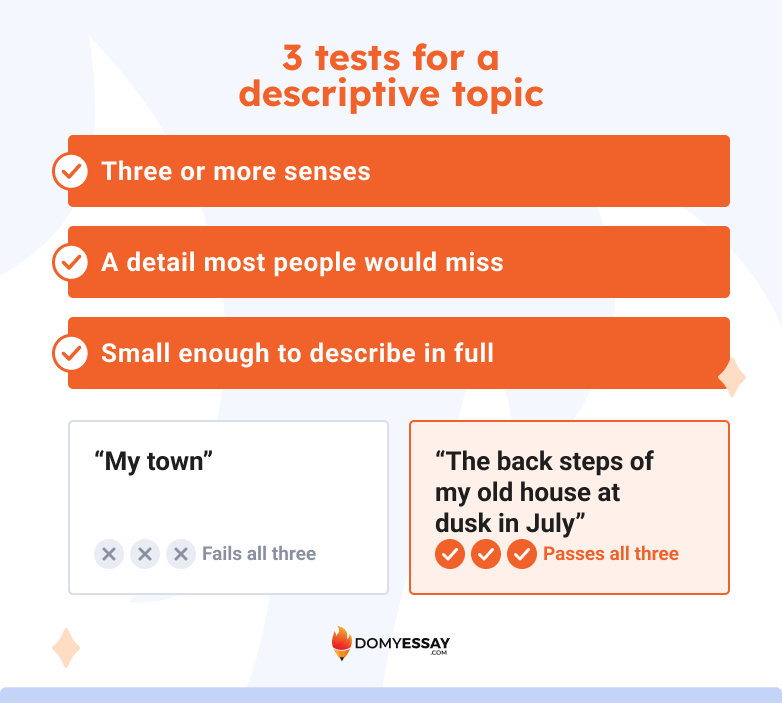
A good descriptive essay topic gives you things to see, hear, and touch, plus a reason for the reader to care. We use three tests. Does the subject involve at least three senses? Is there one detail most people would miss? Could you describe all of it in the pages you have? “My town” fails all three. “The back steps of my old house at dusk in July” passes.
How do you make a descriptive topic more specific?
Add one condition at a time: a place, a moment, a detail. Each condition gives you more to see. This is how a broad subject turns into descriptive essay ideas you can finish in a few pages.
When you are ready to write a descriptive essay, an outline can help you decide how to arrange the details. You can order them by space, by time, or around the main impression you want to leave.
Not feeling very detail-oriented in your writing?
Our experts can take care of your descriptive essay and easily paint a vivid image of your subject.

What are descriptive essay topics by subject?
Start by choosing what kind of subject you want to describe: a person, a place, an object, a moment, or a single sense. Then pick a topic that includes a condition, such as a time of day, a state of wear, or a before and after. Each list below has 15 topics.
Describing people
Look at hands, habits, a person in the middle of a task, or someone right after an event. Show who they are through what they do, not through a list of traits.
- A barber’s hands during the last cut of the day
- My father at the kitchen table, paying bills after midnight
- My favorite teacher’s hands and voice during a lesson that goes well
- My grandfather’s walk from the porch to the mailbox
- A nurse’s face at the end of a double shift
- A street musician packing up after the last set
- My best friend’s face when she is trying not to laugh
- The cashier who has worked the same register for twenty years
- A runner immediately after crossing the finish line
- A mother in the minutes before her daughter’s wedding ceremony
- My roommate’s nightly routine, step by step, before she falls asleep
- A woodworker’s hands as she fits the last joint
- An old neighbor feeding the birds at the same hour every morning
- A student walking out of a hard exam
- My aunt’s laugh and what her whole body does when she tells a story
Describing places
A place changes with the hour, the weather, and what just happened there. Fix your scene at one moment, or compare two.
- My bedroom at 3 a.m. versus at noon
- The campus library on a rainy afternoon, an hour before closing
- A café at 7 a.m., before the first rush
- The school cafeteria after the last lunch period
- A snow-covered campus path at dawn, before anyone has walked on it
- A laundromat on a Sunday night
- A train platform in heavy fog
- The student union at 9 p.m. during finals week
- An empty stadium the morning after a big game
- A beach in the first hour after a winter sunrise
- A kitchen after a family dinner, with the dishes still in the sink
- A hospital waiting room at 2 a.m.
- My childhood home’s hallway when everyone else is asleep
- A farmers market stall at closing time, when the vendors are packing up
- A dorm hallway at 2 a.m., when the vending machine is the only light
Describing objects
Objects work best when they show their history. Choose something worn, inherited, broken, or kept for no clear reason, and let the marks on it tell the story.
- A pair of running shoes after one last season
- My grandmother’s cast-iron pan, passed down to me
- A cracked phone screen I have not replaced
- A watch that no longer keeps time but stays in my drawer
- A coat that belonged to someone else and still carries a trace of them
- A broken umbrella I could not throw away
- A library book with another reader’s notes in the margins
- A favorite sweater, faded and stitched back together
- A key that no longer fits any lock
- A chipped mug that is still my favorite
- A box of old postcards found in an attic
- A ticket stub from a trip I barely remember
- A paperback read so many times that the spine has given up
- A photograph with a crease down the middle
- A toolbox inherited from my father, with every tool in its place
Describing experiences and moments
First times, last times, waiting, and the minute after something ends all hold a strong mood. Keep the scene short and let the small physical details carry it.
- The first time I drove alone
- The last day in a house we were leaving
- Waiting outside a room for news
- The minute after I hit send on an important application
- Waiting at an airport gate for a delayed flight
- The first night in a new city
- The last bell on the last day of the school year
- The minute after a long argument ends
- Waiting in a parked car for the rain to stop
- My first day at a new job, standing at the door before going in
- The last walk through an empty dorm room before returning the key
- The first snowfall seen from a bus window
- The minute after the applause stops
- Waiting outside a theater in the cold for the doors to open
- The first morning in a place that is not yet home
Describing sensory subjects
Choose one smell, texture, sound, or taste and stay with it. These topics train you to find exact words for things most people never stop to notice.
- The smell of rain on hot pavement
- The smell of my grandmother’s house
- The smell of a pencil being sharpened
- The smell of burning leaves in October
- The texture of wet sand under bare feet
- The texture of a wool sweater against bare skin
- The texture of an old wooden banister worn smooth
- The sound of a spoon against a ceramic bowl in a quiet kitchen
- The sound of a train passing a house at night
- The sound of a crowd just before the music starts
- The sound of heavy snow falling
- The taste of the first sip of black coffee
- The taste of salt from the sea on my lips
- The taste of a dish I only eat at home
- The taste of cold water after a long run
What are descriptive essay topics by grade level?
Grade level changes how much a topic can carry. Younger writers do best with small, familiar scenes, while older writers can handle crowds, institutions, and layered meaning. Descriptive essay topics for college, for example, often use campus life and public spaces. The grade labels are starting points, so pick the topic that fits your assignment and gives you plenty to observe.
Middle school (grades 6–8)
These topics use familiar places and simple scenes. Use exact nouns and active verbs, and build each paragraph around one part of the scene.
- The bus stop on a freezing morning
- A pencil case after a long school year
- The gym just before a basketball game starts
- My dog waiting at the door when I get home
- The playground an hour after a rainstorm
- A sleepover at the moment the lights go out
- My lunchbox at the start of lunch period
- The school bus on the way back from a field trip
- The art room after a messy project
- A backyard on the first warm day of spring
High school (grades 9–12)
High school topics can add mood and meaning. Pick a particular time or location so your essay stays focused, and let one main impression guide your choices.
- The school parking lot at the end of the day
- Backstage before the first performance of a school play
- A football game from the student section
- My part-time job at the end of a busy shift
- The hallway outside the counselor’s office
- A graduation gown hanging on the door the night before
- My last home game, seen from the bleachers
- An envelope with a college decision on the kitchen counter
- A group project meeting that runs late in the library
- A family gathering seen from the kitchen doorway
College
These subjects draw on campus life, shared spaces, and personal routines. Use close observation to show how a setting carries meaning, and focus each essay on one scene.
- My dorm room on move-in day
- The campus gym at 6 a.m.
- A lecture hall in the last five minutes of class
- The dining hall during the Sunday brunch rush
- A student protest from the edge of the crowd
- The quad on the first warm day of spring
- A late-night study group in a cramped library room
- The campus bookstore in the first week of the semester
- A college tradition I joined for the first time
- The walk to my first class on the first day
University and ESL
These topics suit university courses that value careful observation, and English learners who want concrete subjects with plenty of useful vocabulary. Choose a scene you can watch in person and write down the words you need before you draft.
- A street food cart at lunchtime
- The central train station during rush hour
- A neighborhood bakery before it opens
- A public park on a weekend afternoon
- A traditional meal in my family’s home
- A busy street corner at three different times of day
- A city bus on a rainy morning
- A small shop that has stayed in the same family for generations
- A new city seen from my apartment window during the first week
- A festival in my hometown, described for a reader who has never been there
What are descriptive writing prompts with constraints?
Constraint prompts are descriptive writing prompts with a rule attached, such as a banned word or a single allowed sense. The rule pushes you to look closer instead of reaching for easy adjectives.
- Describe a place you know well using only sound.
- Describe a meal without naming the food or any ingredient.
- Describe a stranger on a bus using only what you can see from the seat behind them.
- Describe a room through its light alone: where it falls, how it moves, and what it touches.
- Describe an everyday object in four sentences, each one built on a different sense.
- Describe a crowded place using verbs and no adjectives.
- Describe a person leaving a room without naming a single emotion.
- Describe a rainy street without using the words “rain,” “wet,” or “drops.”
- Describe a childhood place twice, as you remember it and as it is now, using the same structure for both paragraphs.
- Describe a market stall without using the words “nice,” “beautiful,” or “interesting.”
What are descriptive narrative essay topics?
A descriptive essay holds one subject still and studies it. A descriptive narrative essay moves through time, so it needs a beginning, a turning point, and an ending, with vivid details at the moments that matter. These descriptive essay ideas all work that way.
- The day I got lost: Describe the surroundings as you realized you were lost, then follow the sights and sounds that helped you return.
- A surprise visit: Begin with the knock or arrival, then describe recognition, reactions, and the atmosphere that followed.
- A moment of victory: Recreate the final seconds of a competition or challenge through movement, sound, physical effort, and reactions.
- The day everything went wrong: Choose a few connected mishaps and use concrete details to show how the day’s mood developed.
- My first attempt at paddleboarding: Describe the board, water, changing balance, and physical sensations as you tried to stand and move.
- An embarrassing mix-up: Recreate the moment you recognized the mistake, including expressions, pauses, words, and your physical reaction.
- The day I helped a neighbor: Describe the task, setting, shared effort, and small details that made the encounter memorable.
- The moment I admitted a mistake: Set the scene, describe the conversation, and show how gestures and tone changed during your admission.
- An unexpected interruption during a presentation: Describe what interrupted you, how the room reacted, and the details you remember as you continued.
- Saying goodbye at a train station: Use luggage, announcements, gestures, and the departing train to carry the scene through its final moment.
What are easy descriptive essay topics?
Easy descriptive essay topics are small, physical things you can hold, taste, or hear right now, so you can collect details in a few minutes. Spend five minutes observing your choice, then organize the essay around one short experience or a few features of the object.
- A freshly made batch of popcorn: Describe the aroma, popping sounds, warmth, texture, and seasoning of a freshly made batch.
- A house key: Examine its metal, teeth, scratches, weight, and the sound it makes against other keys.
- A bar of soap: Describe its shape, scent, smoothness, lather, and changing surface as it becomes wet.
- A piece of chocolate: Capture its color, surface, firmness, flavor, and the way it softens and melts in your mouth.
- My favorite cup: Describe its shape, color, handle, weight, rim, and signs of frequent use.
- Cold water on my hands: Follow the first contact, changing skin sensations, moving droplets, and sounds at the sink.
- A piece of bubble gum: Describe its initial firmness, changing flavor, stretch, stickiness, and the sound of a popping bubble.
- Kneading bread dough: Focus on the dough’s texture, resistance, temperature, floury surface, and movement beneath your hands.
- A comforting hug: Describe the pressure, warmth, posture, duration, and small gestures that make the moment feel comforting.
- A bag of candy: Capture the packaging, crinkling sounds, colors, shapes, and textures of the pieces inside.
- A warm slice of toast: Describe the heat, the crunch, the butter melting, and the smell as you take the first bite.
- Socks fresh from the dryer: Capture the warmth, the static, the softness, and the smell of the fabric.
- A paper clip: Examine its bent shape, shine, springiness, and the small sound it makes when you pull it apart.
- An ice cube melting in a glass: Follow its clear edges, cracking sounds, shrinking size, and the water pooling around it.
- A peeled orange: Describe the spray from the peel, the color of the flesh, the sticky juice, and the sweet, sharp smell.
Descriptive writing isn’t your cup of tea?
Our experts will select the right metaphors, similes, and descriptions to bring your subject to life with the power of the written word.

Which descriptive topics should you avoid?
Avoid any topic where you would have to explain, invent, or cover too much. Five kinds of topics cause the most trouble:
- Subjects with nothing specific to describe. “My school” or “my city” gives you no scene. Pick one corner of it at one moment.
- Topics that need explanation instead of description. If the assignment asks you to explain facts or processes, try informative essay topics instead.
- Abstractions with no physical form. Words like freedom, justice, or happiness have nothing to see or touch. Tie them to one concrete scene.
- Anything too large to cover in full. A whole festival, a whole year, or a whole country will turn into a summary. Choose a single part.
- Topics where you would have to invent the detail. If you have not seen it or cannot picture it clearly, readers will feel the gap. Choose something you can observe or remember.
Last words
A strong descriptive essay starts with a subject small enough to see in full. Add a time, a condition, or a moment, and the details come easily. Then arrange them in a clear order: from the doorway inward for a room, in sequence for an event, and from the whole shape to the smallest feature for an object. During revision, replace vague words with details your reader can picture, and read the essay aloud to check the flow. If you want a hand with the draft, our descriptive essay writing service can help you shape it into a vivid, polished paper.