Essays and research papers may seem similar, but they have important differences. An essay is a short piece of writing that presents your own argument. A research paper requires outside sources in order to analyze a subject further or answer a question.
Essays focus on your own ideas and logic. Research papers are built on facts and documented sources.
In this article, we'll cover everything you need to know about these two kinds of writing and how to recognize the difference between an essay and a research paper.
Major Differences between Research Paper and Essay
Both essays and research papers may appear to have the same surface characteristics. Each has a definitive argument, clear organization and academic voice. However, the intent of each paper is vastly different. One of the more frequent errors made by students is trying to apply one method to both assignments. Here’s a simple comparison of how they differ.
Stuck on Your Research Paper?
Get expert help with research, structure, and overall writing.

What Is an Essay?
Essays are short pieces of writing that develop one idea (or occasionally more) through an ordered series of paragraphs. It presents an opinion and supports it with reasons and examples (occasionally with outside sources, depending on essay type). Essays care less about research and more about how clearly you can develop your argument.
Essays are extremely common because they assess one thing: can you take a subject, develop a perspective on that subject, and communicate your thoughts in writing without getting lost? They can be short pieces of reflective writing or long academic analyses, but the requirement remains the same.
Essay characteristics:
- Length. Generally between 500 and 2,000 words, though some college essays can be longer. Tends to cover a narrower scope than a research paper would.
- Voice. Essays give you a bit more freedom to express your own opinion. Some essay types allow first person, and your writing can have a little character without being “unacademical.”
- Format. Most essays are written in three sections: introduction, body, and conclusion. Each body paragraph discusses one point and relates it to the thesis.
- Thesis. Essays make an argument. Every essay has a thesis statement that clearly defines your position on a subject. Everything you write relates to this claim in some way.
- Sources. Some essays require sources, while others emphasize your own knowledge. Argumentative and analytical essays will usually rely on outside sources to develop their ideas.
- Purpose. To argue, explain, analyze, or brainstorm ideas. Essays are not designed to communicate novel research.
- Versatility. The essay format is more flexible than most other academic forms. Try to bend it to your subject, academic level, and assignment prompt.
What Is a Research Paper?
A research paper questions, examines, and argues about a particular idea or set of ideas. Supported by evidence gathered through study and observation, the paper presents an analysis of your findings with one goal in mind: to add something to what the world already knows.
In order to make your mark on your topic, you have to take what is already known and confirm it, dispute it, or find the gaps that no one has addressed yet. Your research paper should do the same. Unlike essays, research papers require you to find quality sources, understand what others have said about your topic, establish a process, and share new information in a way that allows your readers to verify your findings. Here’s how to do that.
- Abstract: As the beginning of your research paper, your abstract should contain 150 to 250 words summarizing the research you’ll be presenting.
- Introduction: Your introduction should present and outline the focus of your research paper. Make sure you clearly define your thesis statement.
- Literature review: Your literature review will summarize and analyze any books, papers, or studies related to your topic. This section lets you and your readers understand what is already known about your topic.
- Methodology: Your methodology is how you plan to take on your research question. This includes what sources you’ll use, where you’ll look, and why.
- Findings: The findings section is where you’ll share what you discovered while conducting your research. Remember to keep this section organized and free of opinions.
- Discussion: The discussion portion of your paper is where you relate your findings back to the literature review and prove your research question (or thesis statement).
- Conclusion: Your conclusion should include the primary takeaways from your research paper. You can address any limitations to your study and suggest ideas for future research.
- References: Similar to the Works Cited on an MLA paper, your reference list should include every source you mention in your research paper.
Some students choose to buy a research paper when facing complex assignments with extensive source requirements.
What Essays and Research Papers Have in Common
Despite their apparent differences, essays and research papers actually have quite a bit in common structurally and academically.
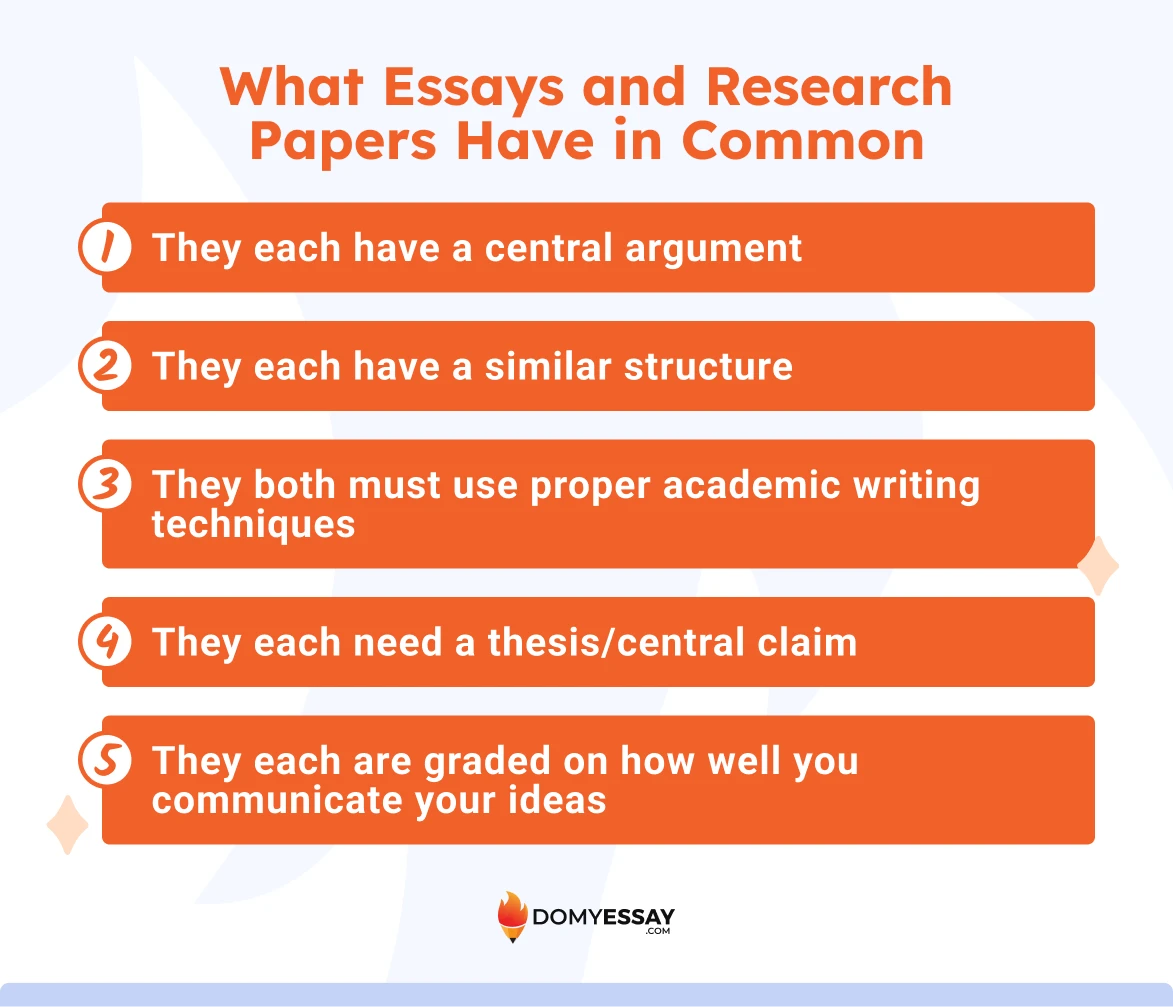
- They each have a central argument: Whether that’s a thesis in an essay or a research question in a paper, you are grounding your writing to one centralized claim or question. Lack of focus ruins both essay writing and research papers.
- They each have a structure: Introduction, body, conclusion. Both paper types use this foundation and build on it. Sections become more refined and formally defined in a research paper than in an essay, but the basic framework of introduction, development of ideas, and conclusion is shared by both.
- They both must use proper academic writing techniques: Formal tone, proper word choice and grammatically correct sentences. Neither format has room for slang and unsupported conclusions.
- They each need a thesis/central claim: May it be argued or not, both have something that you will be supporting or proving through your writing from the beginning.
- They each are graded on how well you communicate your ideas: If your reader can follow your train of thought, how well you build from one idea to the next, and how well you organize your information into a digestible format will matter for essays and research papers.
Whether you are writing an essay or a research paper, starting with an essay outline makes the drafting process much easier.
Research Paper vs. Essay: Example on the Same Topic
Take the topic of social media and mental health in teenagers.
As an essay, you would take a clear position, something like arguing that social media platforms bear responsibility for rising anxiety rates among adolescents, and build a case using reasoning, selected evidence, and your own analysis. The focus is your argument.
As a research paper, you would frame a specific research question, review existing studies on the relationship between screen time and mental health outcomes, outline your methodology, present findings, and discuss what the evidence collectively suggests.
Same topic. Completely different approach.
When to Write an Essay vs a Research Paper
The assignment description will often tell you which one they want, though not always in direct language. Here are some clues to look for.
Write an essay when the assignment prompts you to argue, discuss, analyze, or explain something. If “your opinion” is being tested and how well you can defend it, it’s an essay. Personal statements, opinion pieces, and short analytical exercises all qualify.
You’re writing a research paper when the assignment calls for you to research, study, or scrutinize evidence or add to current scholarship. If your assignment mentions methodology, sources, or findings, you are doing a research paper. Everything is on a larger scale and more organized from the get-go.
Essays often begin with a compelling hook, while research papers usually prioritize background information and context.
Checklist: Are You Writing an Essay or a Research Paper?
Not sure which one you have been asked to write? Run through these quickly before you start.
- Does the brief use words like "argue," "discuss," or "reflect"? Likely an essay.
- Does it ask you to "investigate," "analyze data," or "review literature"? Research paper.
- Is there a word count under 2,000 words? Probably an essay.
- Does it require a methodology or an abstract section? Research paper.
- Are you expected to gather and cite multiple external sources systematically? Research paper.
- Is the focus primarily on your own reasoning and position? Essay.
- Does it ask for headings like findings, discussion, or results? Research paper.
- Is the format flexible with no required section structure? Likely an essay.
- Does it ask you to contribute something new to a field or topic? Research paper.
- Are you being graded on the quality of your argument alone? Essay.
Need a Stronger Draft?
Work with experts to improve your research paper from start to finish.

Final Words
Essays and research papers serve different purposes, and understanding whether you are writing one or the other changes your entire perspective on the assignment. You should have a good understanding of what each paper will require of you. Choose the correct format, adhere to the format, and believe that your effort will pay off. And if you're facing multiple deadlines, simply request 'write a research paper for me' and get help with larger projects.
FAQs
- Stringer, L. (n.d.). Subject Guides: Academic writing: a practical guide: Essays. Subjectguides.york.ac.uk. https://subjectguides.york.ac.uk/academic-writing/essays
- What is the difference between a paper and an essay? | ROBERTSON LIBRARY. (2026). Libraryupei.ca. https://libraryupei.ca/start-here/paper-and-essay