

A “why this major” essay explains what you want to study and why. Colleges want to see that you have a clear starting point, have explored your interests, and know what comes next. Some colleges, such as USC, require you to explain why you chose your major(s).
Here are some “why this major” essay examples for 2026-2027. We also explain why these examples work, how to write your own, and offer tips. These sample essays were created for this article to showcase strong “why this major” essays based on successful patterns.
What is a "Why this major" essay?
A “why this major” essay is a short piece of writing, often just a few hundred words, where you explain what you want to study and what led you there. It connects specific experiences, such as a class, project, or question you couldn't drop, to your plans for college and beyond. The goal is to show real, active interest.
"Why this major" vs. "Why this college" essays
A “why this major” essay is about you and a field of study: where your interest began, what you've done with it, and where it's heading.
A “why this college” essay is about fit: the specific classes, professors, and programs that make one school the right place. Many prompts ask for both. USC's required essay, for example, asks how you plan to pursue your academic interests and why you want to explore them at USC, so you need the major and the school in one answer.
Stuck on your opening moment?
Our writers can help you find a specific story and shape it into a focused draft.

What do admissions officers look for in a "Why this major" essay?
Admissions officers look for a genuine, specific reason you chose your major, backed by proof you've explored it and a clear sense of what comes next.
How long is a "Why this major" essay?
A "why this major" essay word limit runs 150 to 300 words, but always follows the prompt, since limits vary by school. Here are the limits for schools in this guide:
Don’t forget to check out a proper college essay format for more academic guidance.
How to write a “Why this major” essay: 6 steps
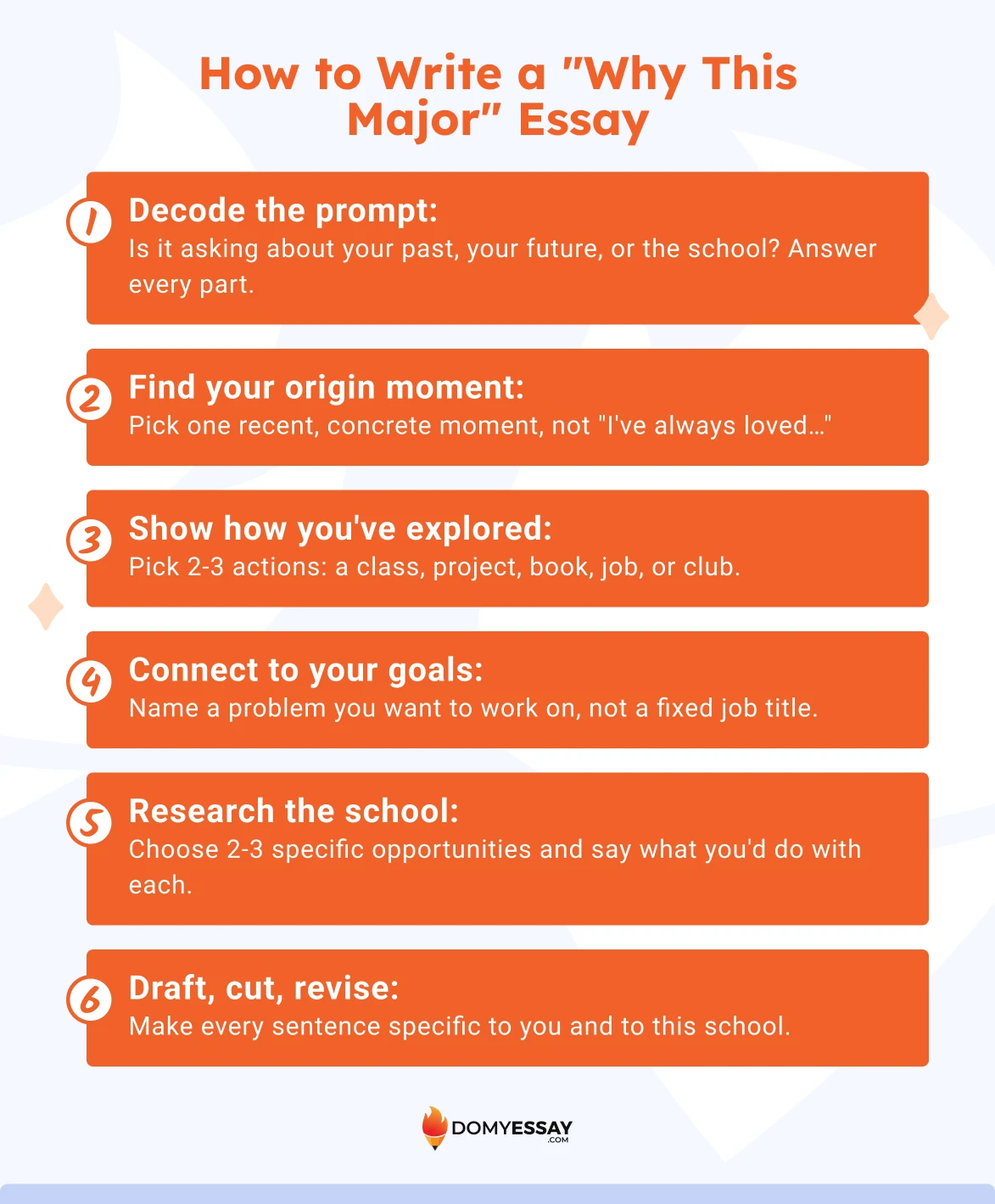
Writing a “why this major” essay comes down to six steps. Decode the prompt, find the moment your interest began, show how you've explored the field, connect it to your goals, research the school, then draft and cut. Follow them in order, and the essay mostly builds itself.
Step 1: Decode the prompt
Look for time words and school names. Words like “why did” or “what experiences” ask about the past, “plan” or “goals” ask about the future, and a school's name asks about fit.
Compare two prompts. A simple one, such as “Why did you choose your major?”, is mostly about the past. USC's required essay asks how you plan to pursue your academic interests and why you want to explore them at USC, so it covers the future and the school. When a “why this major” prompt asks for all three, give each part its own space.
Step 2: Find your origin moment
Choose one recent, concrete moment that made you curious, not “I've always loved…” That line is a claim. A moment is proof. Ask yourself:
- What did I notice, and where was I?
- What did I do next?
- What went wrong or surprised me?
- What did I want to learn afterward?
- Who or what pushed me further?
Pick the answer with the most detail and open it there.
Step 3: Show how you've explored the field
Expand on how you acted on your curiosity. List 2-3 things that you went further with.
- Class: What class did you take outside of your curriculum?
- Project: Something you may have worked on or experimented with.
- Books: A book that you read and leads to a different question.
- Job: Something you learned while working.
- Club: Maybe something you took the initiative on.
Give a brief description of how you expanded on it. If you had a robot project you tried and failed at twice, tell me about it. Don't just rehash your list of activities.
Step 4: Connect the major to your goals
Tie the major to a problem or question you want to work on, not a fixed job title. “I want to design water systems for dry regions” is specific. “I will become a civil engineer” boxes you in. Use phrases like “I hope to” or “one path I'm exploring.” Interests often change, so show direction, not a promise.
Step 5: Research school-specific opportunities
Go through your course listings, labs and faculty as well as student orgs and choose 2-3 that pertain to your story. When you name-drop, it's when you list a professor or course and don't explain why. Add what you would do with each one and tie it back to step 3. If you can replace that sentence with another school's name, then you are being too broad.
Step 6: Draft, cut, and revise
Write a rough draft without editing, then cut until every sentence earns its place. Trim any scene-setting opening that doesn't lead to your major. Use this checklist:
- Is every sentence specific to you?
- Is every school detail specific to this school?
- Does the essay answer every part of the prompt?
- Does it show interest through actions rather than claims?
- Does it fit the word limit and sound like you when read aloud?
"Why this major" essay structure
Use this five-part flow for your "why this major" essay structure:
Origin moment → Exploration → Specific interest within the field → Future goals → Why this school.
Here is a word budget for a 250-word essay:
- Origin moment: about 50 words
- Exploration: about 60
- Specific interest within the field: about 40
- Future goals: about 40
- Why this school: about 60
Give the school part real space, since many prompts ask for it.
For a 150-word version, merge the origin moment and exploration into one 50-word scene. Keep your specific interest to one sentence (about 25 words), goals to about 25, and school fit to about 50.
How to address first- and second-choice majors?
Put your main major first, and your other major if it relates. You can find something that both majors relate to, maybe it's a question, a topic or something you want to learn more about. Write about your first major for most of your response, and just write one or two sentences about your second major. As mentioned above, USC asks about both majors, but it may not always ask about both.
Example: "I'm drawn to why communities ignore flood warnings. Environmental science explains the risk, and my second choice, economics, explains the choices people make."
What if you're undecided?
It's okay to be undecided. Many schools will allow this. Illinois even has a prompt that caters to undecided students. Do not feel as if you need to apologize. Choose 2-3 things you enjoy and elaborate on what you have done for each. State your question that all of these may share. How can this school allow you to further explore that question?
Example: “My major is still very much up in the air. I built a bot last spring that organized my schools lost and found. Spent the summer talking to bus drivers about mass transit. Read up on how mapping can affect politics. All of these topics revolved around one question: how do we interact with public space? I see potential for exploring this in computer science, as well as in city and geographic studies. I see [name of first-year seminar] as a great opportunity to explore that very question.”
Common "Why this major" essay mistakes
You’ll want to avoid these common essay blunders:
- “I have always loved it”: You can say this about anything. Talk about a specific time recently.
- Listing courses without explaining why: This might indicate you've researched the institution, but it doesn't convey genuine interest. Why did you like that course?
- Generic school praise: The "great faculty and students" sentiment is something anyone could write. Pinpoint a course of study at that college and articulate what you aim to achieve through it.
- Writing about the career only: Everyone wants to be a doctor, etc. Share what excites you about the field.
- Your personal statement: You're telling your story again. Pinpoint a specific instance where your academic curiosity was sparked.
- Forgetting to answer a question: Always underline your prompts and make sure you answer each one. If you're discussing the school or a potential second major.
Want a second opinion?
Get feedback on your draft's focus, specific details, and school fit from experienced editors.

Final words
Have a good reason why you want to take that major. Start with a situation that you can relate to about that subject. Show that you have researched that topic. Tell them what you want to achieve with your life and how that college will help you with it. Don’t use boring or general phrases about that topic. Keep your writing personal to you.