A cause and effect essay is a type of writing that explains why something happens, what happens as a result, or both. It connects a focused thesis to evidence and explains how each cause produces an effect. This guide covers essay structures with a sample outline, 8 steps to cover the entire writing process, and a few examples so you can see how everything works in a real project.
What is a cause and effect essay?
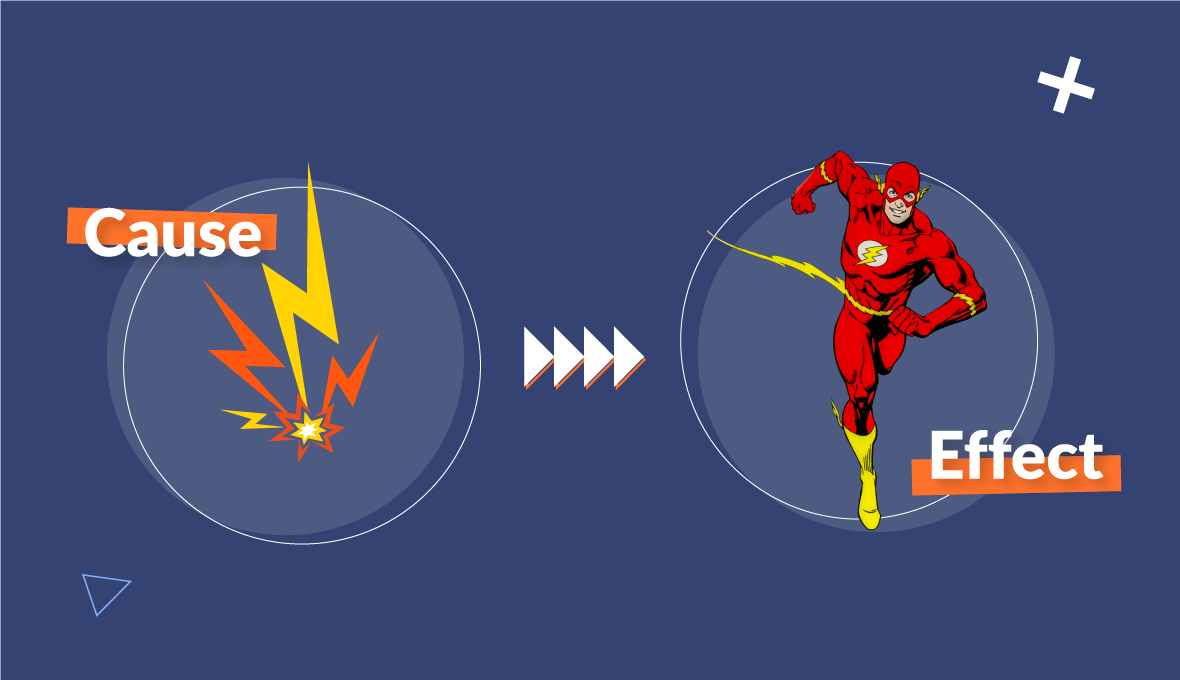
A cause and effect essay is a type of expository writing that seeks out the reasons behind an event or situation and how they evolved into consequences. A cause answers “Why did this happen?” An effect answers “What happened as a result?”
For example, heavy rainfall can overwhelm a drainage system, thus flooding nearby streets. An essay about that relationship would explain how the volume of water exceeds the system’s capacity.
The central task of such writing is to support a causal explanation with evidence. Two events occurring together establish a correlation; a causal argument also needs an explanation of how one influences the other and evidence addressing other possible causes.
A sequence of events can help organize a causal explanation, and narrative essays offer useful examples of chronological organization.
Different types of cause and effect essay structure
There are 2 main types of cause and effect essay structures:
- Block structure
- Chain structure
- Thematic/focus variations
The number of body paragraphs depends on the assignment’s length and the evidence each point requires.
Block structure
In block structure, you group causes together and then discuss the corresponding effects. Use this sequence:
- Introduction: Establish the issue and state the thesis.
- Causes: Explain the contributing factors in one or more paragraphs.
- Effects: Explain the consequences in one or more paragraphs.
- Conclusion: Connect the findings and explain their significance.
This structure suits an essay examining both the causes and consequences of urban flooding.
Causal chain structure
Follow a sequence in which one effect becomes the cause of the next event.
- Introduction: Identify the starting condition and overall outcome.
- First link: Explain how the initial cause produces an effect.
- Following links: Show how each effect triggers the next development.
- Conclusion: Explain the significance of the complete chain.

For example, an essay could trace how drought reduces crop yields, how reduced supply raises food prices, and how higher prices increase household food expenses. Support each link with evidence.
Are There Other Things That You’d Rather Do?
So Do Them, Leave Essay Writing for the Experts!

Cause and effect essay outline
This effects-focused outline organizes three consequences of one cause: expanded paved surfaces. Keep note of how each body paragraph develops one effect, and add documented evidence to turn the outline into a researched essay.
I. Introduction
- Introduce the role of pavement in urban development.
- Explain that impervious surfaces prevent water from soaking into the ground.
- Thesis: Expanding paved surfaces increases stormwater runoff, places greater demands on drainage systems, and carries pollutants into waterways.
II. Body paragraph 1: Increased runoff
- Topic sentence: Pavement directs rainfall across the surface.
- Explanation: Water flows toward streets and drains when it cannot infiltrate the covered soil.
- Evidence to gather: Local land-cover maps and runoff measurements.
III. Body paragraph 2: Pressure on drainage systems
- Topic sentence: Increased runoff raises the volume of water entering storm drains.
- Explanation: Flooding occurs when incoming water exceeds the system’s capacity.
- Evidence to gather: Municipal drainage reports documenting capacity and flooding locations.
IV. Body paragraph 3: Water pollution
- Topic sentence: Runoff transports pollutants from paved surfaces into waterways.
- Explanation: Moving water picks up substances such as oil and road salt.
- Evidence to gather: Local stormwater monitoring results.
V. Conclusion
- Restate the relationship between pavement and stormwater problems.
- Connect the three effects.
- Explain why the findings matter for local drainage planning.

How to write a cause and effect essay: step-by-step guide
To write a cause and effect essay, use the eight steps below and develop a focused argument supported by evidence.

1. Choose a topic
First, turn a broad subject into a focused causal question. For example, narrow “urban flooding” to “How does expanding pavement affect stormwater runoff in this city?” Check that the question fits your word limit and assignment requirements.
2. Conduct research
Gather relevant research and primary records, recording methods, findings, dates, and citation details. Check whether each source supports causation or establishes an association. Consider competing explanations and the possible direction of influence before adopting a causal thesis.
3. Develop a thesis statement
Your thesis statement should identify the cause-and-effect relationship and the main points the essay will explain. For example: “Expanding paved surfaces increases runoff, strains drainage systems, and carries pollutants into waterways.”
4. Create an outline
Organize paragraphs by contributing factor, consequence, cause-and-effect pair, or link in a causal chain. Under each planned paragraph, write its main claim and supporting evidence; an empty evidence slot identifies a research gap.
5. Write the introduction
Introduce the specific issue, provide the background readers need, and end with your thesis. For an essay about local flooding, begin with a documented flood event and explain why drainage capacity matters to the community.
6. Write the body paragraphs
Build each paragraph around one causal claim: state the point, present evidence, explain the mechanism, and connect it to the thesis. Use transitions such as “because,” “consequently,” and “as a result” where the evidence supports that connection.
7. Write the conclusion
Restate your central finding in fresh language and connect the causes and effects established in the body. End with an implication supported by your analysis, such as the importance of accounting for paved surfaces in drainage planning.
8. Proofread and edit
Check causal claims against their evidence, then review citations, paragraph order, grammar, and punctuation. Underline each “leads to” statement and confirm that the paragraph explains how the effect occurs.
Do You Wish for an Improved Academic Life?
We gathered a talented and qualified team of writers to provide you with the greatest essay-writing service!

Cause and effect essay examples
Use these models to see how a causal explanation develops. The first organizes effects by consequence; the second labels the parts of a body paragraph using hypothetical evidence.
Sample 1: How Light Pollution Drives the Decline of Nocturnal Moths
Street lighting is usually treated as a harmless convenience, yet the artificial glow along roads and parking lots is a measurable driver of insect loss. [Evidence] Across Britain, the total number of moths has fallen by about a third over the past 50 years. Light pollution is not the only reason, but a growing body of research shows that the lamps meant to make streets safer are thinning out one of our most important groups of pollinators. [Thesis / connection] This essay argues that artificial night lighting reduces moth populations through two linked mechanisms: it disrupts where females lay their eggs, and it turns adults into easy prey.
[Claim] The clearest damage shows up in the next generation, among caterpillars that cannot simply fly away from the light. [Evidence] Surveys comparing lit and unlit roadsides have found caterpillar numbers in hedgerows roughly 52% lower under LED streetlights and 41% lower under older sodium lights. [Causal explanation] Because caterpillars move only a few feet from where they hatch, their absence under lamps points to a problem at the egg-laying stage rather than ordinary wandering. Female moths, which evolved to deposit eggs in darkness, appear to lay far fewer eggs in brightly lit habitat. [Connection to thesis] A drop in young moths proves that lighting does not merely bother adults; it suppresses reproduction, which feeds straight into the long decline named in the thesis.
[Claim] For the adults that do take flight, the lamp itself becomes a death trap. [Evidence] Moths are pulled upward toward bright fixtures, where biologists say they fall into an ecological trap, a natural cue that now leads them to harm. [Causal explanation] Once a moth is circling a lamp, it is exposed and disoriented, which lets predators such as bats pick it off with little effort. Whiter LED lamps make the pull stronger because they throw off more blue light, the part of the spectrum insects detect most strongly, which is why the newer bulbs do more damage than the sodium ones they replace. [Connection to thesis] This second mechanism accounts for the other half of the thesis: even healthy adults are removed from the breeding population before they can reproduce.
[Claim] The loss then ripples outward to the animals and plants that depend on moths. [Evidence] Moths pollinate many night-blooming flowers and form a staple food for birds and bats. [Causal explanation] When lamp-lined corridors cut moth numbers, the species that feed on them lose a dependable meal, and the plants that rely on night pollination lose a courier. [Connection to thesis] The decline, therefore, reaches well beyond a single insect, which raises the stakes of the central claim.
[Connection to thesis] Light pollution lowers moth populations by discouraging egg-laying and by exposing adults to predators, and the damage spreads through the food web. [Claim] The hopeful part is that this cause has a cheap fix. Lighting is one of the few drivers of biodiversity loss with an easy solution: warmer bulbs with less blue light, shields that aim light downward, and lamps that dim when no one is near. Unlike climate change, that switch can happen on the budget of a single town.
Sample 2: How Contactless Payment Increases Everyday Overspending
Tapping a card or phone takes under a second, and that speed is exactly the problem. [Evidence] Across decades of research, people consistently spend more when they pay with a card than when they pay the same amount in cash, with some experiments showing shoppers willing to bid far higher once physical money leaves the equation. [Thesis] This essay argues that contactless payment increases everyday overspending because it strips away the friction, the visibility, and the deliberation that normally hold a budget together.
[Claim] The first effect is that tapping removes what researchers call the pain of paying. [Evidence] Studies of cash versus card behavior find that handling physical money registers as a small loss in the moment, while swiping or tapping barely registers at all. [Causal explanation] When you hand over banknotes, you see your supply shrink and feel the transaction as a sacrifice, so you pause before buying something you do not need. A contactless tap produces no such signal: the money is abstract, the balance is out of sight, and the purchase feels almost free. [Connection to thesis] With the natural brake of that small discomfort gone, the shopper clears purchases they would have declined with cash, which is the overspending the thesis predicts.
[Claim] The second effect is a rise in quick, unplanned purchases. [Evidence] Merchants adopted contactless partly because it speeds up checkout, and faster checkout lines move more transactions, especially small ones like coffee, snacks, and app subscriptions. [Causal explanation] Deliberation needs time, and tap-to-pay deletes the few seconds that used to involve counting bills, waiting for change, or even entering a PIN. Each of those steps was a tiny checkpoint where a buyer could reconsider. Remove the checkpoints and the default becomes yes. The individually trivial amounts then stack up, because a stream of three-dollar taps never feels like the fifty-dollar total it becomes by the end of the week. [Connection to thesis] A higher volume of low-value impulse buys is overspending by accumulation rather than by a single large splurge, and it flows directly from the frictionless design named in the thesis.
[Claim] The third effect is that the habit erodes a person’s sense of their own running total. [Evidence] People who pay by cash can gauge what remains by the thickness of their wallet, while contactless users rely on a figure they have to deliberately look up. [Causal explanation] Because the balance is hidden until you open an app or wait for a statement, spending and awareness drift apart. By the time the statement arrives, the money is already gone, and the overspending that looked painless at the register turns into a surprise, sometimes an overdraft or a revolving credit balance that adds interest on top. [Connection to thesis] This lag converts many small frictionless decisions into a measurable financial cost, which is the downstream harm the thesis points toward.
[Connection to thesis] Contactless payment drives overspending by muting the pain of paying, by removing the pauses that curb impulse buys, and by hiding the running balance until the damage is done. [Claim] The useful response is to rebuild the friction on purpose. Turning on an instant notification for every transaction restores the moment of awareness a tap deletes; setting a weekly spending cap or moving discretionary money onto a separate prepaid card recreates the visible limit that cash once provided. The technology will keep getting faster, so the brakes have to be added back by the person holding the phone.
Sample 3: How the Loss of Local Newspapers Lowers Civic Participation
When a town’s newspaper closes, the most visible change is an empty storefront, but the lasting effect happens at the ballot box and in city hall. [Evidence] The United States has lost roughly a third of its newspapers since 2005, and more than half of its counties now have little or no local news coverage at all. [Thesis] This essay argues that the disappearance of local papers lowers civic participation because it removes the information residents need to vote, cuts the oversight that keeps officials honest, and weakens the shared sense of community that pulls people into public life.
[Claim] The first effect is that voters lose the information that makes local participation possible. [Evidence] National outlets cover presidents and senators, but almost no one else reports on a school board budget, a zoning change, or a county commissioner’s record. [Causal explanation] Without a paper doing that work, a resident who wants to vote responsibly in a local race has no practical way to learn who the candidates are or what they stand for. Faced with a ballot full of unfamiliar names, many people either skip the down-ballot races or do not turn out at all. [Connection to thesis] Lower turnout and more blank votes in local elections are the direct participation loss the thesis describes, and they trace straight back to the missing coverage.
[Claim] The second effect is weaker accountability, which lets problems grow unchecked. [Evidence] Researchers who study news deserts have found that when local watchdog reporting vanishes, government costs tend to rise: borrowing becomes more expensive and municipal spending climbs, because no one is examining the books. [Causal explanation] A reporter attending council meetings and filing records requests acts as a deterrent; officials behave differently when they know someone is taking notes. Remove that observer and the incentive to cut corners grows, while residents lose the early warnings that once prompted them to show up and object. [Connection to thesis] Fewer people organizing, attending meetings, or pushing back against waste is a decline in active civic participation, caused by the oversight gap the thesis identifies.
[Claim] The third effect is a fraying of the local identity that motivates people to engage in the first place. [Evidence] Local papers once printed the high school scores, the obituaries, the new business openings, and the small stories that told residents they belonged to a shared place. [Causal explanation] When that common record disappears, people increasingly get their news from national and social media sources that emphasize distant conflicts over neighborhood life. Attention drifts away from the town, and a person who feels no connection to local affairs has little reason to volunteer, donate, or run for office. [Connection to thesis] This slow withdrawal from community life is the broadest form of the lost participation named in the thesis.
[Connection to thesis] The closure of local newspapers lowers civic participation by starving voters of information, by removing the watchdog that keeps officials accountable, and by dissolving the shared identity that draws people into public life. [Claim] The encouraging development is that the gap can be filled deliberately. Nonprofit newsrooms, public-radio partnerships, and reader-funded local sites have begun to restore coverage in places the market abandoned. The lesson is that local news is not a luxury but a form of civic infrastructure, and a community that wants an engaged citizenry has to fund the reporting that makes engagement possible.
If you’d rather have a professional handle the writing process from start to finish, just ask us, ‘Write my essay for me.’
Final thoughts
A cause and effect essay explains why events happen and what follows, supporting each causal claim with evidence. Choose block or chain structure, build a focused thesis, outline by cause or effect, then draft, support every link, and proofread. Done well, it turns observed connections into a documented argument.