
Give an accounting student a blank ledger for the first time and watch their mind go blank. Do you debit or credit cash when you deposit it? Take a wild guess: you’re not alone. While student enrollment in accounting programs nationwide grew 12.4% year-over-year as of the spring of 2025, per data from the American Institute of Certified Public Accountants (AICPA), plenty of aspiring accountants second-guess themselves on the foundations of double-entry accounting.
Journal entries record debits and credits to the appropriate accounts for each financial transaction, ensuring the accounting equation remains balanced. A real journal entry example can help make that process clearer. This article walks through exactly that, real, worked journal entries examples across the transaction types accounting students see most often.
What is a journal entry
Let’s start with a simple question - what is a journal entry in accounting? Journal entry accounting is the process by which a financial transaction is recorded for the first time. Every transaction ever made will pass through your journals before it reaches a financial statement. To know what a journal entry is, you must understand how to properly format one. With very few exceptions, every journal entry will look like the one below. In both accounting and writing, a journal entry records an event that occurred at a particular time.
- Date the transaction occurred: Always entered first. Helps to keep the journal in chronological order.
- Accounts: Accounts impacted by the transaction. (ex. Cash, Accounts Receivable, Supplies, etc.) The name of the account is always entered.
- Debit or Credit: Dollar amount of transaction. Total Debits ALWAYS equal Total Credits.
- Memo: Reason for the transaction. Helpful if anyone other than you has to read your books.
- Ref.: Reference number that links to the source document associated with the journal entry.
After all five of these characteristics are included, the journal entry accounting is ready to be posted to the general ledger, so the entry can move from record to result.
A journal entry that you may be more familiar with would be the kind you write for yourself or as a homework assignment for English/classics/humanities. The journal entry format looks different, but every entry should still serve the same basic purpose: ...
- What happened, or what you read
- What do you think or feel about it
- One connection (to class, life, or another text)
- Clear, honest sentences that actually say something useful.
- Length usually 1/2 page to 1 full page
Again, the basic foundational purpose is the same: record something that occurred at a particular time, in the same manner every time, even though what you’re actually recording can look extremely different.
Finish Your Accounting Work Faster
Work with experienced academic writers and accounting experts to submit accurate, well-organized assignments.

Types of journal entries
The types of journal entries in accounting listed below will help you understand why some entries are single-line while others span multiple lines.
- Simple entry: Has only two accounts (one debit and one credit). Most transactions are of this type, such as paying rent or receiving cash from sales.
- Compound entry: Has three or more accounts involved in a transaction simultaneously, like recording payroll entry involving wages expense, tax liabilities and cash simultaneously.
- Adjusting entry: Recorded at the end of an accounting period. Examples include accrued expenses, such as interest or depreciation, incurred during a period but not yet recorded.
- Closing entry: Recorded at the end of a fiscal cycle. It transfers entries for the net result and other selected entries to permanent equity accounts.
- Reversing entry: Recorded at the beginning of a new accounting period to reverse the effect of certain adjusting entries. Once reversed, the actual entries made at that time will not be double-counted.
- Opening entry: Recorded at the beginning of the accounting period or business commencement date. Shows beginning balances brought forward from the previous period or capital invested by the owner.
- Transfer entry: Allows transfer of an amount from one account to another without any transaction occurring.
If you’re working through complex bookkeeping assignments, request ‘do my accounting homework’ to better understand accounting concepts.
Journal entry examples
Seeing real examples of journal entries across a range of accounting situations is the fastest way to build confidence with debits and credits. Below are 8 worked examples, each showing the business scenario followed by the actual entry.
1. Simple entry: cash sale
Here's a simple journal entry example. On March 4, 2025, Maple Street Bakery sells baked goods to a walk-in customer for $450 cash.
2. Simple entry: purchasing supplies on credit
On March 9, 2025, the bakery buys $600 worth of packaging supplies from a vendor, agreeing to pay within 30 days.
3. Compound entry: payroll with deductions
A compound journal entry accounting would be something similar: On March 15, 2025, the bakery processes payroll totaling $3,200. Federal taxes of $480 and state taxes of $160 are withheld before the remaining cash is paid out.
4. Adjusting entry: accrued interest expense
On March 31, 2025, the bakery owes $120 in interest on a business loan for the month, though the cash payment isn't due until next month.
5. Adjusting entry: prepaid insurance used up
On March 31, 2025, one month of a prepaid annual insurance policy, worth $200, is recognized as an expense.
6. Closing entry: transferring revenue to retained earnings
On March 31, 2025, the bakery closes out $8,500 in total revenue for the month into retained earnings.
7. Opening entry: owner's initial investment
Personal journal examples can look like this: On March 1, 2025, the owner deposits $10,000 of personal savings to officially open the bakery's business bank account.
8. Reversing entry: canceling a prior accrual
On April 1, 2025, the bakery reverses the $120 accrued interest entry from March 31, since the actual interest payment will be recorded once it's paid.
9. Transfer entry: reclassifying petty cash
On April 10, 2025, the bakery moves $150 from the main checking account into a petty cash fund used for small, incidental purchases.
10. Simple entry: paying off a portion of a loan
On April 20, 2025, the bakery makes a $500 payment toward its outstanding business loan, reducing the principal balance owed.
Good excel formatting makes it easier to organize journal entries, financial data, and accounting worksheets.
Need Help With Accounting Assignments?
Get expert support with journal entries, financial reports, spreadsheets, and accounting homework.

How to write a journal entry with 8 steps
Whether you’re working on your very first journal entry or your 50th one for the day, there are several steps of how to write a journal entry that you can take to make your work much less error-prone.
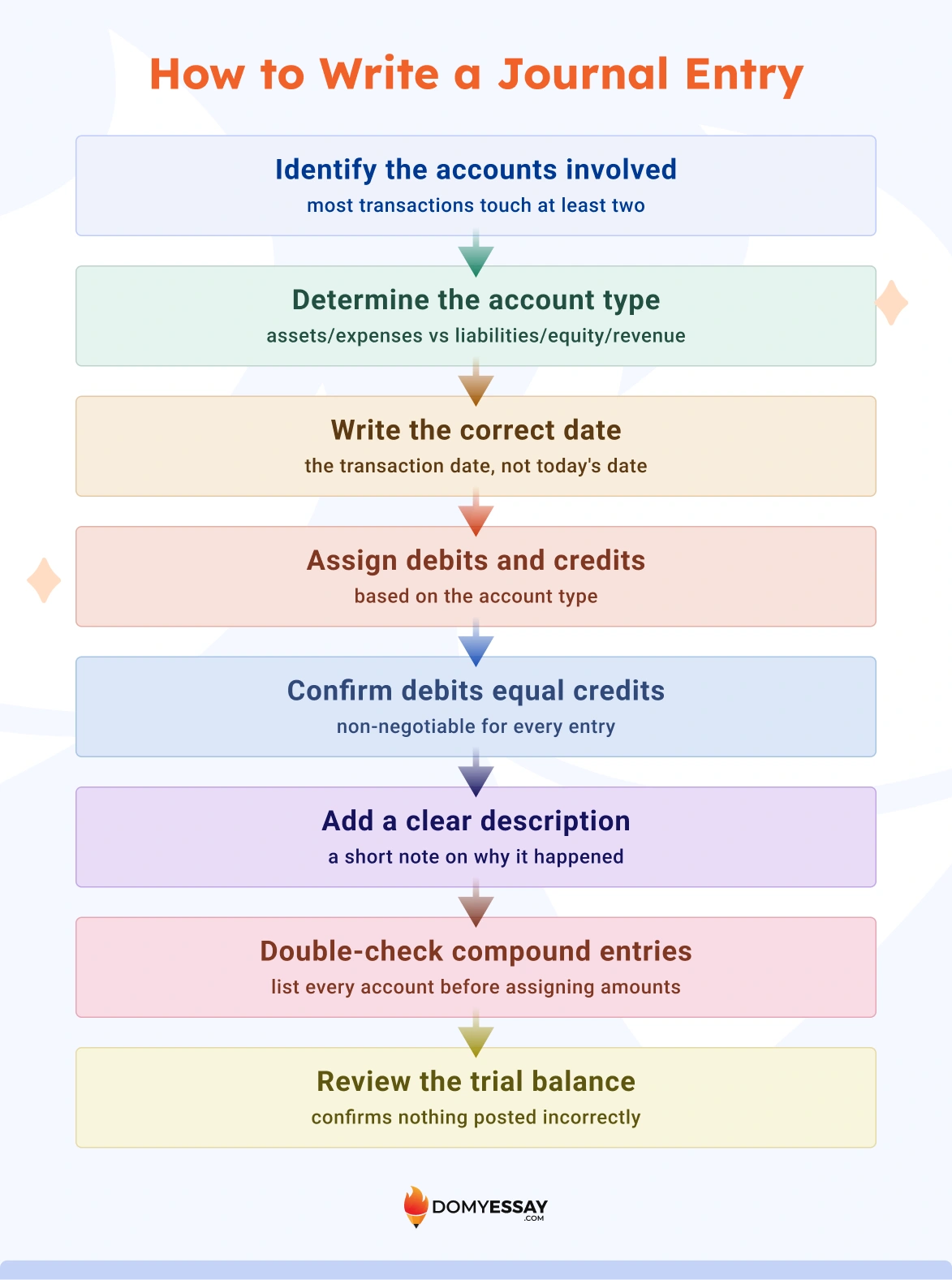
- Know which accounts will be used first: Before you start recording debits and credits, know exactly which accounts will be used in the transaction. Remember that most transactions will use at least two accounts.
- Know which type of account you are working with before deciding whether to debit or credit: Asset and expense accounts are increased with debits. Liability, equity and revenue accounts are increased with credits. If you know the type of account you are working with, you won't have to guess which column to use.
- Enter the date of the transaction: Use the date that the transaction actually occurred. Don't use the date you're entering; this can be very important when making year-end adjusting entries.
- Ensure your debits equal your credits: Sounds pretty obvious, but if your debits don't equal your credits, something is wrong with the entry. Review the amounts before continuing.
- Include a description: Take a few seconds to include a short description of the transaction. You'll thank yourself later when you or someone else is reviewing your entry.
- Triple-check compound entries: When making an entry that affects three or more accounts, it is easy to forget to include all of them. Write down all the accounts that will be affected before plugging in any amounts.
- Work through example entries: While working through problems in your textbook is a great way to learn, take a few extra minutes to work through entries created from real-world situations. Go through payroll, loan transactions, and sales entries.
- Run a trial balance after posting: Once you have posted your entries to your ledger, take a second to run a trial balance. This will ensure that something wasn't entered incorrectly.
After recording journal entries, you may also need to write a financial report that clearly presents your findings.
The bottom line
Journal entries can seem overwhelming at first, but the basic format rarely varies: list the accounts, allocate debits and credits, and ensure the entry balances. The above examples should introduce you to nearly everything you'll see for the first few weeks of an accounting class. Repetition, with enough variation in transaction types, will turn this memorization into instinct.
.webp)