Key Takeaways
- A viable topic should have something that you can vary and something that you can measure.
- In a 2026 Chemical Science review, electrochemical destruction of PFAS was named one of the fastest-growing fields in Chemical Science.
- Because feasibility is a pressing concern in chemistry, make sure you have access to the equipment and reagents you need before getting too deeply invested.
- If you don't have access to a lab at all, consider a computational or database project.
- Electrochemical destruction of PFAS, solid-state batteries, and AI-assisted retrosynthesis were all among the top emerging research areas in 2026.
Chemistry research paper topics can require anywhere from a full-fledged wet lab to just a laptop with chemical database access. This collection of over 250 chemistry research topics is categorized by subcategory and by actual lab requirements so you can choose something doable for your class, equipment availability, and timeframe.
What makes a good chemistry research topic
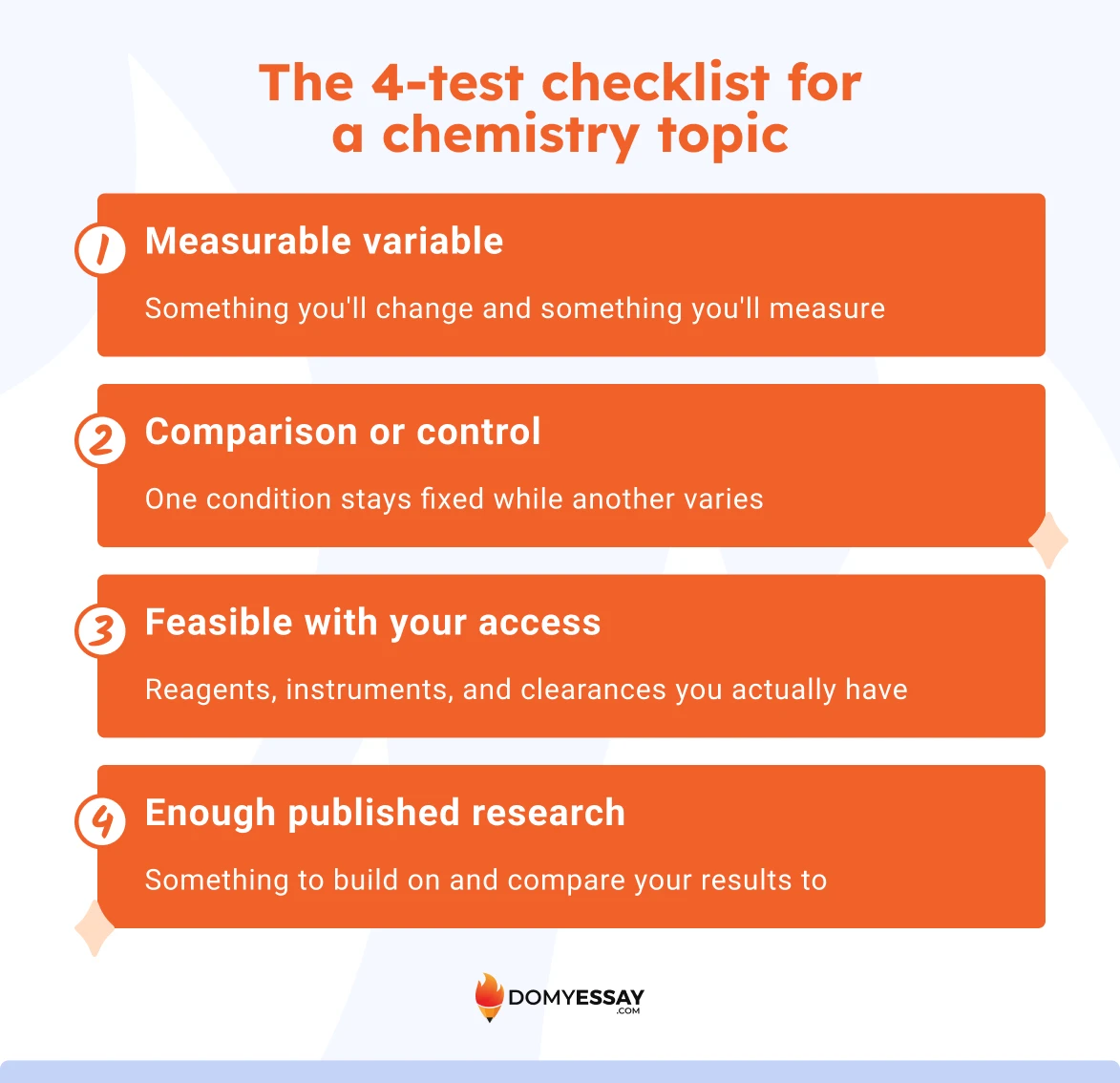
Many ideas seem like they could be chemistry research topics until you try to figure out how you’d actually do an experiment. If it passes these four tests, it gets written into your outline.
- Includes a measurable variable: Do you know one thing you will change and one thing you will measure? “Antioxidants in fruit” is not something you can measure. “The effect of storage temperature on vitamin C degradation in orange juice over two weeks” is.
- Requires a comparison or control: Good chemistry research only varies one thing against a control. If your topic doesn’t have a condition that doesn’t change, you’re writing a description of what happens rather than an investigation into why.
- Is it feasible with your access levels? Double-check that the reagents, instruments, and safety clearances your topic will require are actually things you will have access to. If you do not have access to a required tool this semester, your topic is not possible to research this semester.
- Has sufficient published research to support it: Verify that similar experiments have been done, so you have something to build off of and also something to compare your results to.
The distinction students miss most often: a topic that just describes a substance, "the properties of caffeine," is a report. A topic that compares conditions, "how brewing temperature affects caffeine extraction efficiency," is research. The second version gives you something to actually test.
Need Chemistry Assignment Help?
Get expert support with chemistry research papers, lab reports, and homework.

Chemistry research topics by lab access
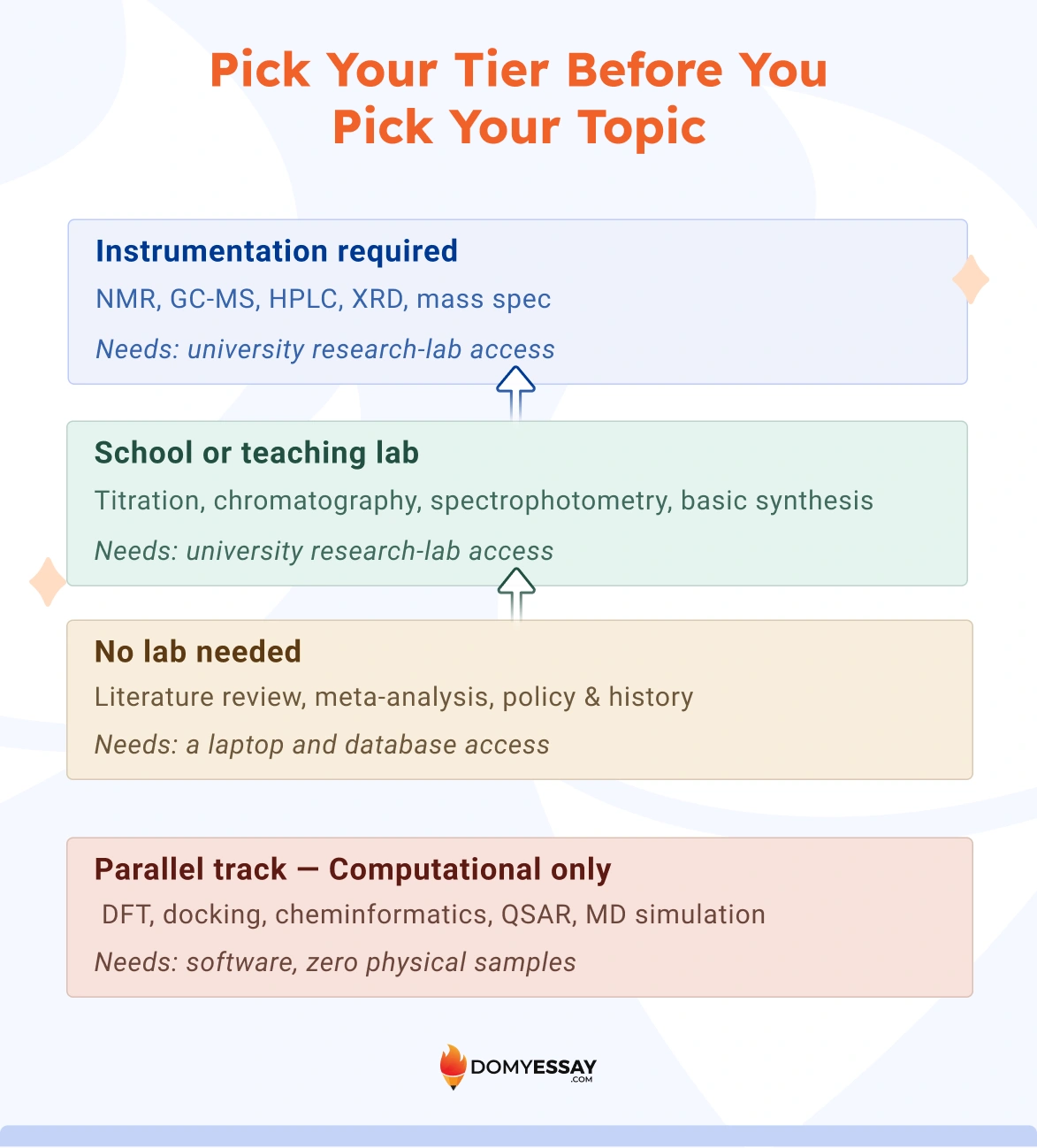
Before browsing chemistry topics for research by subfield, it's worth sorting by what you can actually access. A brilliant topic that needs equipment you don't have isn't a workable topic yet; it's a wish list. These four tiers let you filter by resources first, subject second.
No lab needed
These topics rely on literature review, existing datasets, or historical and policy analysis; no bench work required.
- How has the regulatory definition of PFAS evolved across the US EPA guidance since 2020?
- What does published literature reveal about inconsistencies in green chemistry certification standards?
- How did the discovery of the periodic table's organizing principle change chemical research methodology?
- What historical factors delayed widespread adoption of green chemistry principles in industry?
- How do meta-analyses of catalytic efficiency studies compare methodologies across labs?
- What ethical debates surround the use of animal testing in toxicology research?
- How has chemical patent law shaped pharmaceutical research incentives?
- What does the literature say about reproducibility issues in published chemistry research?
- How did Cold War-era funding shape the direction of nuclear chemistry research?
- What policy gaps exist in current chemical recycling regulations for plastics?
- How has public perception of "chemicals" in food shifted across published surveys?
- What does a comparative analysis of international chemical safety standards reveal?
- How did the development of the Haber-Bosch process reshape 20th-century agriculture policy?
- What case studies exist on chemical spill response effectiveness?
- How has open-access publishing changed collaboration patterns in chemistry research?
If you're struggling with difficult concepts or assignments, simply request ‘do my chemistry homework for me’ support from subject experts.
School or teaching lab
These topics use standard equipment found in most undergraduate teaching labs: titration setups, basic chromatography, spectrophotometers, and simple synthesis glassware.
- How does pH affect the rate of an acid-base titration endpoint accuracy?
- What factors influence separation efficiency in paper chromatography of plant pigments?
- How does concentration affect absorbance readings in a spectrophotometric assay?
- What role does temperature play in the kinetics of an iodine clock reaction?
- How does catalyst concentration affect the rate of hydrogen peroxide decomposition?
- What factors affect the yield of a basic esterification synthesis?
- How does solvent polarity affect separation in thin-layer chromatography?
- What role does buffer capacity play in resisting pH change during titration?
- How does reaction time affect yield in a simple aspirin synthesis?
- What factors influence crystal size during recrystallization purification?
- How does light exposure affect the degradation rate of a colored solution?
- What role does enzyme concentration play in a catalase-based kinetics experiment?
- How does temperature affect the equilibrium position in a reversible color-change reaction?
- What factors affect titration accuracy when using different indicator types?
- How does electrolyte concentration affect conductivity measurements in solution?
Instrumentation required
These topics need access to advanced instruments like NMR, GC-MS, HPLC, XRD, or mass spectrometry, typically available through university research labs.
- How does NMR spectroscopy confirm structural changes in a synthesized organic compound?
- What does GC-MS analysis reveal about trace contaminants in environmental water samples?
- How does HPLC quantify caffeine content variation across commercial beverage brands?
- What does XRD analysis reveal about crystal structure changes under varying synthesis conditions?
- How does mass spectrometry identify unknown degradation products in a pharmaceutical stability study?
- What does FTIR spectroscopy reveal about functional group changes during polymer aging?
- How does HPLC-MS distinguish between structurally similar metabolites in biological samples?
- What does NMR reveal about stereochemistry outcomes in an asymmetric synthesis reaction?
- How does XRD characterize phase purity in a newly synthesized metal-organic framework?
- What does GC-MS analysis reveal about volatile organic compound emissions from consumer products?
- How does mass spectrometry quantify PFAS concentration in contaminated soil samples?
- What does HPLC reveal about the degradation kinetics of a light-sensitive compound?
- How does NMR spectroscopy track reaction progress in real time for a catalytic process?
- What does XRD analysis reveal about defect density in battery electrode materials?
- How does GC-MS distinguish authentic versus counterfeit essential oil compositions?
Computational only
These topics rely entirely on modeling software and computing resources; no physical samples or lab access required at all.
- How do DFT calculations predict the reactivity of a novel catalyst candidate?
- What does molecular docking reveal about the binding affinity between a drug candidate and its target protein?
- How does cheminformatics screening identify structurally similar compounds to a known inhibitor?
- What does a QSAR model predict about toxicity across a series of related compounds?
- How do molecular dynamics simulations model protein stability under varying temperature conditions?
- What does DFT modeling reveal about transition state energy in a proposed reaction mechanism?
- How does machine learning-based retrosynthesis prediction compare to traditional synthetic route planning?
- What does molecular docking suggest about off-target binding risks for a candidate drug?
- How do computational models predict solubility for novel pharmaceutical compounds?
- What does a QSAR model reveal about structure-activity relationships in a compound series?
- How do MD simulations model ion transport behavior in solid-state battery electrolytes?
- What does cheminformatics analysis reveal about chemical space coverage in existing drug databases?
- How does computational screening identify promising candidates for PFAS-degrading catalysts?
- What do DFT calculations predict about the stability of a proposed novel material?
- How do molecular dynamics simulations model membrane permeability for drug delivery design?
Chemistry research topics by subfield
Assuming you have already established your lab availability, the next criterion to consider is subject. The following are chemistry research paper topics broken down by the eight main subcategories, each denoted by the level of difficulty they generally fall under. Use this to reference back to your available options.
Organic chemistry
Organic chemistry research topics focus on carbon-containing compounds, their properties, structure, reactivity, and reactions that convert one organic compound to another. Much drug design, materials synthesis, and reaction mechanism investigation is grounded in organic chemistry.
Feasibility: Mostly school/teaching lab, some computational
- How does solvent polarity affect yield in a Knoevenagel condensation reaction?
- What factors influence stereoselectivity in an asymmetric aldol reaction?
- How does catalyst loading affect enantiomeric excess in a chiral synthesis?
- What mechanism best explains regioselectivity in electrophilic aromatic substitution reactions?
- How does leaving group ability affect reaction rate in nucleophilic substitution?
- What factors improve yield in a multistep total synthesis of a natural product?
- How does temperature affect the ratio of syn versus anti products in an addition reaction?
- What role do protecting groups play in improving selectivity during complex synthesis?
- How does ring strain affect reactivity in cycloaddition reactions?
- What factors influence the efficiency of a Suzuki coupling reaction under varying conditions?
Inorganic and organometallic chemistry
Inorganic chemistry is the subfield of chemistry that focuses on compounds centered around metals, coordination complexes, catalytic cycles, and solid-state inorganic materials with commercial and semiconductor applications.
Feasibility: Instrumentation required for most, some computational
- How does ligand field strength affect the color of a transition metal complex?
- What role do organometallic catalysts play in improving selectivity in cross-coupling reactions?
- How does metal center identity affect catalytic efficiency in a hydrogenation reaction?
- What factors influence the stability of a coordination complex in aqueous solution?
- How does crystal structure affect conductivity in a solid-state inorganic material?
- What role does oxidation state play in determining the reactivity of transition metal catalysts?
- How does ligand geometry affect the magnetic properties of a coordination compound?
- What factors influence catalytic turnover rate in an organometallic hydrogenation cycle?
- How does doping affect electronic properties in a solid-state semiconductor material?
- What role do metal-organic frameworks play in selective gas adsorption applications?
Physical chemistry
Physical chemistry explores how chemical systems work, their rates of reaction, energies released and how surfaces/molecules behave at interfaces.
Feasibility: School/teaching lab for kinetics, instrumentation for spectroscopy
- How does temperature affect the rate constant in an Arrhenius-based kinetics study?
- What factors influence enthalpy change measurements in a calorimetry experiment?
- How does surface area affect adsorption kinetics in a heterogeneous catalytic reaction?
- What role does entropy play in determining the spontaneity of a phase transition?
- How does concentration affect the reaction order determined through initial rates analysis?
- What factors influence peak intensity in a UV-Vis spectroscopy concentration study?
- How does pressure affect equilibrium position in a gas-phase reversible reaction?
- What role does activation energy play in explaining catalytic rate enhancement?
- How does surface functionalization affect wettability measurements on a solid substrate?
- What factors influence diffusion coefficient measurements in a liquid-phase system?
Analytical chemistry
Analytical chemistry identifies substances and accurately determines how much of something is present. Developing techniques to detect stuff and prove that they work.
Feasibility: School/teaching lab for basics, instrumentation for advanced detection
- How does mobile phase composition affect separation efficiency in HPLC analysis?
- What factors influence the detection limit in a trace metal analysis method?
- How does electrode material affect sensitivity in an electrochemical sensor design?
- What role does sample preparation play in reducing matrix interference in GC-MS analysis?
- How does the calibration curve range affect accuracy in a quantitative titration method?
- What factors influence selectivity in a newly developed biosensor for glucose detection?
- How does column temperature affect resolution in a gas chromatography separation?
- What role does internal standard choice play in improving mass spectrometry quantification accuracy?
- How does pH affect extraction efficiency in a liquid-liquid separation method?
- What factors influence reproducibility when validating a new analytical detection method?
Biochemistry
Biochemistry looks at chemical reactions within living organisms. Enzyme activity, protein folding, drug-target interactions, etc.
Feasibility: Instrumentation required for most, computational for modeling
- How does pH affect enzyme activity in a catalase-based kinetics assay?
- What factors influence binding affinity between a small molecule and its protein target?
- How does temperature affect the rate of an enzyme-catalyzed reaction near denaturation?
- What role does substrate concentration play in determining Michaelis-Menten kinetics parameters?
- How does protein misfolding affect enzymatic activity in a model system?
- What factors influence metabolic flux through a specific biochemical pathway?
- How does competitive inhibitor concentration affect enzyme kinetics measurements?
- What role does post-translational modification play in altering protein function?
- How does ligand binding affect protein conformational stability in solution?
- What factors influence allosteric regulation in a multi-subunit enzyme system?
Environmental chemistry
Environmental chemistry investigates the effects of chemical processes on the environment and human health. This field is growing more relevant with concerns over PFAS, microplastics, and atmospheric chemistry changes due to climate change.
Feasibility: Mixed, instrumentation for detection, computational for modeling
- How does electrochemical treatment affect defluorination efficiency for PFAS-contaminated water?
- What factors influence microplastic accumulation in freshwater sediment samples?
- How does UV exposure affect the degradation rate of common atmospheric pollutants?
- What role does soil composition play in PFAS mobility through groundwater systems?
- How does ozone concentration affect the degradation kinetics of airborne volatile organic compounds?
- What factors influence the adsorption capacity of activated carbon for water contaminant removal?
- How does temperature affect methane release rate from thawing permafrost samples?
- What role does particle size play in microplastic toxicity to aquatic organisms?
- How does catalyst design affect efficiency in emerging PFAS destruction technologies?
- What factors influence the heavy metal leaching rate from contaminated soil under varying pH?
Materials and nanochemistry
Materials science/engineering chemistry studies materials engineered at the molecular/nano scale, polymers, nanoparticles, battery materials, and porous materials engineered for desired structures/electronic properties.
Feasibility: Instrumentation required for most, computational for design
- How does nanoparticle size affect catalytic activity in a gold nanoparticle system?
- What factors influence ionic conductivity in a solid-state battery electrolyte material?
- How does polymer chain length affect mechanical strength in a synthesized plastic?
- What role does pore size play in gas selectivity within a metal-organic framework?
- How does synthesis temperature affect crystal structure in a nanomaterial preparation?
- What factors influence thin-film thickness uniformity in a deposition process?
- How does dopant concentration affect conductivity in a semiconductor thin film?
- What role does surface coating play in improving nanoparticle stability in solution?
- How does electrode material composition affect charge capacity in a battery prototype?
- What factors influence the degradation rate in a biodegradable polymer under composting conditions?
Green and industrial chemistry
Green, sustainable and industrial chemistry develops chemical processes that are scalable, replace dangerous reagents/solvents, improve atom economy, and minimize waste outside of laboratory scale.
Feasibility: School/teaching lab for basics, instrumentation for analysis
- How does solvent choice affect atom economy in a green synthesis route?
- What factors influence yield when replacing a hazardous reagent with a safer alternative?
- How does catalyst recyclability affect cost-efficiency in an industrial-scale process?
- What role does reaction design play in minimizing waste byproducts in synthesis?
- How does temperature control affect energy efficiency in a scaled-up chemical process?
- What factors influence the success of chemical recycling methods for mixed plastic waste?
- How does biocatalysis compare to traditional catalysis in reducing environmental impact?
- What role does process intensification play in reducing solvent use at an industrial scale?
- How does feedstock choice affect the carbon footprint of a chemical manufacturing process?
- What factors influence the economic viability of a green chemistry alternative at a commercial scale?
Need more inspiration? Explore our collection of research paper topics across science, healthcare, engineering, and many other disciplines.
Trending chemistry research topics for 2026
The chemistry research topics below track live research directions rather than settled textbook questions, giving you access to current literature and genuinely open problems. This section gets refreshed yearly, so revisit it each cycle for what's actually active.
- How efficient is electrochemical destruction at fully mineralizing long-chain PFAS compounds? University of Chicago researchers achieved up to 99% defluorination of PFAS using battery-derived electrochemistry, with 22 of 33 tested compounds degrading above 70%.
- What air-stability barriers still limit commercial sodium-ion battery cathodes? A 2026 patent landscape review found that sodium layered oxide cathodes remain limited by moisture and CO2 absorption, despite reaching 180 mAh/g practical capacity.
- Can NASICON-type solid electrolytes match sulfide-based conductivity for sodium solid-state batteries? Recent oxide-based sodium-ion conductor research found NASICON materials approaching 1×10⁻² S/cm at room temperature, rivaling sulfide electrolytes while offering better safety.
- How do perovskite and anti-perovskite solid electrolytes compare for sodium solid-state battery stability?
- What catalyst designs most improve efficiency in green hydrogen production via water electrolysis?
- How does electrocatalyst composition affect selectivity in the hydrogen evolution reaction?
- How accurately do machine learning models predict reaction outcomes compared to expert chemist intuition?
- What data limitations currently constrain machine-learning retrosynthesis prediction accuracy?
- What catalyst designs show the most promise for converting captured CO2 into usable chemical feedstocks?
- How does sorbent material choice affect efficiency in direct air capture of CO2?
- What formulation factors most affect the stability and delivery efficiency of lipid nanoparticles for mRNA therapeutics?
- How does lipid composition affect cellular uptake efficiency in nanoparticle drug delivery systems?
- How effective are PROTAC-based targeted protein degraders compared to traditional small-molecule inhibitors?
- What structural factors determine selectivity in targeted protein degradation compounds?
- What chemical recycling methods most effectively break down mixed, contaminated plastic waste streams?
- How does pyrolysis temperature affect yield in chemical recycling of polyolefin plastics?
- What extraction methods show the most promise for recovering critical minerals from electronic waste?
- How does solvent choice affect efficiency in lithium recovery from spent battery materials?
- What degradation mechanisms most limit long-term operational stability in perovskite solar cells?
- How does the encapsulation method affect moisture resistance in perovskite photovoltaic devices?
Chemistry research topics by academic level
Research topics in chemistry should scale with the depth and resources actually available at your level; a high schooler and a master's student shouldn't be tackling the same scope of questions. Below, topics are grouped by academic level with realistic expectations attached to each.
High school and science fair
Suited for simple, observable experiments using accessible materials, typically, a single variable is tested with basic measurements.
- How does water temperature affect the rate at which sugar dissolves?
- What household liquids neutralize baking soda most effectively?
- How does concentration affect the color intensity of a food dye solution?
- What factors affect how quickly an effervescent tablet dissolves in water?
- How does salt concentration affect the freezing point of water?
- What household materials best absorb odor through chemical adsorption?
- How does vinegar concentration affect the rate of a baking soda reaction?
- What factors affect the rust formation rate on iron nails?
- How does light exposure affect the fading rate of a colored fabric dye?
- What factors affect crystal growth rate in a homemade sugar or salt solution?
Undergraduate coursework
Suited for a single-semester lab report with a controlled variable, basic statistical analysis, and 5-10 sources, typically 2,000-3,000 words.
- How does catalyst concentration affect the rate of hydrogen peroxide decomposition?
- What factors influence yield in a basic esterification synthesis reaction?
- How does pH affect enzyme activity in a catalase-based kinetics experiment?
- What role does temperature play in the kinetics of an iodine clock reaction?
- How does solvent polarity affect separation efficiency in thin-layer chromatography?
- What factors influence titration accuracy across different indicator choices?
- How does concentration affect absorbance readings in a spectrophotometric assay?
- What factors affect crystal purity during a recrystallization purification process?
- How does electrolyte concentration affect conductivity measurements in aqueous solution?
- What role does buffer capacity play in resisting pH change during titration?
Capstone and senior thesis
Requires original data collection or a focused literature synthesis around one specific mechanism, typically 6,000-10,000 words with 15-25 sources.
- How does electrode material affect degradation efficiency in electrochemical PFAS treatment?
- What factors influence enantioselectivity in an asymmetric catalytic synthesis?
- How does nanoparticle size affect catalytic activity in a gold-based nanocatalyst system?
- What role does ligand design play in improving selectivity in a cross-coupling reaction?
- How does dopant concentration affect conductivity in a synthesized semiconductor material?
- What factors influence binding affinity in a molecular docking study of a drug candidate?
- How does synthesis temperature affect crystal structure in a metal-organic framework?
- What factors affect the stability of a lipid nanoparticle formulation under varying storage conditions?
- How does column design affect separation efficiency in a scaled-up chromatography process?
- What role does surface functionalization play in improving biosensor selectivity?
Master's level
Appropriate for original research contributing genuinely new analysis, typically 10,000+ words, with several unresolved questions worth flagging directly.
- (Open question) What explains the persistent gap between computational binding-affinity predictions and experimentally measured drug-target interactions?
- What structural modifications most effectively reduce Jahn-Teller distortion in sodium-ion battery cathode materials during cycling?
- (Open question) Is there a reliable predictive model for degradation pathways in perovskite solar cells under real-world humidity and temperature cycling, or does current literature only explain failures after the fact?
- How does pyrolysis reactor design affect selectivity when chemically recycling mixed, contaminated polyolefin waste streams?
- (Open question) Can machine learning-based retrosynthesis models generalize to genuinely novel reaction classes, or do they only interpolate within their training data's chemical space?
- What ligand architectures most effectively improve selectivity in PROTAC-based targeted protein degraders against structurally similar off-targets?
- (Open question) Does current electrochemical PFAS destruction scale economically to real-world contaminated water volumes, or do lab-scale defluorination rates break down at industrial throughput?
- How does solvent system choice affect selective lithium recovery efficiency from mixed spent battery feedstocks?
- What catalyst design principles most improve faradaic efficiency in electrochemical CO2 reduction to multi-carbon products?
- How does encapsulation architecture affect long-term moisture resistance in perovskite photovoltaic devices under accelerated aging conditions?
After completing your experiment, learn how to write a strong chemistry lab report that clearly presents your methods and results.
Where to find chemistry data and literature
None of these chemistry research topics is discoverable without knowing where to look. Here are some actual sources of trusted chemistry data and published research.
- PubChem – A free chemical database run by the NIH that contains information on compound structures, identifiers, and properties. Typically, the best first stop for basic information about a compound.
- ChemSpider – Another free chemistry database that aggregates structure data from hundreds of other sources. Helpful for double-checking compound IDs.
- NIST Chemistry WebBook – Thermodynamic and spectral data, as well as standard enthalpies of reaction, directly from NIST.
- Cambridge Structural Database – The go-to database for experimentally determined crystal structures of organic and metal-organic compounds.
- Protein Data Bank – Because chemists also dock things into proteins. The go-to open-access database for downloadable macromolecular structure data.
- Materials Project – An open database of computationally derived material properties. Useful for material-specific chemistry, especially battery research.
- Reaxys – A large database of reactions and substances, popular in organic synthesis and retrosynthesis.
- SciFinder – The go-to database for searching the chemical literature, patents, and substances. Run by CAS.
- ACS Journal Articles & RSC Journal Articles – Where the majority of active research is published, including the popular topics mentioned above.
Tip: Check what your institution actually licenses before building a project around Reaxys or SciFinder specifically, access is the constraint students discover too late, often after they've already built a topic around a database they can't reach.
Finish Your Chemistry Paper
Work with experienced writers to complete accurate, original chemistry assignments.

Chemistry topics to avoid
While some chemistry research topics grab your attention, they often prove unworkable for a course project when you consider safety, legal, or practical constraints. Check that your topic is not one of these before you get too far down the road.
- If your research question involves controlled chemicals or scheduled precursors, you will not get permission to obtain them for a course-based project.
- Topics that deal with energetic materials or other explosives-related chemistry require sign-offs from institutional safety offices, which you will not receive for a course project.
- If your dream topic requires instrumentation unavailable through your department, your idea is not possible. What you've got is more of a wish than a workable project.
- Questions that are purely descriptive, with no variable to test, are not testable hypotheses. "The chemical composition of vitamins" is a thing.
- Questions that have been answered conclusively, usually decades ago, leave no room for experimentation that can push the field forward. If your topic is this, the scientific literature has already closed the question.
- Topics that would require human or animal samples without IRB or IACUC approval are not workable. Anything involving live humans or animals will need review by your institution's IRB or IACUC, and most course project timelines do not allow that process to occur.
Final Words
Generally, the best chemistry topics survive 4 tests: variable, comparison, access, and literature. Begin with what resources you have available, often equipment. Then refine by your subfield of chemistry. Support any statements you make with links to primary sources. Don't rely on Wikipedia or webpages that reprint other people's findings. Consider PubChem, NIST, or a peer-reviewed journal as strong sources.