

Finance research topics are specific questions about how money, markets, and institutions work. A good one names a measurable variable, a defined group or market, and a time period, and it has accessible data, such as public filings or central bank statistics. “Cryptocurrency” is a field. “How stablecoin market share changed after 2022” is a topic. This guide lists finance research topics by subfield and by level, from undergraduate to doctoral, and also covers how to narrow a topic, where to find data, and which topics to avoid.
Not sure which finance topic fits?
Our writers can help you narrow it to one clear question.

Finance research topics by subfield
These research topics in finance fall into 12 subfields, from banking and corporate finance to behavioral and international finance. Each list gives ten questions you can narrow into a paper, and each intro names the kind of data you can use.
Banking and financial regulation research topics
These banking research topics suit students who can work with public bank data, such as FFIEC call reports or central bank statistics.
- How did deposit outflows at regional banks differ after the March 2023 failure of Silicon Valley Bank, and which bank characteristics explain the differences?
- Do higher capital requirements reduce lending to small businesses?
- How does deposit insurance coverage affect depositors’ behavior during periods of stress?
- Did stress tests change risk-taking at the largest banks?
- What explains the decline in the number of US community banks over the past two decades?
- How do rising interest rates affect banks’ unrealized losses on securities?
- Does bank consolidation change loan pricing for small borrowers?
- How cost-effective are anti-money-laundering rules at detecting illicit flows?
- Do limits on overdraft fees change bank fee revenue and customer behavior?
- How did the Dodd-Frank Act change systemic risk measures at large banks?
Corporate finance and governance research topics
These corporate finance research topics rely on company filings, such as SEC EDGAR, plus governance data on boards and executive pay.
- How do share buybacks affect long-term investment at publicly listed firms?
- Does stock-based CEO pay change risk-taking?
- Do firms with more independent directors have better acquisition outcomes?
- How does capital structure differ between family-owned and widely held firms?
- Do dual-class share structures affect firm value?
- How do firms’ dividend policies respond to changes in tax rates on dividends?
- Do mergers within the same industry create value for acquirers’ shareholders?
- How do firms change their cash holdings during economic downturns?
- Do say-on-pay votes change executive compensation?
- How does activist investor involvement affect target firms’ performance?
Entrepreneurial finance and venture capital research topics
These topics focus on how startups raise money, using funding databases, public announcements, and founder surveys.
- How does the timing of a startup’s first funding round relate to its survival?
- Do startups backed by corporate venture arms perform differently from those backed by independent funds?
- How do campaign features relate to funding success on crowdfunding platforms?
- Does geographic distance between investors and startups affect funding terms?
- How do founders’ gender and early-stage funding outcomes relate?
- What explains differences in returns among angel investors?
- How did the 2021 funding boom change valuations and the later share of down rounds?
- Do accelerators improve startups’ follow-on funding?
- How do convertible notes and SAFEs differ in their effects on founder ownership?
- How do SPAC mergers compare with traditional IPOs in post-listing returns?
Financial markets and volatility research topics
These topics use market data, such as stock indexes, volatility indexes, and trading volumes, available from sources like FRED and exchange websites.
- How did trading volume and volatility change for a stock after it joined a major index?
- Does the VIX predict stock market returns?
- How did zero-commission trading affect retail trading volumes?
- How do Federal Reserve rate announcements move bond and equity markets?
- Did the GameStop episode of January 2021 change short-selling patterns in other heavily shorted stocks?
- How do overnight returns differ from daytime returns in US equities?
- What explains the size of the equity risk premium across different periods?
- How do circuit breakers affect volatility on the days they trigger?
- How did the 2022 UK gilt market turmoil spread to pension funds?
- Do high-frequency traders improve or reduce market liquidity?
Financial reporting and auditing research topics
These topics use financial statements, audit reports, and enforcement releases, much of it available on SEC EDGAR.
- Do firms with longer-tenured auditors report higher-quality earnings?
- How do restatements affect stock prices and executive turnover?
- Does adopting IFRS change the comparability of financial statements across countries?
- How effective are Sarbanes-Oxley internal control reports at reducing misstatements?
- Do going-concern audit opinions predict bankruptcy?
- How do non-GAAP earnings measures relate to firms meeting analyst forecasts?
- What are the effects of mandatory audit firm rotation in countries that adopted it?
- Does the readability of annual reports relate to future performance?
- How does earnings management differ before and after major regulatory changes?
- Do audit fees reflect client risk?
Fintech, blockchain, and cryptocurrency research topics
These fintech research topics draw on public blockchain data, regulatory filings, and platform or survey data.
- How did stablecoin market share change after major exchange failures, such as FTX in 2022?
- Did the EU’s Markets in Crypto-Assets regulation change trading activity in covered tokens?
- How do central bank digital currency pilots compare in design and reported outcomes?
- Do buy now, pay later users have different repayment patterns from credit card users?
- How does mobile payment adoption relate to financial inclusion in developing economies?
- What explains price co-movement between Bitcoin and equity indexes over time?
- How do decentralized exchanges compare with centralized ones in price efficiency?
- Do robo-advisors improve portfolio diversification for small investors?
- How do open banking rules affect competition between banks and fintech lenders?
- How accurate are machine learning credit-scoring models compared with traditional scorecards, and for which groups do they differ?
Investment and asset pricing research topics
These topics use return data, such as the Kenneth French Data Library, to test how assets are priced.
- Does the value premium still exist in US stock returns?
- How well does the Fama-French five-factor model explain returns compared with the three-factor model?
- Do momentum strategies remain profitable after trading costs?
- How do passive index fund flows affect the prices of the stocks they hold?
- Does low-volatility investing earn higher risk-adjusted returns?
- How have active fund managers performed against benchmarks after fees over rolling periods?
- How do yield curve inversions relate to later recessions?
- How do dividend-paying stocks perform during rising interest rates?
- Does adding commodities improve portfolio outcomes?
- How do ETF liquidity and the liquidity of underlying assets interact in stress periods?
Personal finance and financial literacy research topics
These topics suit surveys, school or community programs, and public household data, such as the Federal Reserve’s Survey of Consumer Finances.
- Does a high school financial literacy course change saving habits in early adulthood?
- How do student loan repayment plans affect borrowers’ later home buying?
- Do automatic enrollment features raise retirement savings among lower-income workers?
- How does use of budgeting apps relate to young adults’ emergency savings?
- What factors explain differences in retirement savings between gig workers and salaried workers?
- How does inflation change household saving and spending choices?
- Do financial education programs reach the people with the lowest financial literacy?
- How do credit scores change after a first late payment, and how long does recovery take?
- How do payday loan restrictions affect other forms of borrowing?
- What shapes whether households buy insurance, such as renters or disability coverage?
Real estate and housing finance research topics
These topics rely on housing price indexes, mortgage data, and local records, such as FRED’s housing series and Home Mortgage Disclosure Act data.
- How did rising mortgage rates change housing turnover and listings in US metro areas?
- Do zoning reforms change housing supply and prices?
- How do institutional investors’ purchases affect local home prices and rents?
- Does the Low-Income Housing Tax Credit increase affordable housing supply?
- How do mortgage lending patterns differ by race and income in HMDA data?
- How did mortgage underwriting standards change after the 2008 housing crisis?
- Do real estate investment trusts diversify a stock portfolio?
- How do property tax limits affect local government finances?
- What explains differences in price-to-rent ratios across cities?
- How do opportunity zone designations relate to investment and property values?
Sustainable and green finance research topics
These finance project topics suit short studies of ESG ratings, green bonds, and climate disclosures, using public company reports and bond data.
- Do green bonds trade at lower yields than similar conventional bonds from the same issuer?
- Do ESG fund returns differ from conventional funds after controlling for investment style?
- How consistent are ESG ratings across different providers for the same firms?
- Does mandatory climate risk disclosure change firms’ emissions or investment?
- How do investors respond to firms’ announcements of net-zero targets?
- Does a carbon price affect firms’ capital spending?
- How does exposure to physical climate risk show up in property or insurance prices?
- Do sustainability-linked loans lead to measurable improvements in the borrower’s targets?
- How do banks’ fossil fuel lending policies change after public commitments?
- How do small firms finance energy efficiency upgrades?
Behavioral finance research topics
These topics test how psychology shapes financial choices, using experiments, surveys, or trading records.
- Does the disposition effect appear in retail investors’ trading records?
- How does overconfidence relate to trading frequency and returns?
- Do investors chase past fund performance?
- How does loss aversion affect decisions in a savings or investing experiment?
- Does social media attention influence trading in individual stocks?
- Does presenting a fee as a percentage or as a dollar amount change investors’ choices?
- Do herd behavior patterns differ between novice and experienced investors?
- How do news headlines affect investor sentiment and short-run returns?
- Does mental accounting explain why people hold savings and debt at the same time?
- How does financial stress affect decision quality in a lab task?
International finance research topics
These topics use exchange rates and trade and capital flow data from sources such as the IMF, the BIS, and the World Bank.
- How do exchange rate movements affect export competitiveness in small open economies?
- How did Brexit change the location of financial activity between London and EU financial centers?
- Does euro adoption change a country’s borrowing costs?
- How do capital controls affect exchange rate stability in emerging markets?
- How do remittances affect household finance and investment in recipient countries?
- What explains the persistence of the US dollar’s role in global trade invoicing?
- How do sovereign debt restructurings affect later market access?
- Do foreign exchange interventions by central banks change exchange rates?
- How do interest rate differences between countries relate to currency returns, such as carry trades?
- How do sanctions affect the financing and currency of targeted economies?
If exchange rates and capital flows interest you, you may also enjoy exploring these interesting economic topics, which cover the wider economy beyond financial markets.
Finance research topics by academic level
Scope matters as much as subject. The same field can produce a one-term paper or a multi-year study, depending on your level.
Finance research topics for undergraduate students
At this level, aim for one clear comparison, public data, and a term-length timeline. Company filings and free market data are enough, and simple methods such as charts and averages will do.
- How have a company’s profit margins changed over five years compared with its closest competitor?
- How did a local bank’s advertised savings rates change after the Federal Reserve began raising rates in 2022?
- Do stock prices rise in the weeks after a company announces a stock split?
- How do business and non-business majors on one campus differ in their attitudes toward investing?
- How do the ten-year returns of a technology sector ETF compare with those of the S&P 500?
Want to compare options outside finance? Our collection of research ideas covers many subjects and levels, so you can see how other fields frame a strong topic.
Finance dissertation topics for master’s students
Finance dissertation topics at the master’s level need one focused question, a defined sample, and a standard method such as an event study or a regression. Plan for one to two semesters, and check whether your university gives you access to databases such as Compustat or Bloomberg.
- How did share prices react in the three days after layoff announcements, and did the reaction differ by industry?
- Does a firm’s ESG rating relate to its cost of debt among mid-sized European companies?
- What explains differences in IPO first-day returns across exchanges in one region over ten years?
- How does corporate governance quality relate to the success of cross-border acquisitions by firms from emerging markets?
- How well did value-at-risk models predict losses for a sample of exchange-traded funds during the 2020 market fall?
Finance research topics for PhD students
Doctoral topics must add something new. Expect a causal design or a new dataset, a theory to test, and several years of work aimed at publication.
- Using a regulatory change, how does mandatory climate risk disclosure alter the allocation of banks’ lending across industries?
- How does a reduction in a central bank’s balance sheet transmit to corporate bond liquidity, using transaction-level data?
- Can a model of limited investor attention explain delayed price reactions to earnings news?
- How do bank-firm relationships affect firm survival during credit crunches, using matched loan-level data?
- How does private equity acquisition affect employment and wages at target firms, using matched employer-employee data?
How to choose a finance research topic?
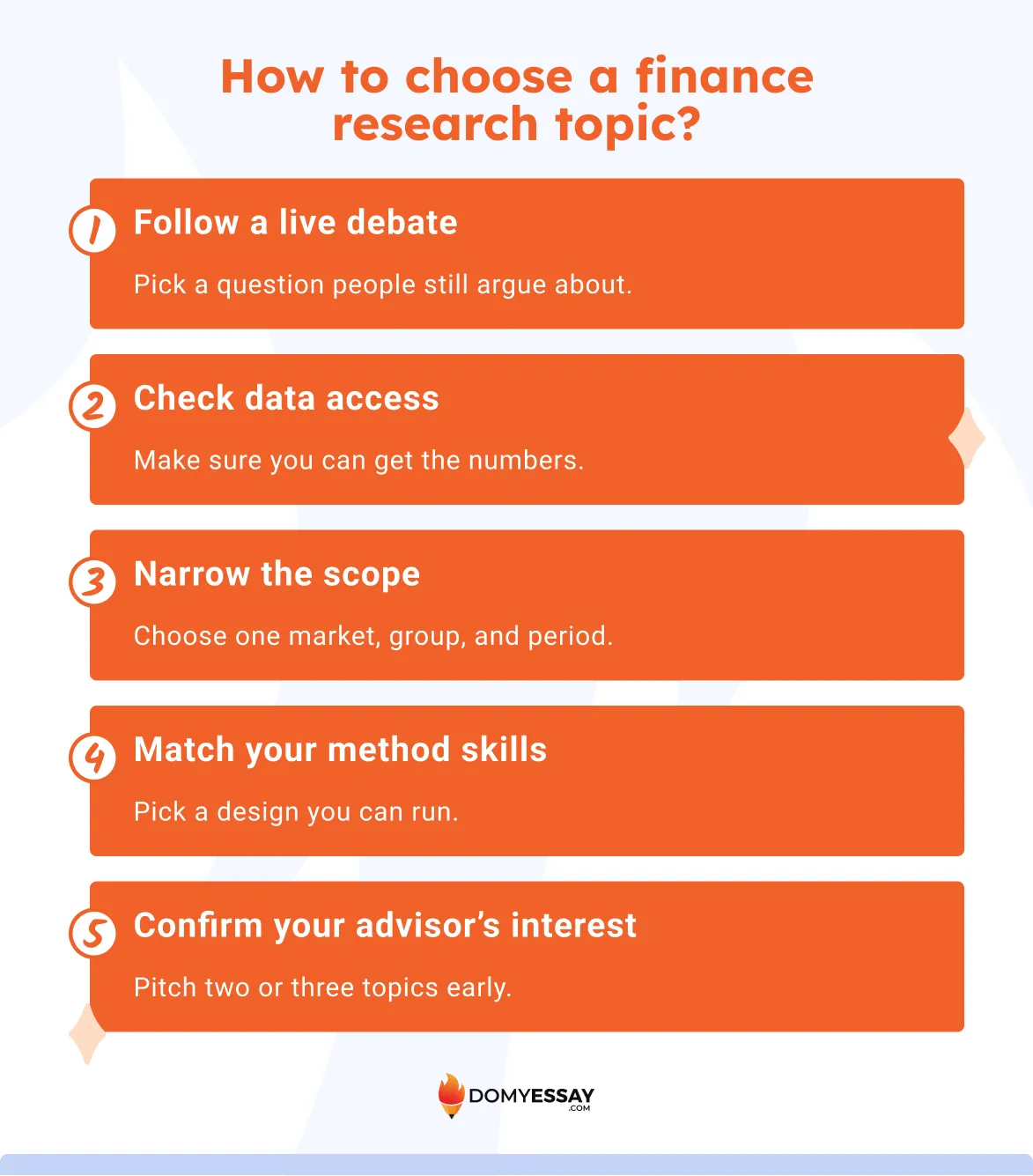
Knowing how to choose a finance research topic comes down to five checks: a live debate, reachable data, a narrow scope, methods you can run, and an advisor who will back it. Work through them in order.
- Follow a current debate. Start with a question people are still arguing about, such as how rising interest rates affect bank balance sheets. Recent central bank speeches, news coverage, and working papers show where the evidence is thin.
- Check data access. Confirm you can get the numbers before you commit. Free sources such as SEC EDGAR filings and FRED economic series cover many topics, while databases like Compustat or Bloomberg may need university access.
- Narrow the scope. Move from a field to a specific market, group, and period. “Cryptocurrency” becomes “how stablecoin market share changed after major exchange failures in 2022.”
- Match your method skills. Choose a design you can run. An event study or a simple regression suits many student projects, while panel data and causal designs take more training and time. When in doubt, pick the simpler method and do it well.
- Confirm your advisor’s interest. Pitch two or three narrowed topics early. An advisor who knows the area can flag data problems, suggest sources, and tell you whether the scope fits your program’s timeline.
Once the scope is narrow, turn it into one clear research question. Seeing real examples can help you check that yours names a market, a group, and a period.
Data sources for finance research
Whichever finance research paper topics you pick, the data decides whether you can finish. Free sources such as FRED, SEC EDGAR, the World Bank, and the IMF cover most macro and company-filing questions. Stock-price and company-fundamentals databases such as CRSP and Compustat usually need university access through WRDS.
With your topic set, the next job is the paper itself. Our guide to writing a research paper walks you through planning, drafting, and finishing on time.
Common research methods in finance
Most finance papers use one of five methods, and the right one depends on your question and your data.
- Event study: Use it to measure how prices react to a specific announcement, such as an earnings release or a merger.
- Panel regression: Use it to compare many firms, banks, or countries over time while controlling for differences between them.
- Time-series analysis: Use it when your data is one series over time, such as interest rates or volatility, and you want to model trends or forecast.
- Survey: Use it when the data does not exist, such as investors’ attitudes or households’ saving habits.
- Case study: Use it for an in-depth look at one firm, event, or policy, such as a bank failure, when you want to explain how and why.
If you are new to research, start with the simplest method that answers your question. If a deadline is close and you need extra support, you can ask our team to do my finance homework while you focus on your research.
Need your finance paper written?
Get a paper built to your requirements and deadline.

Summing up
A good finance research topic names a variable, a group, and a period, and rests on data you can reach. Pick from the 12 subfields or three academic levels, narrow it with the five tips, and check your data sources and method before you commit. Choose a topic you can finish, not just one that sounds interesting.