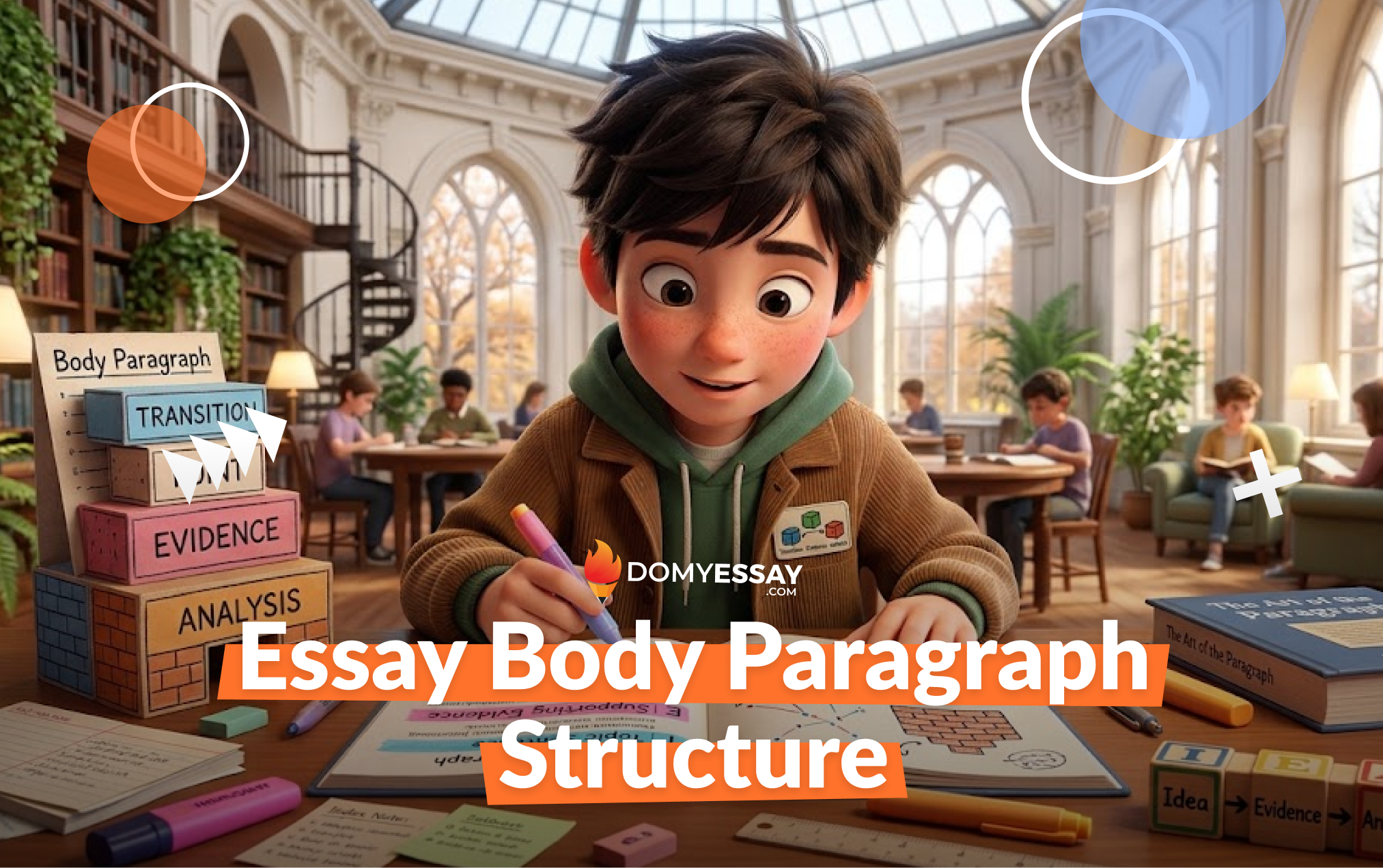
Essay body paragraph structure is a five-part pattern that develops one idea into a point your reader will accept: topic sentence, supporting evidence, analysis, significance, and a link or transition. Every body paragraph should develop a single main idea that supports your thesis, which keeps your argument easy to follow and hard to argue with.
This guide explains the job of each part, compares three structure models writers actually use, lays out a step-by-step process for building a paragraph, and gives you worked examples you can adapt for your next essay.
Struggling to structure your paragraphs?
Get expert help turning your ideas into clear, well-supported body paragraphs.

What is the structure of a body paragraph in an essay?
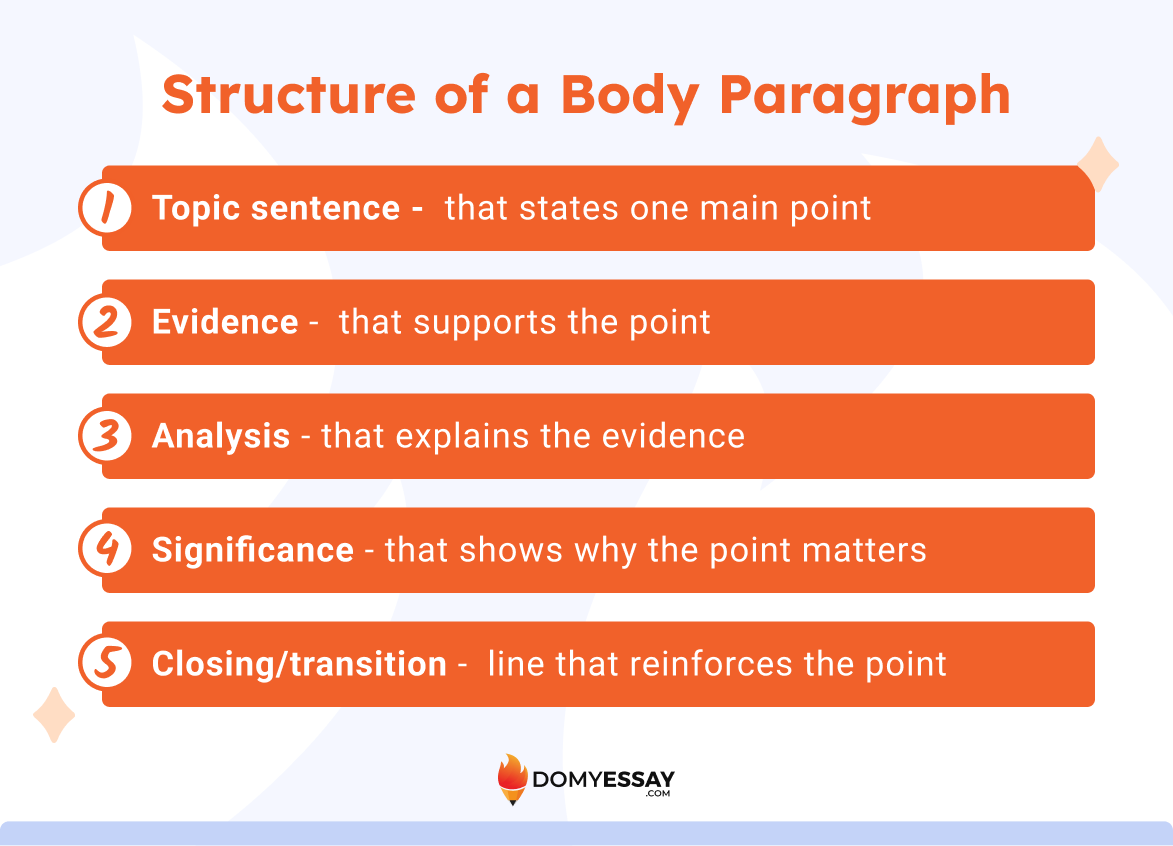
The structure of a body paragraph in an essay has five parts: topic sentence, supporting evidence, explanation and analysis, significance, and a closing or transition sentence. A strong paragraph opens with a clear point, backs it with evidence, interprets that evidence, and links the idea back to your thesis.
The exact model changes with your assignment, your subject, and your professor’s taste. A literature essay leans on quotations and close reading. A lab report leans on data and method. Even so, the core logic is that you should always state your point, prove and explain it, and connect it to your thesis, in this very order.
Parts of a strong essay body paragraph
The five parts of an essay body paragraph are the topic sentence, supporting evidence, explanation and analysis, significance, and a concluding or transition sentence. Each one has a distinct job, and together they develop a single focused idea. Skip one, and the paragraph loses its point or leaves the reader guessing.
1. Topic sentence
A topic sentence states the paragraph’s main point and connects that point to your thesis. It tells the reader exactly what claim you are about to prove before you prove it. The trap most students fall into is writing something too broad to defend in one paragraph.
A strong topic sentence:
- Makes one specific claim the paragraph can prove.
- Signals how the claim links to your thesis.
- Stays narrow enough to cover in five or six sentences.
Vague: “Social media affects teenagers.”
Specific: “Heavy Instagram use raises anxiety in teenage girls because it fuels constant social comparison.”
2. Supporting evidence
Supporting evidence is the proof that makes your topic sentence believable. A claim with no backing reads as personal opinion, and readers tend to ignore opinions. Evidence comes in several forms, and the right kind depends on your subject:
- Facts and statistics for data-driven claims
- Direct quotations for literature and primary sources
- Examples and case studies for real-world patterns
- Textual evidence for close reading of a passage
First, every piece of evidence must directly support the point in your topic sentence. Second, your sources need to be credible. Reach for peer-reviewed studies, recent statistics, and primary documents. A random blog post or a figure from 2009 will weaken the whole paragraph. Pick evidence a doubtful reader cannot wave away.
3. Explanation and analysis
Analysis is the part where you interpret your evidence for the reader. The most common reason good evidence falls flat is a quote or statistic that gets dropped in with no follow-up. Your job is to answer one question for the reader: how does this evidence support my point?
Good analysis usually covers three things:
- What the evidence actually shows
- Why that detail matters for your claim
- How it ties back to the topic sentence
Suppose you cite a study where 60% of teens check their phones within five minutes of waking. Your analysis explains that this habit signals a dependency strong enough to override a basic morning routine, which is the compulsive behavior your point predicted.
4. Significance or interpretation
Significance is the moment you show why your point matters to the bigger argument. A paragraph can have a sharp topic sentence, solid evidence, and clean analysis and still feel pointless if the reader never learns why any of it counts. This step connects your single idea to the thesis that holds your whole essay together.
Watch the difference:
- Weak (restates evidence): “So, 60% of teens check their phones right after waking.”
- Strong (adds significance): “This level of dependency helps explain why screen-time limits alone seldom change teen behavior, which supports my thesis that teen phone use is driven by ingrained habit.”
5. Concluding or transition sentence
A concluding or transition sentence wraps up the paragraph’s point or sets up the idea that comes next. You have two solid options:
- Reinforce: restate why this paragraph’s idea strengthens your thesis.
- Transition: hint at the connection to your next point so the essay flows.
Not every paragraph needs a formal closing line. In a tight five-paragraph essay, a heavy closing line in every paragraph reads as repetitive and slow. Trust your ear. If the next topic sentence already bridges the gap cleanly, a transition line can feel redundant.
Example transition: “If habit drives the problem, the fix has to target routines, which is where behavioral design comes in.” That line closes one idea and opens the next.
PEEL, TEEL, PIE, and SEE: common body paragraph structures
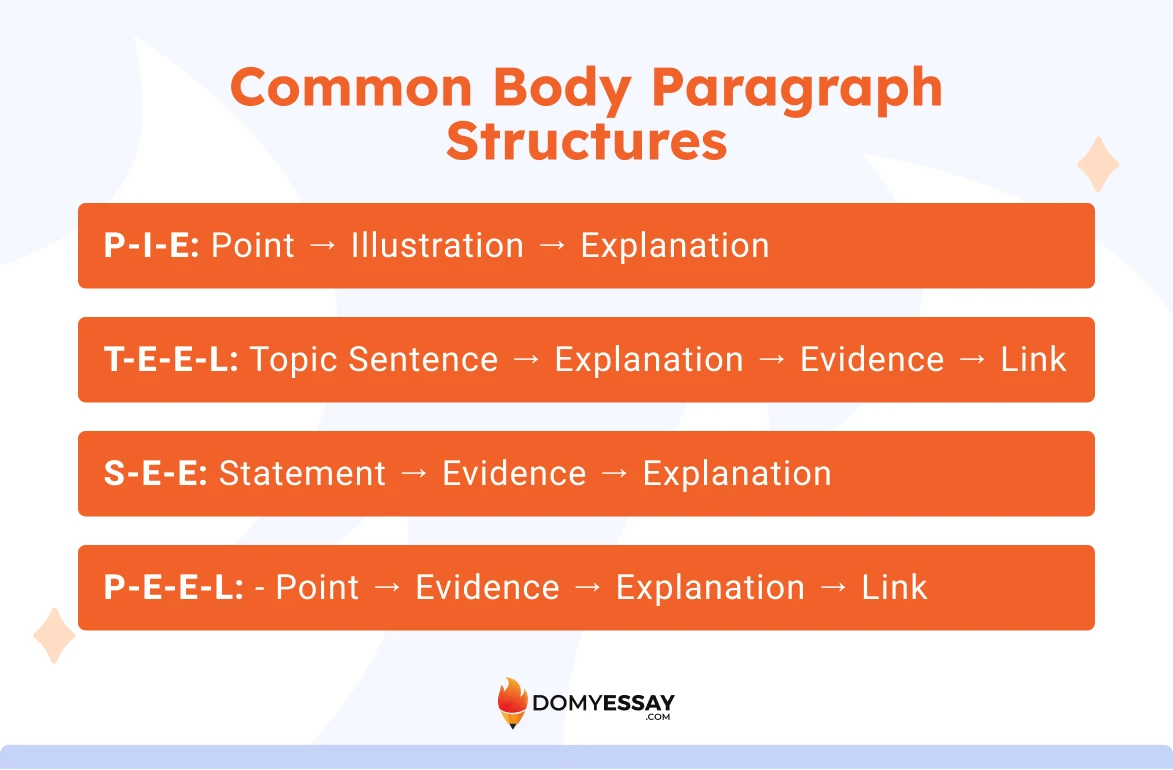
PEEL, TEEL, PIE, and SEE are four popular models for building a body paragraph, and they describe nearly the same process under different labels. Each one walks you through a point, the support for that point, an explanation of what the support proves, and a connection back to your argument. The letters change, the order shifts a little, and some models fold two steps into one. Learn the four-step logic once and any acronym your teacher prefers becomes easy to follow.
PEEL structure
PEEL stands for point, evidence, explanation, link. Most writing centers teach this model first, and for good reason: it matches how a persuasive paragraph actually works.
Here is the sequence:
- Point: your topic sentence, one claim tied to the thesis
- Evidence: the facts, quotes, or data that back the claim
- Explanation: your analysis of what the evidence proves
- Link: a sentence that connects back to the thesis or sets up the next paragraph
PEEL works best for argument-driven essays where every paragraph needs to push a thesis forward. The link step is the part that keeps a long essay connected instead of reading as a set of unrelated observations.
TEEL structure
TEEL stands for topic sentence, evidence, explanation, link. The model is almost identical to PEEL, with the opening point relabeled as the topic sentence. Schools in Australia and the UK tend to favor this version.
The four steps:
- Topic sentence: states the paragraph’s main idea
- Evidence: examples, quotations, or statistics
- Explanation: how the evidence supports the idea
- Link: ties the paragraph back to the question or thesis
TEEL puts extra emphasis on the topic sentence, which helps students who tend to state their main point too late in the paragraph. Use it when your paragraphs keep drifting off the question.
PIE structure
PIE stands for point, illustration, explanation. This is the shortest of the four models, which makes it a favorite for timed exams and shorter essays where you have little room to spare.
The three parts:
- Point: the claim you are making
- Illustration: an example, quote, or statistic that shows the claim in action
- Explanation: your analysis of why the illustration proves the point
PIE drops the formal link step, so the connection to your thesis has to come through in the Explanation. Use PIE when you want a fast, clean paragraph and trust your topic sentences to keep the whole essay connected.
SEE structure
SEE stands for statement, explanation, example, though some teachers swap in evidence for the middle E. The model shows up often in science and social science writing, where clarity and proof come first.
The three steps:
- Statement: your main point for the paragraph
- Explanation: the reasoning that develops the point
- Example: the evidence or case that confirms it
SEE reverses the usual order and explains before it gives the example, which suits arguments that need context first. Use it when your example will not make much sense until the reader understands the reasoning behind it.
How to structure a body paragraph in an essay?
To structure a body paragraph in an essay, follow these 6 steps: choose one main point, write a focused topic sentence, add evidence that directly supports it, analyze what that evidence proves, explain why the point matters to your thesis, and close with a line that reinforces the idea or transitions to the next paragraph. The whole paragraph develops a single idea from start to finish.
Step 1: choose one main point
Start by picking one idea from your thesis or outline for essay that this paragraph will develop. Your thesis breaks down into a handful of claims, and each claim deserves its own paragraph.
Run through this quick check before you write:
- Can I sum up the point in one sentence? If it takes two, you have two paragraphs.
- Does this point support the thesis directly?
- Do I have enough evidence to fill five or six sentences?
The most common structural mistake is cramming two or three unrelated ideas into one paragraph. When that happens, none of them get enough evidence, and the reader loses the thread.
Step 2: write the topic sentence
Turn your chosen point into a focused claim the reader can see coming. A good topic sentence names the specific idea for this paragraph and signals how it supports your thesis. Keep it narrow enough to prove in five or six sentences.
Watch a weak claim become a strong one:
- Too broad: “Exercise helps mental health.”
- Focused: “Regular aerobic exercise reduces symptoms of depression by increasing endorphin production.”
The second version tells the reader exactly what you will prove and why it matters. Two quick rules:
- Lead with your claim, not a fact or a quote.
- Make it arguable. A statement nobody would dispute is not a claim.
If you also want to learn how to open the entire paper, not just the body paragraph, read our guide on essay introduction writing.
Step 3: add relevant evidence
Choose evidence that supports the specific claim in your topic sentence, not just the general topic. A fact about your broad subject is not the same as proof of your exact point, and students miss this distinction all the time.
Say your topic sentence argues that aerobic exercise lowers depression. Here is the difference in practice:
Test every source with one question: Does this prove my topic sentence, or is it just written near it?
Step 4: analyze the evidence
Explain what your evidence means and why it backs the paragraph’s claim. Evidence never speaks for itself. Once you present a fact or quote, spell out the connection the reader should draw.
Good analysis answers three questions in order:
- What does the evidence show?
- Why does that detail matter for my claim?
- How does it tie back to the topic sentence?
Say you cited a study where depression scores dropped 30% after twelve weeks of running. Your analysis explains that the drop tracks the exercise directly, which supports your claim about aerobic activity. One rule of thumb: your analysis should run at least as long as the evidence you are analyzing.
Step 5: explain why the point matters
Connect the paragraph back to your broader argument. Analysis tells the reader what your evidence proves. This step tells them why it matters to the essay as a whole. Without it, a paragraph can feel like a dead end.
Here is the move:
- Analysis: “Depression scores dropped 30% after twelve weeks of exercise.”
- Significance: “This supports my thesis that affordable, non-drug treatments deserve a bigger role in mental health care.”
One quick check: if you deleted this paragraph, would your thesis lose something? The answer should be yes. If it is no, the paragraph needs a clearer stake or it needs to go.
Step 6: close or transition
Finish the paragraph by reinforcing its point or building a bridge to the next one. You have two solid moves:
- Reinforce: restate, in fresh words, why this idea strengthens your thesis.
- Transition: point toward the idea your next paragraph will develop.
Use this guide to decide which:
Not every paragraph needs a formal closing line. In a short essay, a summary sentence at the end of each one reads as repetitive. A clean transition might be: “If exercise works this well alone, the next question is how it compares to medication.”
Since we’re talking about endings, learn what a conclusion paragraph is exactly, and how you can write one correctly.
Essay body paragraph structure examples
The clearest way to learn paragraph structure is to see it work. The three essay body paragraph structure examples below come from different essay types: an argumentative paragraph, a literary analysis paragraph, and a counterargument paragraph. Each one labels its parts so you can see the pattern, then a short note explains why the paragraph holds together.
Argumentative essay body paragraph structure example
[Topic sentence] Four-day work weeks boost productivity rather than cut into it. [Evidence] When the UK ran a six-month trial in 2022 with 61 companies, 71% of staff reported lower burnout, and revenue held steady across the group. [Analysis] Those numbers suggest that output depends on focus and energy, not raw hours logged, because rested employees produced the same results in less time. [Concluding sentence] This evidence supports a wider case for rethinking the standard work week as a tool for both well-being and performance.
Why it works: The claim is arguable, the evidence is specific and dated, and the analysis explains the mechanism instead of restating the stat.
Literary analysis essay body paragraph structure example
[Topic sentence] In The Great Gatsby, the green light works as a symbol of Gatsby’s unreachable dream. [Evidence] Fitzgerald describes Gatsby reaching toward it across the water, “trembling,” before the light fades into the dark. [Analysis] That physical gesture turns an abstract longing into something the reader can picture, and the fading light hints that the dream was always out of his grasp. [Concluding sentence] The symbol lets Fitzgerald show the gap between Gatsby’s hope and his reality without stating it outright.
Why it works: It pairs a short, well-chosen quote with a close reading that interprets the image rather than just naming the symbol.
Counterargument paragraph structure example
[Topic sentence] Critics argue that remote work weakens team collaboration, and the concern deserves a fair hearing. [Evidence] A 2023 Microsoft study found that fully remote teams formed fewer cross-department connections than in-office teams. [Analysis] The finding is real, but it measures informal networking, not project outcomes, and the same study showed deadline performance stayed level. [Concluding sentence] The collaboration worry points to a management problem that structure can solve, which strengthens rather than defeats the case for remote flexibility.
Why it works: It states the opposing view honestly, concedes a real point, then shows why the objection does not sink the main argument.
Strong vs. weak body paragraph structure in essay
The fastest way to see what structure does is to read the same point written two ways. Both paragraphs below argue that homework has limited value in early grades. One lands. One drifts.
Weak version: Homework is not very good for young kids. A lot of people think it helps, but it probably does not help that much. Kids are tired after school, and homework makes them more tired. Some studies say homework is bad. Younger students especially do not need it. Homework should maybe be reduced for young children because it does not really do much for them.
Strong version: Homework offers little academic benefit for students below fourth grade. Harris Cooper’s review of 180 studies found no measurable link between homework and achievement in elementary school. The gain only appears in older students, which suggests young children lack the study skills that make homework productive. This is why several districts have dropped homework in early grades without any drop in test scores.
The weak paragraph repeats itself, cites “some studies” with no source, and never explains anything. The strong one makes a specific claim, backs it with named evidence, interprets that evidence, and ties it to a real-world result.
If you ask us, ‘Write my essay for me,’ our professionals will make sure to write authentic and well-argued papers every time.
Want a second look at your essay?
Our writers can check your topic sentences, evidence, and analysis before you submit.

Common essay body paragraph structure mistakes
Most paragraph problems trace back to a handful of structural errors. Here are the ones worth watching for, each with a quick fix:
Final thoughts
Strong body paragraphs come down to one habit: develop a single idea with a clear topic sentence, relevant evidence, honest analysis, and a link back to your thesis. The acronyms, whether PEEL or SEE, all point to the same logic. Learn that logic once, apply the six steps, and your paragraphs will carry your argument instead of cluttering it.