An effective conclusion provides the final insight to an essay. It helps conclude the paper because it allows you to return to your main point with a more powerful approach, as your readers have already seen the whole argument from start to finish. Therefore, a conclusion needs to be a well-thought-out part of the essay’s overall structure, one that was neither plagiarised from the introduction nor rushed in to create a new idea at the last minute.
In this article, we’ll give you some more insight into the requirements for a conclusion, how to create one, and how to ensure that your conclusion paragraph feels complete.
Conclusion Paragraph Characteristics
Conclusions must do more than sound final. When creating a conclusion paragraph, each element should demonstrate to the reader what points their essay has proved and why they needed to discuss these points in the first place. Here’s what a proper final paragraph looks like:
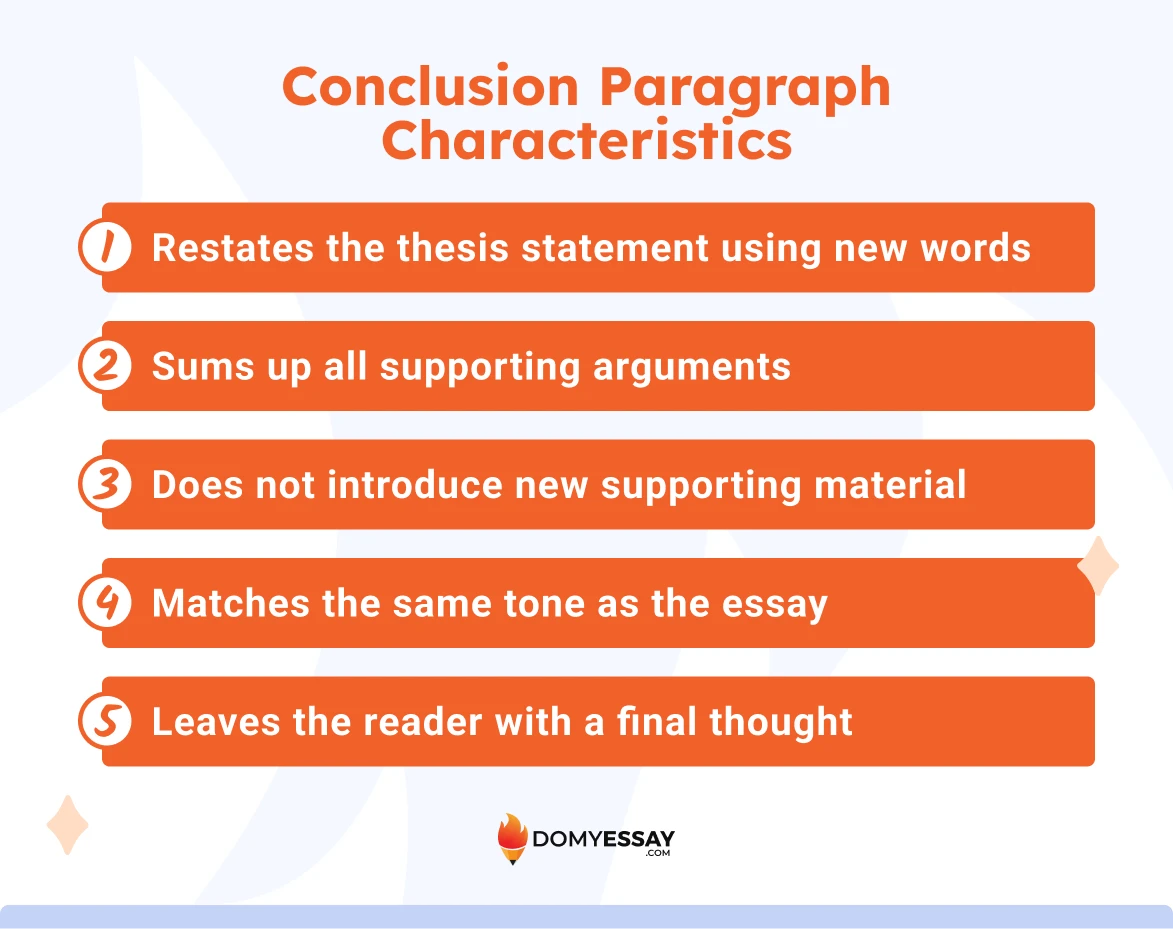
- Restates the thesis statement using new words. A conclusion needs to refer back to the thesis without repeating it word-for-word.
- Sums up all supporting arguments. They combine the arguments presented in each body paragraph as one logical argument.
- Does not introduce new supporting material. The conclusion should wrap up the discussion of the subject, not start an entirely new discussion.
- Matches the same tone as the essay. A personal essay will require a different conclusion compared to a research paper or literary criticism.
- Leaves the reader with a final thought, ideally, an idea, consequence, or takeaway.
Need Right Words to Finish?
Work with experts to build stronger claims, rebuttals, and essay structure from the start.

How to Write a Conclusion Paragraph
Your essay's conclusion should leave the reader with a strong sense that they have reached the end of your essay, rather than just stopping abruptly. The steps below explain how to build a strong conclusion that sounds purposeful and focused.
Return to the Thesis
The conclusion is the time to revisit your thesis and restate it in a way that reflects what you have proved throughout the essay. The reader doesn't need the exact same sentence as in the introduction, but they should rather receive a more informed version an informed version, now that the argument is complete. Too often, students make the mistake of introducing new material in this part of the essay. A well-written conclusion first provides a summary of your thesis statement, as well as the components of the body connected to the original claim.
Starter phrases:
- “The discussion shows that…”
- “The evidence suggests that…”
- “This essay demonstrates that…”
A clear essay outline ensures your conclusion naturally follows the ideas developed in the body.
Connect Main Ideas
After restating the thesis in the conclusion, you should outline how each of the paragraphs supported your main claim. You are not repeating each point you have already written. You must remind the reader of the relationship between the arguments and the final claim. What did the examples and reasoning prove when taken as a whole? A well-structured conclusion helps the reader understand exactly that.
Show the Importance
This part of the conclusion will answer the question in the reader's mind after the main point ends. Why does this issue deserve attention at all? The answer to this question should flow naturally from your essay itself. You should not make any overarching philosophical statements that do not relate directly to your topic. Instead, you should describe the actual impact of your topic. Some essays point to social implications, while others identify trends in behavior, educational policy, and cultural practices. A well-structured ending demonstrates to the reader how this argument can be applied outside of the classroom and encourages them to continue thinking about the topic.
Point Toward a Larger Perspective
Some essays benefit from ending with a wider perspective. This could mean mentioning a future challenge, a practical implication, or a question that still deserves attention. The key is moderation. One thoughtful idea creates a stronger conclusion than a long prediction section that drifts away from the paper’s focus. Readers should feel that the discussion continues beyond the final paragraph, even though the essay itself reached a clear endpoint. A good final perspective leaves the reader thinking instead of feeling cut off mid-thought.
Finish With a Memorable Line
The last sentence carries more pressure than most students expect. Readers remember endings clearly, especially after a long paper. A weak closing line can make the conclusion feel unfinished, even when the argument itself was solid. Strong conclusion paragraphs usually end with a sentence that sounds direct and intentional. Sometimes the best approach is a sharp observation connected to the thesis. Sometimes a short reflective statement works better. The goal is simple: leave the reader with a feeling that the paper ended exactly where it needed to.
Examples:
- “Public opinion often changes faster than policy.”
- “The problem continues long after public attention fades.”
- “Small decisions inside schools can influence larger social habits.”
Keep the Conclusion Proportional
Length matters more than students realize. A conclusion that feels too short can make the essay seem rushed. A conclusion that drags on usually weakens the final impact because the reader already understands the argument. The ending should match the size and complexity of the assignment. A short response paper may only need a few sentences. A research essay often needs more space because the argument took longer to develop. Readers should leave the paper feeling satisfied, not exhausted by repetition that keeps circling the same point.
Revise the Ending With Fresh Eyes
Most rough conclusions contain small problems that become obvious during revision. Some sentences repeat ideas too closely. Others sound vague because the writer became tired near the end of the paper. Read the conclusion separately from the rest of the essay and pay attention to its tone. Every sentence should sound connected to the argument. Remove filler phrases that add length without adding meaning. A polished conclusion feels calm and controlled. Readers should finish the essay feeling guided toward a final point instead of pushed through an abrupt stop.
A strong conclusion should restate a thesis in fresh language rather than repeating it word for word.
How to Write a Conclusion Paragraph for Various Essay Types
Different essays need different closings because each one leaves the reader with a different kind of work finished. The conclusion should match the purpose of whatever paper you just wrote. When it does, the final paragraph feels less like a required ending and more like the paper’s last useful move.
How to Write a Conclusion Paragraph for an Argumentative Essay
An argumentative conclusion should bring the claim back with more clarity than it had in the introduction. By the end, the reader has seen the reasoning, so the final paragraph can sound sharper and more settled. The point is to show that your position held up under pressure.
- Recast the claim: Bring back the thesis in language that reflects the full argument.
- Point to the strongest support: Refer to the evidence or reasoning that carried the most weight.
- Name the larger stakes: Explain what the issue affects beyond the page.
Example: Stronger digital privacy laws would give users real control over personal data and make careless collection harder for companies to defend.
How to Write a Conclusion Paragraph for an Informative Essay
An informative conclusion should help the reader leave with a clearer understanding than they had at the start. Since the essay explains rather than argues, the ending should not suddenly sound forceful or opinion-heavy. Its job is to gather the explanation into one clear final view. The best version feels steady. It reminds readers what they now understand and why that knowledge is useful.
- Return to the main subject: Remind readers what the essay explained.
- Highlight the clearest takeaway: Focus on the information that made the topic easier to understand.
- Close with relevance: Show why the subject deserves attention.
Example: Understanding sleep cycles makes it easier to see why rest affects memory and daily focus so directly.
How to Write a Conclusion Paragraph for a Persuasive Essay
Persuasive essays guide the reader toward the author’s position and explain it with arguments and evidence, so the ending should make that position impossible to ignore. Still, this pressure does not mean the conclusion should go melodramatic. A strong persuasive ending gives readers a reason to care and a clear direction for their response. It should sound confident enough to nudge action without sounding like a slogan.
- Reinforce the position: State the main opinion with direct, confident wording.
- Return to the most convincing reason: Remind readers what makes the position hard to dismiss.
- Invite action or reflection: End with a practical next thought for the reader.
Example: Schools should treat student mental health support as part of academic planning because emotional strain shapes how students learn each day.
How to Write a Conclusion Paragraph for a Synthesis Essay
A synthesis conclusion cannot simply recap one source after another. The point is to show what becomes visible when those sources meet. Maybe they agree in an unexpected way. Maybe they reveal a gap. Maybe they complicate a topic that seemed simple at first. The ending should name that combined insight so the reader sees the value of bringing the sources together.
- Return to the shared insight: State what the sources reveal as a group.
- Clarify the relationship between sources: Explain how the evidence connects across the discussion.
- End with the larger meaning: Show what the combined view suggests about the topic.
Example: Read together, the sources suggest that remote work changes professional culture through communication habits and expectations around productivity.
Students under tight deadlines can request 'write my essay' to complete polished academic papers.
What to Avoid in Writing a Conclusion Paragraph
The table below covers common mistakes people make in a conclusion paragraph for an essay, why those problems weaken the ending, and how to fix them without overcomplicating the writing.
Reviewing an essay introduction example can help you create a conclusion that connects back to your opening.
Write Smarter Today
Get expert help with your assignments when your deadline is approaching.

Final Thoughts
Now we’ve finally arrived at this essay’s conclusion, as well. A strong ending to any kind of paper should return to the thesis with a clearer perspective, connect the main ideas naturally, and leave readers with a final thought. Every conclusion, regardless of the type, depends on the clarity of the main points. Readers should finish the paper feeling guided toward a complete final point instead of dropping at the edge of an unfinished thought.
FAQ
- How to write a conclusion to an essay. (n.d.). BBC Bitesize. https://www.bbc.co.uk/bitesize/articles/z66qmfr
- Conclusion. (2026). https://www.massey.ac.nz. https://www.massey.ac.nz/study/study-and-assignment-support-and-guides/types-of-assignments/essay/conclusion/
- Writing a Conclusion | Kent State University. (n.d.). https://www.kent.edu/. https://www.kent.edu/stark/writing-conclusion