
A theoretical framework in research is an established theory, sometimes several related theories, that determines how a researcher understands the subject and the connections within it. Common theoretical framework examples include:
- Social learning theory
- Attachment theory
- Constructivism
- Critical race theory
- Maslow’s hierarchy of needs
These frameworks provide tested concepts and relationships that help you interpret evidence. This article explains their purpose, covers the main framework types, separates theoretical models from conceptual ones, and presents ten examples that can support a credible research project.
What Is a Theoretical Framework?
Theoretical framework in research is the organized body of theory that defines the central concepts in a study and explains how they may relate. It gives technical terms an exact meaning within your project, supports the question, and provides a reasoned basis for any hypotheses you propose.
Here is the check I find most useful: every major variable should connect to a proposition in the selected theory. If the theory appears in the literature review and then disappears once the analysis begins, it is doing no real work. The types of theoretical framework below differ according to their source, reasoning process, or intended purpose.
One framework may fit several of these categories because the labels describe separate aspects of its design. Research paper ideas about employee turnover, for example, could apply self-determination theory through a deductive, explanatory framework. The study might test how autonomy, competence, and workplace connection affect an employee’s intention to resign.
Need More Than Theoretical Framework Examples?
Get personalized writing assistance based on your topic and academic requirements.

Why Is a Theoretical Framework Used?
A theoretical framework gives the study an intellectual structure before evidence is collected and analyzed. More practically, it helps you justify individual research decisions and lets readers see the reasoning behind them. Researchers use a framework to:
- Define central concepts in precise, study-specific terms.
- Convert a broad topic into focused research questions.
- Identify the variables, constructs, and relationships that need attention.
- Support hypotheses through established theoretical propositions.
- Guide decisions about participants, measurements, interviews, and observations.
- Set clear boundaries around the research problem.
- Provide categories for coding and interpreting evidence.
- Connect new findings with existing scholarship.
- Explain results through mechanisms identified by the theory.
- State assumptions clearly enough for readers to evaluate them.
Consistency is another important purpose. Your question, method, analysis, and conclusion should follow the same theoretical reasoning. Readers can then trace each interpretation back to a defined concept and understand exactly how you reached it.
The Difference Between Theoretical and Conceptual Framework
A theoretical framework applies an established theory to a phenomenon. Its constructs, propositions, and expected relationships appear in scholarly literature. For employee misconduct reporting, the theory of planned behavior would define attitudes, subjective norms, perceived behavioral control, intention, and behavior. The researcher must state applied or tested propositions.
A conceptual framework addresses one research problem. Its concepts require support from theory, empirical findings, or study context. A misconduct-reporting model could connect anonymous reporting, managerial response, job security, previous retaliation, and reporting intention. Each connection requires a source. Quantitative models must also state the expected direction.
To choose a theoretical or conceptual framework, list the constructs in the research question and trace each relationship’s source. Use a theoretical framework if one theory defines the constructs and their connections. Use a conceptual framework if the project combines factors supported across several studies.
Both frameworks may appear in one study. The theoretical framework establishes the constructs and explanatory propositions. The conceptual framework adds study-specific variables, mediators, or moderators to the model. Label theory-derived relationships separately from empirically supported connections.
Align the framework with the method. Create an alignment table with each construct’s definition, data source, measurement, and analysis. Perceived behavioral control could be measured with a Likert scale and analyzed as a predictor of reporting intention. Qualitative research would require interview questions and coding categories tied to the construct. Remove variables without a measurement or defined analytical role. Every relationship needs a statistical test, comparison, or qualitative analysis procedure.
Theoretical Framework Examples
The following examples of theoretical framework use show how an established theory connects with a research problem, question, variables, and analysis.
1. Social Learning Theory
Field: Education
- Objective: Understand how peer behavior influences class discussion in undergraduate seminars.
- Research problem: Sometimes, students participate more after observing a peer receive encouragement from the instructor.
- Research question: How does observed peers' reinforcement impact another student's participation?
- Theoretical framework: Bandura's social learning theory (theories based on people learning by observing and then copying what they see).
- Key constructs: Observational learning, modeled behavior, reinforcement, self-efficacy, and participation.
- Application: The researcher documents peer participation, responses from the instructor, and additional participation from observing students. Interpretations of approval/disapproval by instructors and social risks can also be assessed through interviews.
2. Attachment Theory
Field: Developmental psychology
- Objective: Explore the relationship between young adult attachment styles and methods of conflict resolution.
- Research problem: Young adults react differently to disagreements, emotional distance, and/or feeling rejected by people they are close to.
- Research question: What is the relationship between adult attachment styles and methods for resolving conflict?
- Theoretical framework: Attachment theory connects early life experiences with the expectations of security, trust, and emotional support from others.
- Key constructs: Secure attachment, anxious attachment, avoidant attachment, emotional regulation, and conflict behavior.
- Application: Participants complete validated measures of attachment style and conflict resolution strategies. Regression analysis can generalize the relationship between attachment style and conflict resolution method (e.g., avoidance, accommodation, direct discussion).
3. Social Constructivist Theory
Field: Online learning
- Objective: To evaluate how structured peer discussions affect students' comprehension of science concepts.
- Research problem: Students may complete online coursework individually, with limited opportunities to test their interpretations through discussion.
- Research question: How does structured peer-to-peer dialogue affect conceptual understanding in a biology course taught online?
- Theoretical framework: Social constructivist theory treats learning as knowledge development through interaction, prior experience, language, and guided support.
- Key constructs: Collaborative learning, prior knowledge, scaffolding, dialogue, and conceptual development.
- Application: The study compares assessment results with discussion transcripts. Codes can identify explanation, disagreement, clarification, and revision of ideas within each group.
4. Feminist Standpoint Theory
Field: Workplace studies
- Objective: Examine how women in male-dominated occupations experience promotion procedures.
- Research problem: Formal promotion policies may produce different experiences across organizational positions and gendered workplace roles.
- Research question: How do women engineers describe the influence of workplace power relations on promotion decisions?
- Theoretical framework: Feminist standpoint theory examines how social position affects knowledge, experience, and access to institutional power.
- Key constructs: Social position, power, gendered labor, situated knowledge, and institutional practices.
- Application: Interviews focus on evaluation standards, informal sponsorship, assignment distribution, and promotion decisions. Analysis connects individual accounts with recurring organizational practices.
5. Critical Race Theory
Field: Education policy
- Objective: Analyze racial disparities in disciplinary referrals at public secondary schools.
- Research problem: School discipline statistics may show unequal referral and suspension rates across racial groups, even after researchers account for reported behavior.
- Research question: How do disciplinary policies and staff discretion contribute to racial differences in suspension outcomes?
- Theoretical framework: Critical race theory examines how institutional rules, legal structures, and routine practices may reproduce racial inequality.
- Key constructs: Structural racism, institutional power, racialization, interest convergence, and counter-storytelling.
- Application: The project combines disciplinary records, policy analysis, and interviews with affected students. Researchers examine decision points such as referrals, offense classification, and sanction selection.
6. Systems Theory
Field: Healthcare management
- Objective: Identify organizational factors associated with medication errors during hospital shift changes.
- Research problem: Medication errors can involve communication procedures, staffing levels, electronic records, workload, and supervision.
- Research question: How do interactions among staffing, communication, and documentation systems affect medication errors during shift handovers?
- Theoretical framework: Systems theory analyzes outcomes as results of relationships among interconnected components within an organization.
- Key constructs: Inputs, processes, outputs, feedback, interdependence, and system boundaries.
- Application: The researcher maps the handover process, reviews incident reports, and observes communication practices. Analysis identifies how failures in one component affect other parts of the medication system.
7. Self-Determination Theory
Field: Organizational psychology
- Objective: Assess how remote-work conditions affect employee motivation and intention to remain with an organization.
- Research problem: Remote employees report different levels of independence, professional confidence, and connection with colleagues.
- Research question: How does satisfaction of autonomy, competence, and relatedness needs predict motivation and turnover intention among remote employees?
- Theoretical framework: Self-determination theory links motivation and well-being with the satisfaction of three basic psychological needs.
- Key constructs: Autonomy, competence, relatedness, intrinsic motivation, and turnover intention.
- Application: Survey instruments measure need satisfaction and motivation. Mediation analysis can test if motivation explains the relationship between psychological need satisfaction and turnover intention.
8. Theory of Planned Behavior
Field: Public health
- Objective: Examine university students’ intentions to receive an annual influenza vaccination.
- Research problem: Vaccine availability alone does not explain differences in vaccination intention or behavior.
- Research question: How do attitudes, subjective norms, and perceived behavioral control predict influenza vaccination intentions among university students?
- Theoretical framework: The theory of planned behavior connects intention with attitudes toward the behavior, perceived social expectations, and perceived control.
- Key constructs: Attitude, subjective norm, perceived behavioral control, behavioral intention, and vaccination behavior.
- Application: A questionnaire measures each construct separately. Regression or structural equation modeling can estimate how strongly each factor predicts intention and reported vaccination.
9. Diffusion of Innovations Theory
Field: Agricultural technology
- Objective: Explain the adoption of soil-moisture sensors among small-scale farmers.
- Research problem: Farmers adopt the same agricultural technology at different rates, even within communities that receive similar access and training.
- Research question: How do perceived technology characteristics and communication channels affect farmers’ adoption of soil-moisture sensors?
- Theoretical framework: Diffusion of innovations theory explains adoption through perceived advantage, compatibility, complexity, trialability, observability, communication, and social systems.
- Key constructs: Innovation attributes, adopter categories, communication channels, social networks, and adoption rate.
- Application: Surveys measure farmers’ perceptions of the sensors, while interviews document information sources and adoption decisions. Adoption timing can be analyzed across adopter categories.
10. Maslow’s Hierarchy of Needs
Field: Social work
- Objective: Examine how housing instability affects adults’ participation in employment-support programs.
- Research problem: Participants facing immediate concerns about shelter, food, and personal safety may engage inconsistently with long-term employment services.
- Research question: How do unmet physiological and safety needs affect participation in employment-support programs among adults experiencing housing instability?
- Theoretical framework: Maslow’s hierarchy organizes human needs into physiological, safety, belonging, esteem, and self-actualization categories.
- Key constructs: Basic needs, safety, belonging, esteem, personal development, and program participation.
- Application: Interviews identify participants’ reported needs and barriers, while attendance records document engagement. The researcher should avoid treating the hierarchy as a fixed universal sequence because people may pursue several need categories simultaneously.
Just ask someone from DoMyEssay, ‘Write my research paper for me,’ if you’re too tired to keep drafting and revising.
How to Write a Theoretical Framework?
Students should begin making a theoretical framework after they settle the research question. Identify a theory that explains the relationship, then operationalize its concepts. The advice for building a framework below will work well together with tips for writing a research paper:
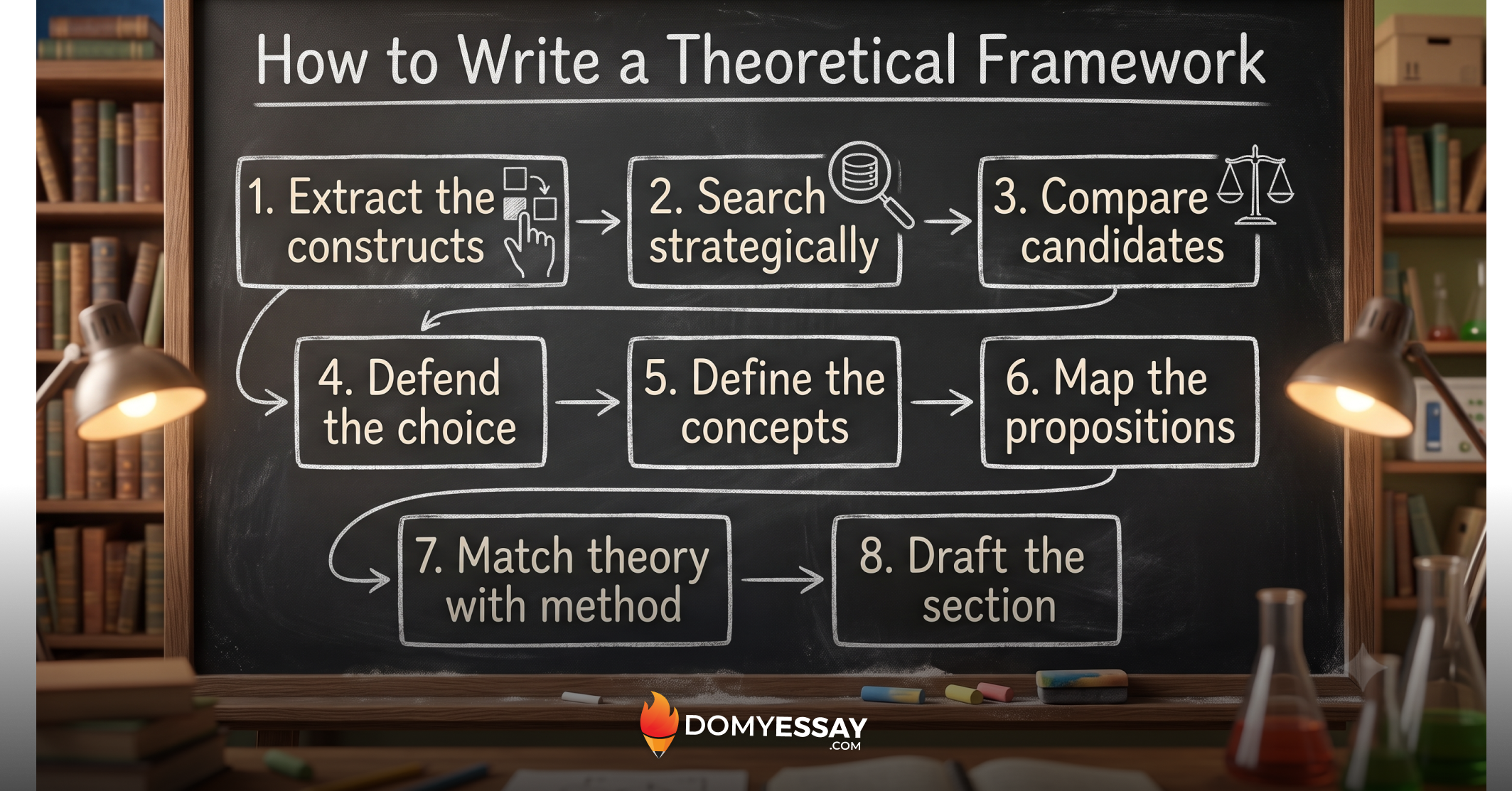
- Extract the constructs: Identify all the constructs from the research question - concepts, participants, context, and relationship.
- Search strategically: Relate each construct to “theory,” “model,” and your discipline in database searches.
- Compare candidates: Read the propositions and supporting factors (applications, supporting evidence) for each theory, then identify its limitations.
- Defend the choice: Specify how the selection relates to your question, participants, context, and analysis.
- Define the concepts: Take each construct’s meaning from the theory and cite the primary source.
- Map the propositions: State relationships precisely and add a diagram only when useful.
- Match theory with method: Give each construct a measure, interview prompt, code, or analytical function.
- Draft the section: Introduce the theory, explain its propositions, apply them, and disclose justified adaptations.
Take a look at our list of dissertation topic ideas if you’re looking for inspiration for your final project.
Don't Let Theory Slow Down Your Research
Get help organizing your theoretical framework and connecting it to your study.

Theoretical Framework Mistakes to Avoid
Academic phrasing can conceal framework errors. Accuracy depends on decisions about scope, terminology, sources, and presentation. Check these problems:
- Retelling the theory’s history: Biographical and unrelated historical details displace propositions used in the research.
- Presenting theory as fact: Theoretical claims remain open to testing, criticism, and revision.
- Collecting theories without order: Unexplained theoretical roles make the primary framework unclear.
- Claiming total explanation: Plausible alternative mechanisms require acknowledgment during interpretation.
- Depending on summaries: Textbooks and websites may simplify constructs or omit limitations in primary scholarship.
- Drifting between terms: Alternate labels obscure the number and meaning of variables under discussion.
- Letting text and diagram disagree: Arrows, labels, hypotheses, and explanations must describe identical relationships.
- Forgetting scope conditions: Application to another population, culture, or setting requires explicit justification.
- Burying the framework: Use a precise section heading and reproduce it in the table of contents.
Final Thoughts
A theoretical framework defines the concepts and relationships that organize a research study. Its theory must suit the question, inform the method, and remain visible in the analysis. Good writing requires careful theory comparison, precise construct definitions, explicit propositions, and justified adaptations. Accurate citations, stable terminology, and agreement among the framework, diagram, and methods make the final research argument credible.
FAQs
- Anfara, V., & Mertz, N. (2006). Theoretical Frameworks in Qualitative Research. SAGE Publications, Inc. https://methods.sagepub.com/book/edvol/theoretical-frameworks-in-qualitative-research/back-matter/d5
- Grant, C., & Osanloo, A. (2014). Understanding, selecting, and integrating a theoretical framework in dissertation research: Creating the blueprint for your “house.” Administrative Issues Journal Education Practice and Research, 4(2), 12–26. https://files.eric.ed.gov/fulltext/EJ1058505.pdf
- LibGuides: Research Writing and Analysis: Theoretical Framework. (2014). https://resources.nu.edu/. https://resources.nu.edu/researchtools/theoreticalframework
.webp)