
An APA research paper outline is essentially a blueprint for your paper. You plan out all the sections of your paper before writing your research paper, formatting each section according to APA style guidelines established by the American Psychological Association. I have read through hundreds of APA-style papers with my students. You will find that they all break down into the same major sections: title page, abstract, introduction, method, results, discussion, and references. Each section has a distinct role. If you omit one, the reviewer will know it.
In this article, I explain how to construct an APA format outline template step by step. I provide actual examples for each section so that you can structure your paper correctly.
What makes structure so important in APA?
Structure is important because it helps your reader understand your ideas, not guess where your ideas end and others begin. An effective organization relies on a consistent format that complies with American Psychological Association style guidelines, whether you are writing a student paper, a conference poster, or a manuscript for peer review. To achieve this consistency from the start, creating an APA paper outline before writing your first paragraph is key. Without an outline, papers often meander; points get repeated, evidence ends up in the wrong paragraph, and your argument can get lost before readers reach your discussion.
Need Help Formatting an APA Paper?
Get expert assistance with APA outlines, citations, research, and academic writing.

What does a research paper outline do?
An APA paper outline organizes your main points and evidence before drafting your essay. Outlines are different from tables of contents. They show how your ideas relate to and build upon each other to support your thesis.
- Divides paper into small sections with a central focus.
- Allows you to map out your argument and how it supports your thesis.
- Helps you identify any gaps in logic or weak arguments early on.
- Allows you to stay organized by structuring your research.
- Helps you save time writing and editing your paper.
Our APA paper writing service can help ensure your research paper follows the latest APA formatting guidelines.
APA research paper structure
An APA style outline will have these parts in the following order. You may want to structure your outline the same way before you begin writing. Each section has a specific role. Inserting material in the wrong section is one of the quickest ways to lose points on an otherwise quality research paper.
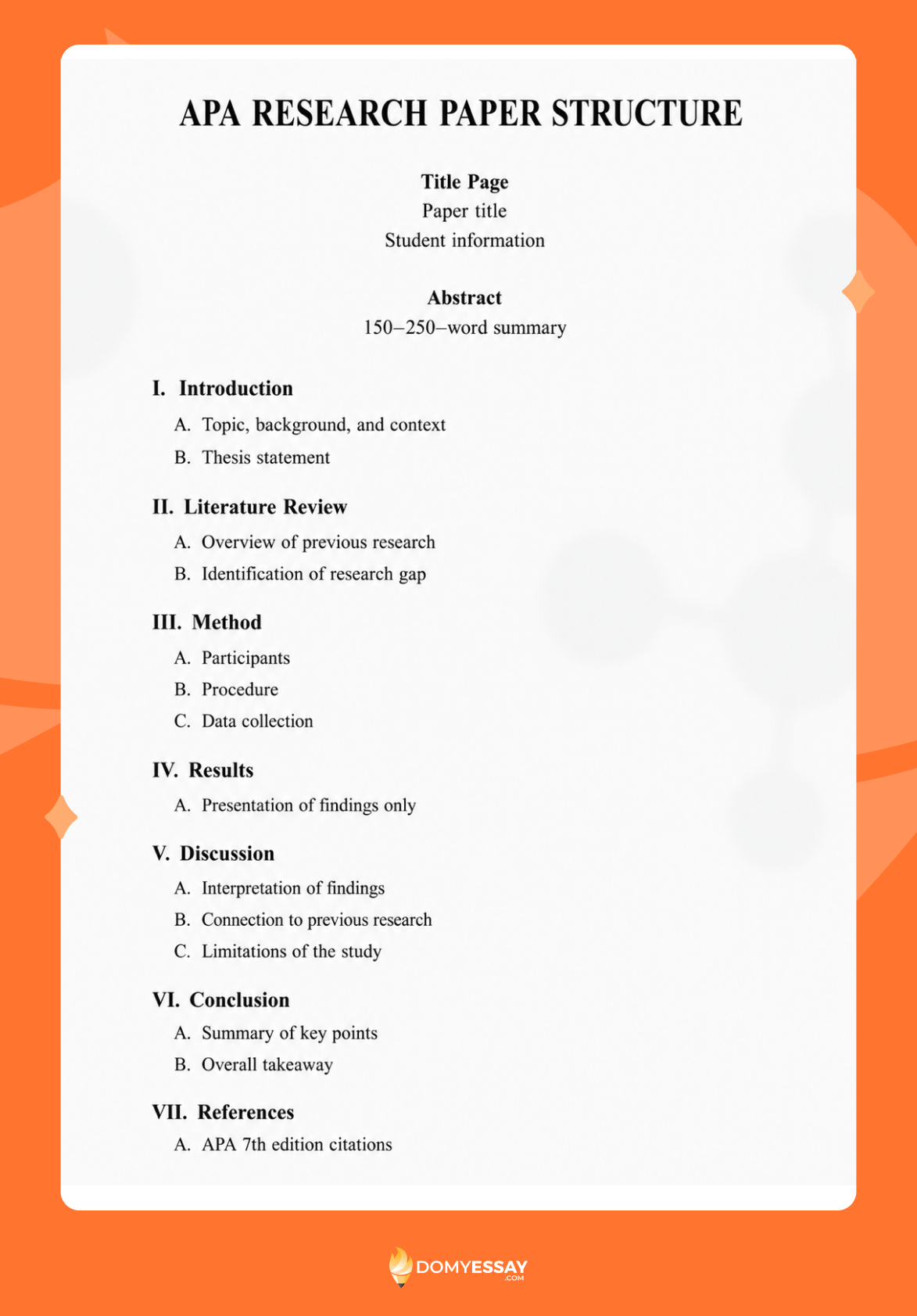
Title page
The title page includes the title of your paper, your name, and your institutional affiliation. Student papers no longer require a running head in APA 7, but professional papers do. The title should be brief and avoid unnecessary abbreviations.
Abstract
The abstract is a summary of your whole paper. Typically, the abstract is 150-250 words and briefly includes your research question, method, key results, and conclusion. Some instructors do not require this for shorter student research papers. Check with them if you are unsure.
Introduction
The introduction introduces the topic, provides background information, and closes with a thesis statement. The introduction answers the question: what question is this paper answering, and why does it matter?
Literature review
The literature review discusses previous research done on the topic. It should highlight where prior scholarship agrees, where it conflicts, and finally, where a gap remains for the current paper to fill.
Method
The method explains exactly how the research was done. Who or what were the participants? What was used or manipulated? How was the data collected? Include enough detail that another researcher could replicate your study.
Results
The results section simply reports what you found in your data. Interpretation of the results belongs in the discussion section. Facts, figures, and observations go here.
Discussion
The discussion is where you interpret your results and relate them back to your thesis. You should also discuss any limitations that affected your study. Think of this as where all the pieces of your paper’s argument come together.
Conclusion
The conclusion briefly restates your paper’s main findings and what they mean. Like the introduction, keep this section short. Try to limit it to just a few sentences and do not introduce any new evidence here.
References
The reference page includes every source cited in your paper. Every in-text citation should correspond to a source here. If you do not cite it in your paper, do not include it in your references. Make sure to format your list according to APA 7th edition style guidelines.
Appendices
Your appendices will include any supplemental material used in your paper. Raw data, survey questions, lengthy tables. Only include this section if you actually have supporting material to add.
Understanding APA style annotation is essential when preparing annotated bibliographies and source notes.
Types of APA outline format
APA outlines typically fall into one of three styles: alphanumeric, full sentence, or decimal. These formats organize your main points, subpoints, and details using different labeling systems. Your instructor may prefer one APA outline format over another, or it may depend on the length of your paper.
Alphanumeric outline format
The alphanumeric outline is the most frequently used APA outline style. Every level is assigned a different type of character: Roman numerals, capital letters, Arabic numbers, and lowercase letters. Every time you move down a level, you take one step closer to the specific. This allows a reader to immediately see how far into the outline they are by reading the labels.
To construct one, begin with your Roman numerals as your main sections, which will correspond with the four main sections of your paper: introduction, method, results, and discussion. Below each roman numeral, insert capital letter headings that correspond with the major points that you will use to prove that section. Below those, place your Arabic numbers. These will hold specific evidence or examples that you will use to prove your capital letter subpoints. Below those, if necessary, use lowercase letters to break that specific evidence down even further. Typical student papers will only go three levels, but a lengthy thesis would have five.
.webp)
Alphanumeric APA outline format example:
I. Introduction
- A. Background of the study
- Prior research on the topic
- a. Specific finding relevant to the thesis
II. Method
- A. Participants
- Selection criteria
Full sentence outline format
A full-sentence outline uses the same alphanumeric labels, but every single line must be a complete sentence rather than a short phrase. This format forces you to work out your actual argument before drafting, since a vague fragment like "background info" cannot hide behind a label the way it can in a phrase outline. Instructors often assign this format for essays and speeches, since a complete sentence at each level reads almost like a compressed version of the final paper.
Writing one takes longer up front, but it pays off during the drafting stage. Each sentence becomes close to a topic sentence for its matching paragraph, so turning the outline into full prose is mostly a matter of expanding what you already wrote. The structure below it, Roman numerals down to lowercase letters, stays identical to the alphanumeric format; only the content at each level changes from fragments to full sentences.
Full sentence APA outline format example:
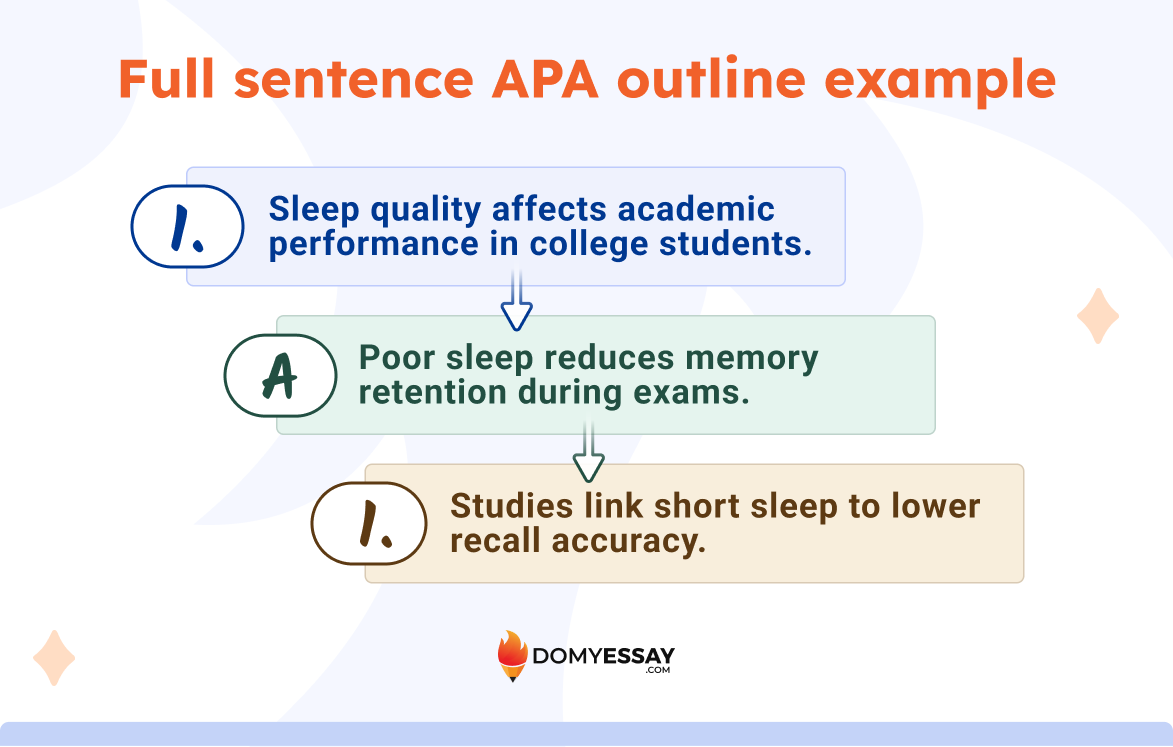
I. Sleep quality affects academic performance in college students.
- A. Poor sleep reduces memory retention during exams.
- Studies link short sleep duration to lower recall accuracy on tested material.
II. Sleep habits are shaped by external factors beyond a student's control.
- A. Irregular class schedules disrupt consistent sleep timing.
Decimal outline format
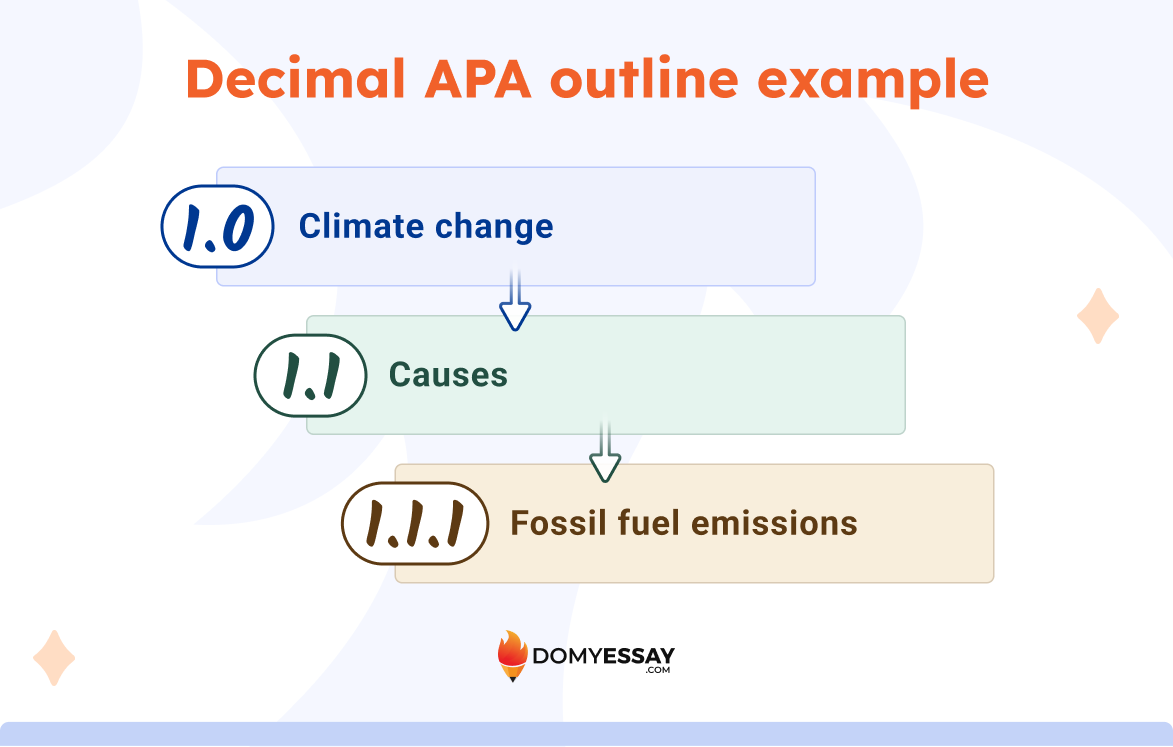
The decimal format organizes an outline using numbers only, with each added digit marking a deeper level of detail. A main heading is labeled 1.0, its first subpoint becomes 1.1, and a point nested under that becomes 1.1.1. Reading the number alone tells you exactly where that line sits in the hierarchy, since the digit count corresponds directly to how many levels deep the point goes.
This format works well for research papers with heavy numerical data or technical detail, since the decimal structure mirrors how scientific and engineering documents are already organized. It also scales cleanly: adding a fourth or fifth level just means adding another digit, without switching to a new type of character the way alphanumeric outlines do when they run out of letters and numbers.
Decimal APA outline format example:
1.0 Climate change and coastal cities
- 1.1 Primary causes of rising sea levels
- 1.1.1 Fossil fuel emissions driving thermal expansion
- 1.2 Effects on urban infrastructure
2.0 Adaptation strategies for coastal regions
- 2.1 Physical barriers and sea walls
A well-structured essay outline makes it easier to organize ideas before expanding them into a full research paper.
Research paper outline formatting rules under APA 7th edition
APA 7 format specifications are useful when creating an outline, just as they would be if you were writing the entire paper. Formatting correctly from the beginning allows you to skip reformatting later, and many professors will check for proper formatting.
- Font: 12-point Times New Roman (or acceptable alternative fonts: 11-point Arial or Calibri)
- Spacing: Double-space your paper and outline, including the reference page.
- Margins: 1-inch margins on all sides
- Page numbers: in the upper right corner of each page.
- Headings: Bold; subheadings can be italicized or plain text, depending on the level you are using.
- Alignment: Left; never justify
- Labels: Use your Roman numerals, capital letters, Arabic numbers and lowercase letters for each level of your outline.
- Title page: Place your title and author centered on the page; no bold, italics, or underlining.
- Indentation: Create a hanging indent for each sublevel of your outline.
Every outline should be supported by accurate APA citation practices to properly credit your sources.
Standard APA research paper outline template
Use this as your rough outline for any APA-format paper. Edit the section titles to fit your assignment. Leave every level blank, even if you only have one or two bullets under a section. It is easier to write an outline that is filled in than one that has gaps.
I. Introduction
A. Background and context of the topic
B. Statement of the problem
C. Thesis statement
II. Literature review
A. Summary of key prior studies
B. Gaps in existing research
III. Method
A. Participants or subjects
B. Materials and instruments used
C. Procedure
1. Step-by-step description of data collection
IV. Results
A. Presentation of findings
1. Key statistics or data points
B. Observations without interpretation
V. Discussion
A. Interpretation of results
B. Connection back to the thesis
C. Limitations of the study
VI. Conclusion
A. Summary of key findings
B. Broader significance
VII. References
A. Full citation list in APA 7th edition format
Review these tips for writing a research paper to improve your planning, research, and organization.
How to build an APA outline?
Building an APA style outline helps if you take the steps below in order, rather than jumping right to writing. Each step in building your outline refers to the previous step, so skipping ahead will often require you to return to address missing information.
Step 1. Read your paper prompt. Before you even begin to consider what you will write, double-check how long the paper should be, whether it is analytical, argumentative, or empirical, and if your professor wants you to use a decimal outline or a full-sentence outline.
Step 2. Write your research question and thesis. Write out your thesis statement or research question. Everything else you write in your outline (and later in your paper) will relate back to this one sentence.
Step 3. Decide on an outline style. Will you use alphanumeric, full sentence, or decimal format? If you are writing a longer, data-driven paper, you may want to consider the decimal format. If you are writing a persuasive paper, a full sentence might be your best option.
Step 4. List your paper sections. What are the large sections that your paper will be divided into? Will you need an introduction, a literature review, a method, results, a discussion, and a conclusion? If so, list these. These will likely match your APA paper format directly.
Step 5. Add subpoints. Under each section heading, write what evidence or points you will use to back up that particular section. Use bullets, decimal or lettered points, depending on your format choice from step 3.
Step 6. Check that it all flows. Read through your outline and make sure each point you want to make flows from the previous heading. Also, make sure that you don’t have too much or too little under any heading.
Step 7. APA format. Use your APA-required font, spacing, and margins. Bold or italicize your headings only if APA format permits you to do so. Label each level of your outline consistently.
Step 8. Proofread, then write your paper. Read over your outline one more time. Check for parallel structure in your headings, and delete any repeated points.
APA research paper outline example
Here's a filled-out APA paper outline example with an actual topic, so you can see what each level of the outline relates to when you're writing about something real instead of a placeholder title. Notice how each bullet below a header supports the idea above it.
I. Introduction
A. Antibiotic resistance has accelerated in hospital settings
B. Current infection control protocols vary widely by institution
C. Thesis: standardized antimicrobial stewardship programs reduce
resistant infection rates more effectively than facility-specific
protocols
II. Literature review
A. Studies linking stewardship programs to lower resistance rates
B. Studies showing inconsistent outcomes from ad hoc protocols
III. Method
A. Retrospective analysis of infection data from 15 hospitals
B. Materials: hospital infection control records, 2020 to 2025
C. Procedure
1. Hospitals grouped by presence or absence of a standardized
stewardship program
IV. Results
A. Hospitals with stewardship programs showed a 22 percent lower
resistant infection rate
B. Facilities without standardized protocols showed greater
variation in outcomes
V. Discussion
A. Standardization reduces variability in prescribing practices
B. Inconsistent protocols may allow resistant strains to persist
C. Limitation: hospital size and patient population were not
fully controlled for
VI. Conclusion
A. Standardized stewardship programs show a measurable advantage
over facility-specific approaches
B. Broader adoption could improve infection outcomes across
healthcare systems
VII. References
A. Full citation list in APA 7th edition format
Submit a Perfect APA Research Paper
Work with experienced writers to create a well-organized paper that meets APA requirements.

7 Tips for writing a strong APA research paper outline
Every academic discipline teaches students to create outlines before writing papers, but only a few disciplines stress these handful of practices that distinguish an outline that will help your writing from one you discard mid-draft. They appear in almost every piece of academic writing advice, regardless of discipline:
- Write your thesis as the first line of your outline; make it narrow enough that each subsequent section will support it.
- Divide ideas into small chunks. The purpose of each subpoint should be to support only its parent section, not to wander onto tangents.
- Maintain parallel construction. If one heading is worded as a verb-command, don’t randomly switch tenses or voices in the other headings at the same outline level.
- Reflect importance through hierarchical position. Don’t give weak arguments their own top-level headings. Make them subpoints instead.
- Link every level. Every subheading should logically expand on the heading above it.
- Eliminate redundancies. If you find two similar subpoints, choose the stronger one and delete the other.
- Don’t introduce new topics at the end. The last thing your readers should learn in your paper is your thesis.
Longer academic projects may also require a table of content for research paper to improve navigation.
Final thoughts
Creating an APA outline helps your paper have a strong structure before you even begin writing. You can use whichever type you like: alphanumeric, full sentence, or decimal. By starting with an outline that follows APA 7 format rules, you'll spend less time revising and more time polishing your argument from your intro to your reference page.
FAQs
- American Psychological Association. (2019). Paper Format. In https://apastyle.apa.org. https://apastyle.apa.org/style-grammar-guidelines/paper-format
- LibGuides: APA Citation Guide (7th edition): Paper Format. (2026). In Libguides.com. https://bradley.libguides.com/apa7th/paperformat
- Schemm, N. (n.d.). Research, Citation, & Class Guides: APA Style (7th ed.): Format Your Paper. In libguides.uww.edu. Retrieved July 23, 2026, from https://libguides.uww.edu/apa/format