The most active environmental science research topics in 2026 include bioremediation of pollutants, eutrophication and algal blooms, urban air quality, greenhouse gas impacts, and environmental health. Each area offers public datasets and open questions.
This article lists 200+ environmental science research topics across water, soil, air, biodiversity, energy, and policy, then explains the four-step method that turns broad environmental research paper topics into focused, researchable questions. The best picks for a one-semester paper stay small enough to answer with a single public dataset.
What makes a good environmental science research topic?
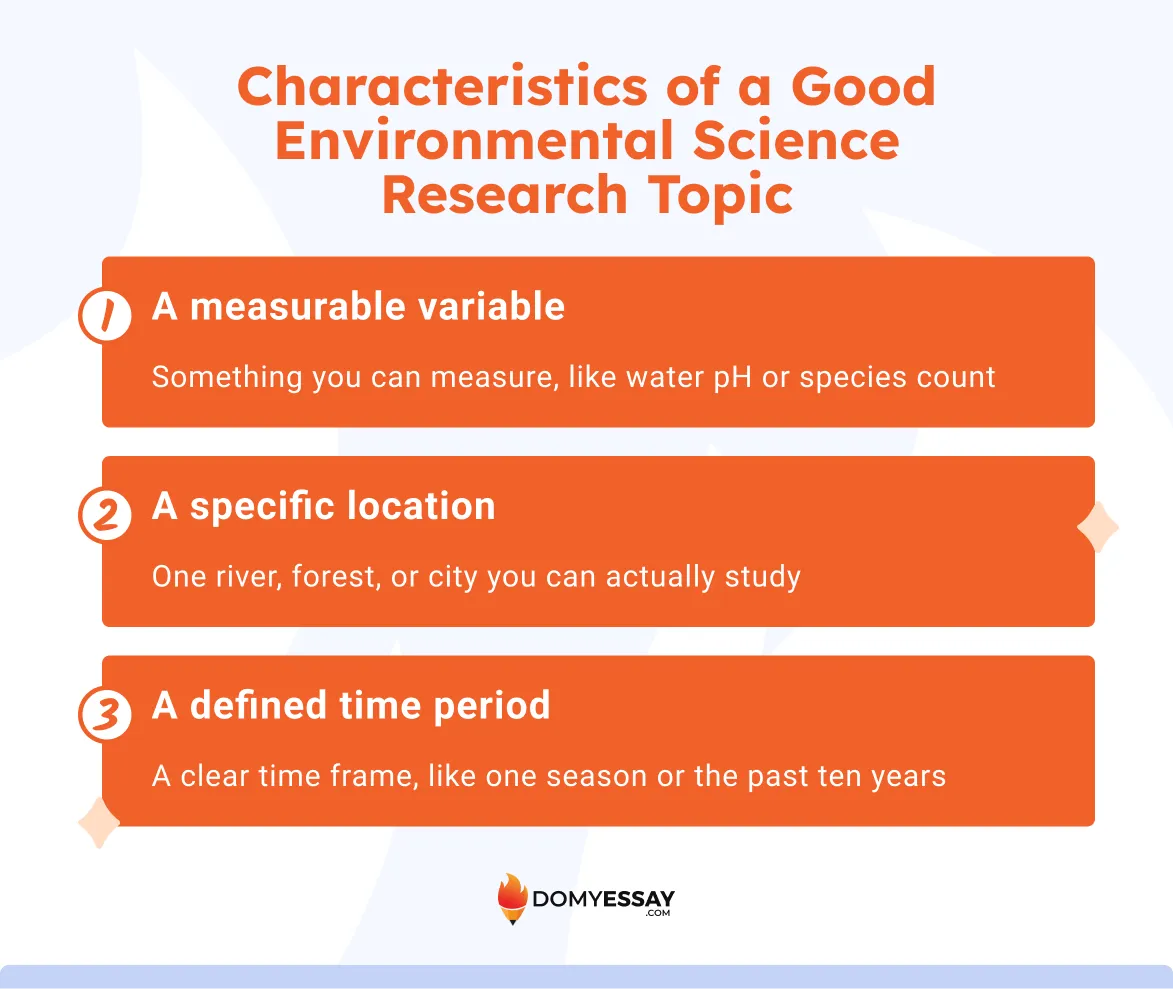
A good environmental science research topic names three things:
- A measurable variable, such as nitrate concentration, canopy cover percent, or species count.
- A specific location, such as a named watershed, city block, or monitoring station.
- A defined time period, such as one season, one year, or a span tied to a policy change.
If the broad topic of the research is Salt pollution in freshwater, the narrowed-down version would be Chloride concentration in the Aberjona River across the winters of 2023, 2024, and 2025.
How do you narrow an environmental science topic?
Four passes turn a broad environmental science topic into one researchable question: a theme, a sub-theme, a single variable and setting, then a dated question with a data source. One example of how to write research questions runs like this:
Monthly household budget → food and drink spending → café coffee purchases → Did average weekly café spending fall after brewing coffee at home for the first quarter of 2026?
The hypothesis: home brewing lowered average weekly café spending below the 2025 baseline. The dataset: bank card transactions tagged by merchant category.
Your Deadline Is Our Problem Now
Hand off the paper that’s been staring you down and let us get you to finished draft while you rest.

What are environmental science research topics by subfield?
Environmental science research topics split cleanly across 12 subfields, each with its own variables, datasets, and methods. The 120 environmental research paper topics below cover air, water, climate, biodiversity, ecology, soil, pollution, energy, cities, oceans, policy, and health.
Air quality and atmospheric science
- How does wildfire smoke change PM2.5 levels in cities 200 miles downwind?
- Indoor nitrogen dioxide concentrations in homes with gas stoves.
- Compare weekday and weekend ozone readings across one metro area.
- What drives seasonal spikes in agricultural ammonia emissions?
- Volatile organic compounds in consumer cleaning products.
- Does traffic volume predict carbon monoxide levels near highway on-ramps?
- Radon accumulation in basements across one housing stock.
- Track pollen counts through a single allergy season in a mid-size city.
- Black carbon concentrations near a major shipping port.
- Which weather conditions trap the worst winter smog in a valley city?
Water resources and hydrology
- How did reservoir levels respond to the 2025 drought in a named basin?
- Groundwater depletion beneath irrigated farmland.
- Compare nitrate concentrations upstream and downstream of a wastewater plant.
- What drives seasonal turbidity in an urban river?
- Daily streamflow changes after a dam removal.
- Phosphorus loading and its sources in a shallow lake.
- Does septic density raise bacterial counts in rural well water?
- Spring discharge trends across a karst aquifer over 10 years.
- Which irrigation methods lose the least water to evaporation?
- Rainwater harvesting and municipal demand in dry-season months.
Climate change and climate science
- How much has the local growing season lengthened over 30 years?
- Permafrost thaw and methane release in Arctic tundra.
- Compare heatwave frequency across two decades in one region.
- What share of the summer water supply depends on a shrinking snowpack?
- Glacier retreat across 15 years of satellite imagery.
- Carbon sequestration rates in restored wetlands.
- Does extreme precipitation intensity show an upward trend in regional records?
- Plant hardiness zones have shifted over the past 40 years.
- Why do frost dates now arrive later for key crops?
- Sea-level rise and salt-marsh migration along an estuary.
Biodiversity and conservation
- How has bird species richness changed in a park over 20 years?
- Pollinator decline near large monoculture farms.
- Map habitat fragmentation along a new highway corridor.
- What effect do invasive plants have on native understory diversity?
- Genetic diversity in small, isolated amphibian populations.
- Does wildlife crossing infrastructure reduce roadkill on rural routes?
- Seed bank recovery after a controlled burn.
- Artificial light at night and firefly abundance.
- Which protected areas face the heaviest poaching pressure?
- Bat activity near operating wind turbines.
Ecology and ecosystems
- How does leaf litter depth affect soil invertebrate counts?
- Trophic cascades after a predator reintroduction.
- Compare plant succession on two abandoned lots of different ages.
- What triggers duckweed cover on a shallow pond?
- Stream macroinvertebrates as early indicators of ecosystem stress.
- Does deadwood removal lower fungal diversity in managed forests?
- Nutrient cycling rates in a restored meadow.
- Edge effects on songbird nesting success in forest patches.
- Why do some wetlands resist plant invasion better than others?
- Mycorrhizal networks and seedling survival in a mixed forest.
Soil science, land use, and agriculture
- How does no-till practice change earthworm density over five years?
- Cover crops and nitrogen retention in row agriculture.
- Compare erosion rates on terraced and flat fields.
- What effect does biochar have on crop yield in sandy soils?
- Compost application and reduced synthetic fertilizer need.
- Does heavy grazing increase soil compaction in pastures?
- Long-term salinity trends in irrigated cropland.
- Crop rotation schedules and soil-borne disease suppression.
- Which tillage method best retains soil moisture in dry years?
- Grassland conversion to cropland and topsoil loss.
Pollution, toxicology, and waste
- How does PFAS contamination spread in drinking water near airports?
- Pharmaceutical residues in treated wastewater effluent.
- Track e-waste volumes at a municipal drop-off over one year.
- What health risks follow long-term exposure to landfill leachate?
- Pesticide drift and bystander exposure near sprayed fields.
- Does deposit-return legislation cut beverage container litter?
- Tire wear particles in road runoff after storms.
- Flame-retardant chemicals in household dust.
- Which compostable packaging actually breaks down in home compost?
- Mercury accumulation in predatory freshwater fish.
Energy and sustainability
- How much does rooftop solar cut household grid demand in winter?
- Life-cycle emissions of lithium battery production.
- Compare energy use in certified green buildings and standard ones.
- What barriers slow heat pump adoption in older homes?
- Seasonal output gaps in small wind installations.
- Does time-of-use pricing lower peak electricity demand?
- Energy savings after a lighting retrofit in a school.
- Food waste and methane capture at anaerobic digesters.
- Which retrofit pays back fastest in cold-climate housing?
- EV charging demand and strain on a neighborhood grid.
Urban and built environment
- How do roofing materials of different colors affect rooftop surface temperature?
- Street design and pedestrian exposure to traffic pollution.
- Green infrastructure and stormwater capture in dense districts.
- What role does transit access play in household car dependence?
- Noise pollution levels across a mixed-use neighborhood.
- Does bike lane expansion lower local traffic emissions?
- Vacant lot conversion and urban soil restoration potential.
- Building code updates and energy use in new housing.
- Which parking requirements increase paved land area the most?
- Construction and demolition waste diversion rates.
Marine and coastal science
- How does ocean acidification affect shellfish larvae's survival?
- Microplastic counts in surface and deep water samples.
- What drives seasonal hypoxia in a coastal bay?
- Ocean warming and shifting fish ranges along a coastline.
- Does marine protected area status rebuild fish stocks?
- Coral bleaching severity across three warm seasons.
- Coastal erosion and dune restoration outcomes.
- Which estuaries face the heaviest nutrient pollution?
- Harmful algal blooms and shellfish harvest closures.
- Kelp forest decline and sea urchin overgrazing.
Check out biology research topics too if the study of all living things interests you.
Environmental policy and law
- How effective are carbon taxes at cutting industrial emissions?
- Permitting delays and renewable energy deployment.
- Compare recycling mandates across three states.
- What enforcement gaps weaken clean water regulations?
- Local zoning rules and residential solar access rights.
- Does fossil fuel subsidy reform change energy investment?
- Public comment periods and pipeline approval outcomes.
- Climate disclosure rules and corporate emissions reporting.
- Which conservation easements best protect farmland from development?
- Treaty compliance on ozone-depleting substances.
Environmental justice and health
- How does proximity to highways affect childhood asthma rates?
- Heat exposure and outdoor labor risk in low-income neighborhoods.
- Compare shade access across income brackets in one city.
- What communities bear the heaviest industrial pollution burden?
- Unequal access to clean drinking water in rural counties.
- Does flood risk fall hardest on historically redlined districts?
- Hazardous waste site locations and neighborhood demographics.
- Lead exposure and housing age in older urban cores.
- Which populations face the longest recovery after extreme weather?
- Language barriers and the reach of environmental hazard warnings.
Where can you find data for an environmental science research paper?
Nine public databases cover most environmental research questions: EPA AirData for air quality, NOAA NCEI for climate records, USGS for water data, and NASA Earthdata for satellite imagery, plus five more below. Every source listed here allows free download, which matters for a reproducible research paper.
- EPA AirData: US air quality by monitoring station, downloadable by date and pollutant.
- NOAA NCEI: historical weather, climate normals, and recorded extremes.
- USGS Water Data: streamflow, groundwater levels, and water quality readings.
- NASA Earthdata: satellite imagery for land cover and surface temperature, including Landsat.
- Copernicus Climate Data Store: European and global climate reanalysis.
- GBIF: global species occurrence records.
- iNaturalist: citizen-science observations for local biodiversity surveys.
- EPA Toxics Release Inventory: facility-level pollutant release data.
- Global Forest Watch: deforestation and land-cover change tracking.
What are AP environmental science research topics?
AP environmental science research topics work best when they pair a testable problem with a proposed solution. The APES course and exam reward students for proposing and justifying solutions with evidence, which decides how each topic should be framed. The 15 topics below span all six APES units: the living world, populations, land and water use, energy, pollution, and global change.
- How does removing an invasive species affect native plant cover in a local woodland?
- Decomposition rates in two soil types and what speeds nutrient return.
- Which restoration method rebuilds a degraded wetland fastest?
- Model how a 10% change in birth rate shifts a town’s population over 20 years.
- Deer density limits in a fragmented suburb.
- Does crop rotation reduce fertilizer runoff on a test plot?
- Overgrazing and soil loss on rangeland.
- Which planning change best cuts impervious surface area?
- Compare the payback period of solar panels and a home battery.
- What solution lowers a school’s peak electricity demand most cheaply?
- How does a rain garden reduce stormwater pollutant loads?
- Plastic waste audit of a single cafeteria over one week.
- Which filtration method removes the most lead from tap water?
- Track local temperature records against the 20th-century average.
- What mitigation step cuts a household’s carbon footprint fastest?
What are environmental science topics for high school, undergraduate, and graduate students?
Environmental science topics scale with the student’s level: high school projects fit one site and one season, undergraduate work adds a public dataset and a hypothesis, and graduate research tackles research topics with original data.
High school: one site, one season, and tools a student already owns.
- Measure pH in a local stream at five points along its length.
- Compare plant growth in soil from three neighborhood spots.
- How much food waste does one household produce in two weeks?
- Test which household items decompose in a backyard compost bin.
- Survey bird visits to a single feeder across one month.
- Does mulch depth affect soil moisture in a garden bed?
- Count litter types along a 500-meter park trail.
- Track indoor temperature in rooms with and without blinds drawn.
- Which local tree species drops its leaves earliest in autumn?
- Test tap water hardness in five homes on one street.
- Measure noise levels at four times of day near a school.
- Record daily rainfall against a local forecast for one month.
Undergraduate: a public dataset, a stated hypothesis, and one semester of analysis.
- How did PM2.5 near one EPA station change across three wildfire seasons?
- Streamflow response to upstream development in USGS gauge data.
- Compare land surface temperature in two neighborhoods with Landsat imagery.
- Does species occurrence in GBIF records track reported range shifts?
- Model nutrient loading in a watershed from land-use data.
- Which counties show the steepest groundwater decline over 15 years?
- Pollinator observation trends in iNaturalist data for one county.
- Does urban canopy cover predict summer surface temperature?
- Analyze facility pollutant releases near residential zones in TRI data.
- How does reservoir storage correlate with regional drought indices?
- Deforestation rates in one region from Global Forest Watch data.
- Compare recycling rates across three municipalities with public reports.
Graduate: original data collection or novel analysis, with four genuinely open questions marked below.
- What are the long-term soil carbon effects of large-scale biochar application across climates?
- Microplastic transport pathways through a coastal river system.
- How do multiple simultaneous stressors interact in coral reef collapse?
- Machine learning models for predicting algal bloom onset in lakes.
- Which nature-based solutions deliver verifiable carbon drawdown at scale?
- PFAS degradation rates under different bioremediation treatments.
- Economic valuation methods for urban ecosystem services.
- How will microbial community shifts affect permafrost methane release?
- Policy effectiveness of carbon pricing across comparable economies.
- Remote sensing methods for detecting illegal deforestation in near-real time.
- Sediment core analysis of pollution history in an industrial harbor.
- Genomic adaptation of a species to rapid urban temperature change.
What are field-based environmental science project ideas?
Field-based environmental science research topics need only simple gear: a transect line, a quadrat, a water test kit, a thermometer, and a phone. The 15 projects below suit students without dataset skills. The data directory above covers students without field access.
- Run a transect across a park edge and count plant species every two meters.
- Quadrat sampling of weed cover on three disturbed plots.
- How does water temperature change along the length of a stream?
- Test dissolved oxygen at five points on a pond with a kit.
- Which street corner records the highest midday heat on a thermometer?
- Phone decibel readings of noise at four sites over one day.
- Map tree diameter across a woodlot with a tape measure.
- Does leaf litter depth change under different canopy types?
- Soil pH strips across a garden, a lawn, and a forest patch.
- Count pollinator visits to one flower patch in 10-minute windows.
- Photograph and log shoreline litter along a 200-meter stretch.
- Measure stream flow with a float and a stopwatch at two bends.
- How does bird species count differ between a hedgerow and an open field over one morning?
- Record air temperature hourly in sun and shade with a thermometer.
- Turbidity readings after rain using a homemade Secchi tube.
What are current environmental science research topics?
Current environmental science research topics in 2026 cluster around nine active fronts: PFAS cleanup, freshwater microplastics, compound drought-heatwave events, urban heat mortality, battery mineral mining, carbon removal verification, wildfire smoke and lungs, pollinator loss, and coastal managed retreat. The 15 questions below track those live debates.
- How effective are current methods at destroying PFAS in contaminated groundwater?
- Where do PFAS compounds concentrate along a drinking-water supply chain?
- What fraction of freshwater microplastics comes from synthetic clothing fibers?
- Microplastic uptake in freshwater fish and its path up the food web.
- How often do drought and heatwave events now strike the same region in one summer?
- Compound climate extremes and crop failure risk.
- Which urban populations face the highest heat-related death rates?
- How much do cooling centers lower heat mortality during extreme events?
- Environmental damage from lithium and cobalt mining for batteries.
- What recycling rate would cut demand for newly mined battery metals most?
- How do you verify that a carbon removal project stores carbon for a century?
- Measurement standards for direct air capture performance.
- Does wildfire smoke exposure raise long-term respiratory disease rates?
- Pollinator decline and its effect on wild plant reproduction.
- When does coastal managed retreat cost less than repeated rebuilding?
Papers Written, Panic Cancelled
Send the brief, get a real draft back!

Final thoughts
A workable environmental science research topic names one variable, one place, and one timeframe, then narrows across four passes until a public dataset can answer it. The 200+ topics above span 12 subfields and every student level. Pick a question, match it to a free data source, and start measuring.