
A critical analysis essay lets you examine a piece of work, whether an article, book, or movie, and judge if the author was successful. Students often summarize the work rather than analyze it.
Below, we will go over how to write a critical analysis essay step by step. Read the work you want to analyze, develop a thesis that lets you evaluate it, list your points, write about the work, and finish with an evaluation. At the end, we will show you what a critical analysis essay looks like, with an outline and an example.
What is a critical analysis essay?
A strong critical analysis essay examines a work by breaking it down into its main parts. These can include the argument being made, the evidence supporting it and how it is constructed. Once you have reviewed these components, form an argument about what the piece does well and what it does not do as well. When writing your essay, keep the following parts separate.
- Summary: what the piece is about. Keep this short.
- Analysis: how the piece is put together. What does it do to help create the message?
- Evaluation: how well it does what it is trying to do. Why do you think it is good or bad?
Your summary should be a brief overview of the piece. The analysis should go into more detail about what the piece is about and how it is constructed. Evaluation is where you say whether you think it did a good job.
Write better essays
Work with professional writers to strengthen your analysis and improve your grades.

Critical analysis vs. summary, critical review, and rhetorical analysis
Many students confuse this with the other 3 similar assignments. All require you to read a piece but ask you to complete something different. Once you know what you are being asked to do, you won't write an incorrect type of assignment.
An analytical essay writing service can help you organize evidence, strengthen your arguments, and polish your final draft.
Essential skills for critical analysis
The 6 skills you'll need for a critical analysis are as follows:
- Reading critically: When you read an article, keep questions in mind. What is being claimed? What evidence supports it, and what is not covered? You cannot analyze something without first understanding what is written.
- Knowing logic: Understand an article's sequence and see whether one idea connects to the next. If something does not follow logically, it can also be analyzed.
- Knowing if the evidence used is strong enough: There should be relevant, up-to-date information supporting an article's claims. Without support, the claims are less convincing.
- Assumptions & bias: Are there any assumptions or biases in the article? Assumptions and bias can cause problems in an argument.
- Judging source credibility: Is the person who wrote the article reliable, and what did they base their knowledge on? You want to know your sources and how reliable they may be.
- Academic writing: Make sure your writing is academic and supports everything with evidence. Your writing should be objective and explain why you believe what you do.
Critical analysis essay structure
There are three components to a critical analysis essay.
- Intro: State the piece of work you are analyzing and who wrote it. Tell what it is about in one or two sentences, and conclude with your thesis on whether the work was successful or not.
- Body paragraphs: Analyze each aspect of the work that you want to talk about. Make one statement per paragraph and support your statement with examples from the text.
- Conclusion: Rehash your opinion about the work and state why it may apply to other works.
Each body paragraph should follow these guidelines:
- Statement: What are you trying to say in this paragraph?
- Supporting Evidence: Use a quote from the work to back up your statement.
- Explanation: Explain your evidence.
- Evaluation: Do you think it was effective or not?
- Transition: Link your point back to your thesis.
You will typically have 3-5 body paragraphs, but make sure to check your prompt for specifications.
If you're new to this type of assignment, our guide to critical analysis explains the key concepts and writing techniques in more detail.
Critical analysis essay outline
An outline lets you check your argument before you write full paragraphs. Use this critical analysis essay template and fill in each bullet with your own points.
Introduction
- Context: the work, author, and topic
- Author’s main argument
- Your thesis: your judgment of the work and why
Body paragraphs (repeat for each point)
- Claim: the strength or weakness you are examining
- Evidence: a quote or detail from the work
- Interpretation: what that evidence shows
- Evaluation: how well it supports the author’s purpose
Conclusion
- Overall judgment
- Broader significance
The example below follows this outline, so you can see how each part turns into finished writing.
How to write a critical analysis essay: 8 steps
There are 8 steps to take when you write a strong critical analysis essay. By reading, asking questions about the work you will be able to judge if it is good or bad. After you decide you can write your thesis statement. Then you will write an introduction, body and conclusion. This format for a critical analysis essay will help you evaluate your work at all times.
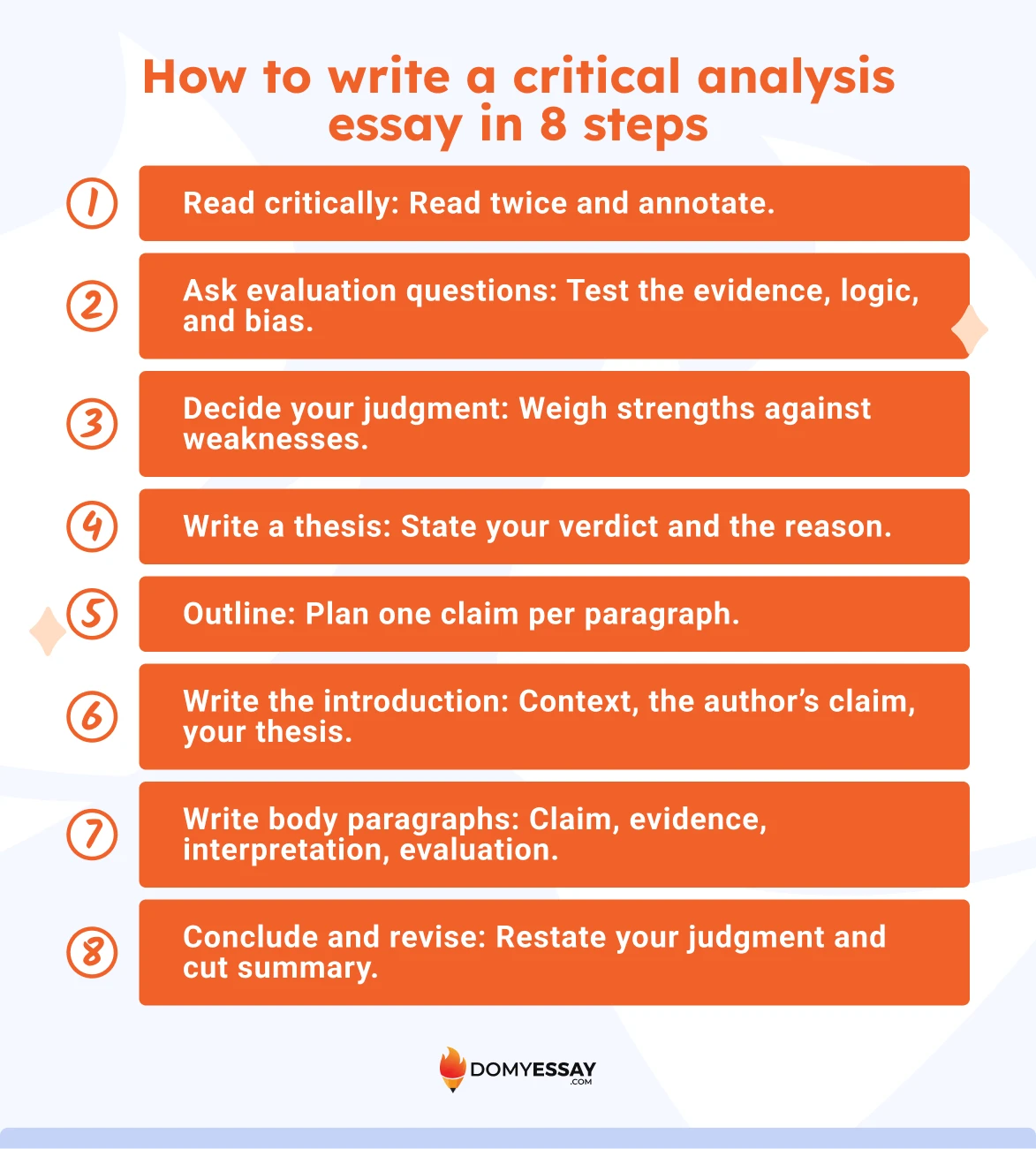
1. Read the text critically
Read it twice. Once skim through it and once with a pencil in hand. You should jot notes on the side of the page and find what the thesis, main idea, who it’s being written to and any supporting facts. If there are areas that you agree with or don’t note.
2. Ask evaluation questions
Ask yourself the following questions when evaluating the piece of work.
- Does the writer provide enough support for their argument?
- Are they logical?
- What are they assuming?
- Do they show any bias?
- Does the writer state any opposing arguments?
- How are Ethos Pathos Logos employed?
3. Decide on your overall judgment
Weigh strengths against weaknesses, and ask which matter more to the work’s purpose. One serious flaw in the core evidence can outweigh several small strengths, while a slip in a minor point may not. Put your verdict in one clear sentence.
4. Write an analytical thesis
A strong thesis gives your judgment and the reason for it.
5. Create an outline
Plan one claim per body paragraph using the critical analysis essay format above. Check that every point supports your thesis before you start drafting.
6. Write the introduction
Open with brief context: the work, the author, and the topic. State the author’s main claim in a sentence, then end with your thesis. Keep the summary short.
7. Write body paragraphs
Each paragraph needs a claim, evidence (quotes or paraphrases with citations), interpretation, and evaluation. Here is a short sample:
King’s strongest move is his test for unjust laws. He argues that a law is unjust when a majority forces it on a minority but does not follow it itself, and he reminds readers that Hitler’s actions in Germany were technically legal (King, 1963). This example shows that legality alone cannot decide what is right, which weakens the clergymen’s call to follow the law. The argument is hard to dismiss, though it depends on a moral standard that not every reader holds.
8. Write the conclusion and revise
Restate your judgment in fresh words and explain why it matters beyond this work. Then revise, checking for summary creeping in. If a sentence only says what the work says, add evaluation or cut it.
Creating an essay outline before you start writing makes it easier to organize your ideas and supporting evidence.
Useful phrases for critical analysis essay
Use these phrases to keep your evaluation clear and fair.
Critical analysis essay example
This example of critical analysis essay evaluates a short, well-known text: Abraham Lincoln’s Gettysburg Address (1863). Lincoln gave it in about two minutes at the dedication of the Soldiers’ National Cemetery in Gettysburg, Pennsylvania, after the featured speaker, Edward Everett, spoke for two hours. The speech argues that the dead are honored by finishing the work they died for. The sample below follows the outline above and uses MLA citations.
Sample essay
Short Words, Large Claim: Evaluating Lincoln’s Gettysburg Address
In November 1863, Abraham Lincoln spoke for about two minutes at the dedication of a cemetery for soldiers killed at Gettysburg. His main argument is that the dead are best honored by finishing the work they died for, which he describes as a nation “dedicated to the proposition that all men are created equal” (Lincoln). The address succeeds because it turns a cemetery dedication into a statement of national purpose through plain, tightly shaped language, but its silence about slavery, and about what “a new birth of freedom” would require, leaves its central promise open to interpretation.
Lincoln’s strongest move is to redefine what the war means. By opening with “four score and seven years ago,” he points back to the nation’s founding and ties it to the principle of equality, an idea that echoes the Declaration of Independence (Lincoln). He then calls the war a test of whether a nation “so conceived and so dedicated” can “long endure” (Lincoln). These choices turn a battle into a question about the nation’s founding idea, so the soldiers’ deaths serve a shared purpose. The reframing is effective because it gives mourners and the wider public one clear goal in a few sentences.
The speech’s form strengthens its argument. Lincoln admits the limits of words: “we can not dedicate—we can not consecrate—we can not hallow—this ground,” because the soldiers have consecrated it “far above our poor power to add or detract” (Lincoln). The repeated “we can not” builds rhythm, and the humility earns credibility. Brevity adds to the effect. Everett later wrote that he wished he had come as near “the central idea of the occasion” in two hours as Lincoln did in two minutes (“Gettysburg Address: Everett Copy”). That praise supports the point, though it comes from a fellow speaker, not a neutral observer.
The address is weaker on specifics. It never uses the word “slavery.” It defines the war’s goal through the proposition of equality and through “that cause for which they gave the last full measure of devotion” (Lincoln), but it does not say what equality would change. The “unfinished work” and the “new birth of freedom” are named, not explained, so readers must decide what they require and for whom. This vagueness may have helped Lincoln speak to a divided audience, yet it also means the speech promises more than it explains.
Weighing these points, the Gettysburg Address earns its place as a model of purposeful writing. Its framing and form do more in under three hundred words than a longer speech might, and its vagueness is a real limit, not a fatal flaw. The address matters because it shows how a short text can set a nation’s goals while leaving others to decide how to reach them. (about 470 words)
Works Cited
“Gettysburg Address: Everett Copy.” Abraham Lincoln Presidential Library and Museum, presidentlincoln.illinois.gov/exhibits/online-exhibits/gettysburg-address-everett-copy/. Accessed 18 Oct. 2026.
Lincoln, Abraham. “Address Delivered at the Dedication of the Cemetery at Gettysburg (Bliss Copy).” 19 Nov. 1863. The Collected Works of Abraham Lincoln, edited by Roy P. Basler, vol. 7, Rutgers UP, 1953.
Breakdown
Thesis: The thesis makes a judgment (“succeeds”) and a limit (“but its silence...”). That two-part shape lets the body paragraphs argue both a strength and a weakness.
Each body paragraph ends with an evaluation, and the conclusion weighs the strengths against the weakness.
A strong thesis statement gives your critical analysis a clear focus and guides the rest of your essay.
Mistakes to avoid when writing a critical analysis essay
There are 7 ways your essay can be bad. See if any of these are present in your paper.
- Summary. You are telling what happens in the piece. Make sure to analyze more than half of your word count.
- No clear thesis. Saying something along the lines of "This article was informative" is not a thesis. You need an opinion and why.
- Not enough evidence. Back up your claims with quotes from the text.
- Analysis is either all positive or all negative. Your analysis should have some positives and negatives.
- Too many points in one paragraph. Focus on one main point per paragraph.
- "I liked/didn't like this piece." This is an opinion, not an analysis. Tell us why you liked or didn't like the piece.
- No transition. Each paragraph should flow into the next.
Developing strong critical thinking skills will help you evaluate evidence, identify assumptions, and build persuasive arguments.
Master critical analysis
Get expert help writing clear, insightful analytical essays from start to finish.

How is a critical analysis essay graded?
Instructors often grade a critical analysis essay on seven criteria, though weights and wording vary.
Final thoughts
Writing a strong critical analysis essay means judging a work, not retelling it. Read closely, state a clear thesis, and support each point with evidence. Weigh strengths against weaknesses, and finish with an honest verdict. Make sure to revise until every sentence is analyzed.