There are many polyatomic ions to memorize in chemistry, and having them in one place can make learning easier. Below, students will find a polyatomic ions list, along with their names, formulas, and charges. We also provide quick study notes to help you learn the trends of these ions. Our polyatomic ions study guide PDF is available for download and is perfect for keeping in your notebook. It’s a great cheat sheet to study before tests, labs, and exams.
Stuck on a Chemistry Assignment?
Our chemistry experts can walk you through your homework step by step.

Polyatomic Ions List
This list of common polyatomic ions is the main quick-reference guide for studying, covering the ones you're most likely to be tested on. Use it to memorize names, formulas, and charges together, since you'll need all three for naming compounds and balancing equations. The notes column flags patterns and easy mix-ups.
Printable Polyatomic Ions PDF
If you want the list on paper, download the printable PDF of a list of polyatomic ions, a clean study sheet with the same core names, formulas, and charges from the table above. Print it, tape it inside your notebook, and quiz yourself with it until the ions stick.

If you're struggling to solve chemistry problems, simply request ‘do my chemistry homework’ from subject experts.
Polyatomic Ion Naming Patterns
You don't have to memorize every ion as a separate fact. Names follow patterns, and once you spot them, the list gets much shorter. The sections below cover the main ones: endings, oxygen counts, and added hydrogen.
Common Polyatomic Cations
Most polyatomic ions are negative, so cations are the exception. Ammonium (NH₄⁺) is the one you'll see most, and it acts like a metal ion in salts such as ammonium chloride. Mercury(I) is a trickier example. It is written Hg₂²⁺, because two mercury atoms are bonded together and share a 2+ charge. Don't split it into two separate Hg⁺ ions.
Polyatomic Ions Ending in -ide
The -ide ending usually denotes a single atom, as in chloride or oxide. A few ions keep that ending anyway. Hydroxide (OH⁻), cyanide (CN⁻), and azide (N₃⁻) are polyatomic ions examples to know, and each carries a 1− charge. So if you see -ide and the formula has more than one atom, treat it as one of these exceptions. Peroxide (O₂²⁻) fits here too.
Polyatomic Ions Ending in -ite and -ate
The -ate ion has one more oxygen than the matching -ite ion. Nitrite is NO₂⁻ , and nitrate is NO₃⁻. Sulfite is SO₃²⁻ and sulfate is SO₄²⁻. The charge stays the same within each pair.
Chlorine shows the full pattern. It runs hypochlorite, chlorite, chlorate, perchlorate, adding one oxygen each step. All four keep a 1− charge. Only the oxygen count changes: 1, 2, 3, then 4. Bromine and iodine follow the same series.
Polyatomic Ions with Hydrogen
Adding H⁺ to an ion changes its name and its charge. Each hydrogen added raises the charge by 1. Carbonate (CO₃²⁻) becomes hydrogen carbonate (HCO₃⁻), and sulfate (SO₄²⁻) becomes hydrogen sulfate (HSO₄⁻).
Phosphate shows it in steps. PO₄³⁻ turns into hydrogen phosphate (HPO₄²⁻), then dihydrogen phosphate (H₂PO₄⁻). You may also see older "bi-" names, such as bicarbonate and bisulfate. They mean the same thing.
How to Memorize Polyatomic Ions?
Memorizing polyatomic ions can be easier if you break them down into smaller groups instead of trying to learn a huge list of 30. Here are some tips that have helped many students.
- Learn by family: Learn all of your chlorines at once. Then learn your sulfurs, then nitrogens, etc. Similar polyatomic ions usually go hand in hand.
- Break them down by charge: Many polyatomic ions will be a 1- or 2-. So learn the few that have a 3- phosphate phosphite and arsenate. And learn your 2 positive ions.
- Compare them: Place sulfite and sulfate side by side. You should notice they have one more oxygen atom and therefore a change in charge.
- Flash cards: Have the name on one side and the formula/charge on the other. Then reverse the order and have you go from formula to name.
- Learn from memory: Take your list of polyatomic ions and try to write out all the formulas from memory. Then test yourself on the ones you missed.
Understanding polyatomic ions is also essential when writing a chemistry lab report and explaining chemical reactions accurately.
How to Use Polyatomic Ions in Chemical Formulas?
Remember, your compound should always have a neutral charge. You will adjust the amount of ions you have to get your positive and negative charges to balance out.
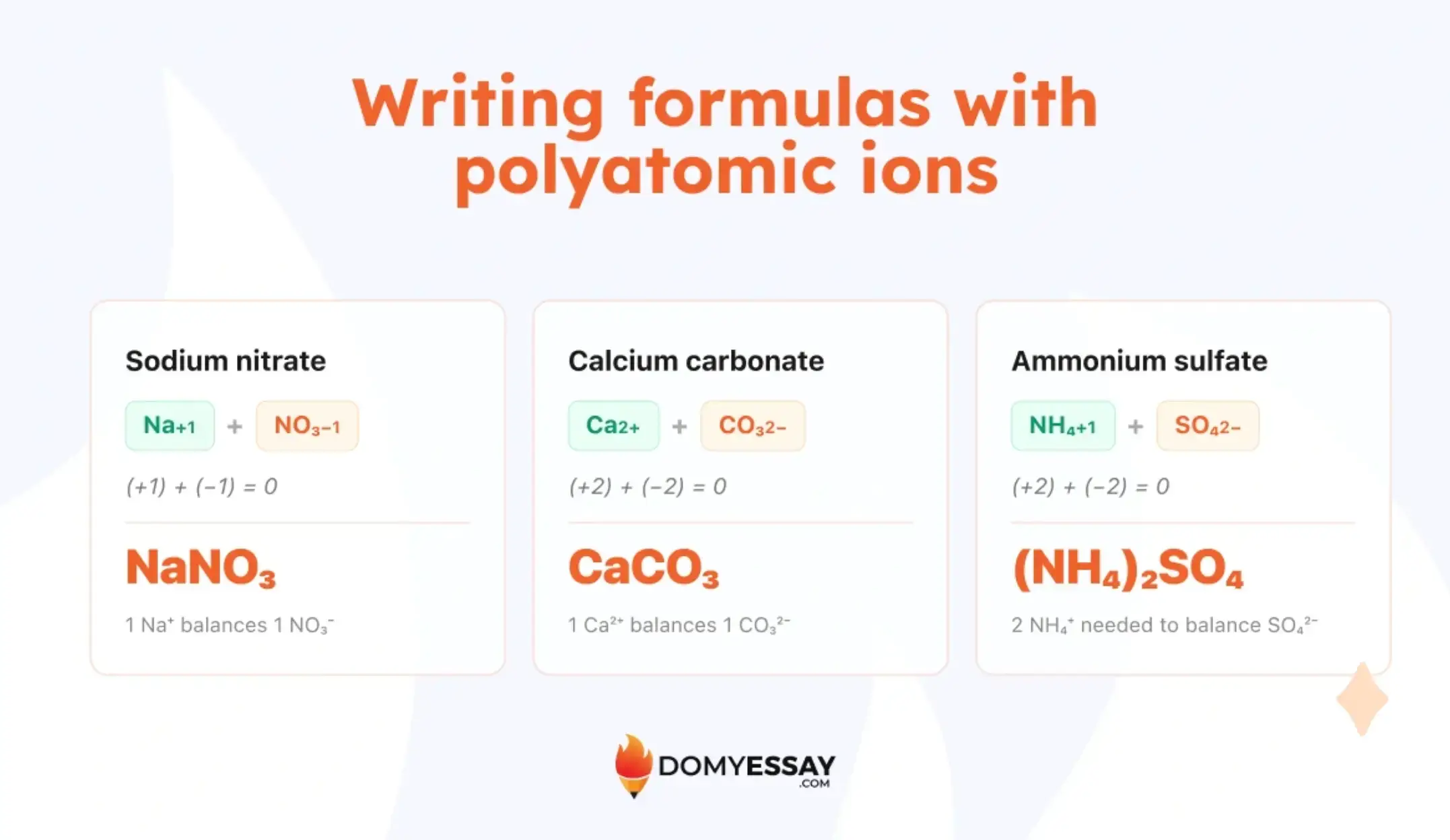
If there is only one of the polyatomic ions, do not use parentheses. If you have more than one, you will need parentheses around the polyatomic ion.
NaNO3 does not need parentheses, but Ca(NO3)2 does. This is because Na+ and NO3- have charges that balance each other. Ca2+ and NO3- need a 2 on the NO3 to balance their charges, so we put it in parentheses.
Here are some examples:
- Sodium nitrate: Na⁺ and NO₃⁻ balance one to one, giving NaNO₃.
- Calcium carbonate: Ca²⁺ and CO₃²⁻ balance one to one, giving CaCO₃.
- Ammonium sulfate: two NH₄⁺ (2+) balance one SO₄²⁻ (2−), giving (NH₄)₂SO₄.
Do NOT add numbers to your polyatomic ions to balance your charges. Adding a 2 to the end of your NO3 ion would give you NO2, which is a different ion. Only add numbers outside the parentheses if needed.
Need Help Before the Exam?
Get expert support with practice problems, lab reports, and study guides.

Polyatomic Ions Practice
Try these eight questions without looking at the list. They cover names, formulas, and polyatomic ions charges, so you'll need to keep all three in mind. Check your answers below.
- What are the formula and charge of sulfate?
- Name NO₂⁻.
- Write the formula for ammonium.
- Which has more oxygen, chlorite or chlorate?
- What is the charge of phosphate?
- Write the formula for calcium hydroxide.
- Write the formula for sodium carbonate.
- Name HCO₃⁻.
Answers:
- SO₄²⁻
- Nitrite
- NH₄⁺
- Chlorate (ClO₃⁻ has three oxygens, ClO₂⁻ has two)
- 3−
- Ca(OH)₂, since two hydroxide ions are needed
- Na₂CO₃, with no parentheses because carbonate is used only once
- Hydrogen carbonate (also called bicarbonate)
Final Thoughts
Once you know how to break them down, polyatomic ions will come more easily. Know your families and the amounts of oxygen that go with each. Then learn how to write formulas with them by balancing charges. You'll find this PDF super helpful for studying and locking them in. Finally, check your work with the full chart.

.webp)