

Most weak college essays fail for one of two reasons. The topic is so common that readers have seen it many times, or it makes the reader worry about the writer. Below are 25 college essay topics to avoid, from clichés such as the big game and the mission trip to the few subjects that can hurt an application. If you are not sure what not to write about in a college essay, start here. Then see which risky topics can still work, and how to give an overused one a better angle.
What topics should you avoid in a college essay?
College essay topics to avoid can fall into 3 categories: detrimental to your application, potentially dangerous, and very over-used. Obviously, you don't want to write about the first category. It may be possible to write about the second. And if you have an unusual perspective on the third, that could also be successful. You can use the following table as a guide.
Whichever tier your idea falls in, a small, real moment usually beats a big claim.
Stuck on a topic?
Share your ideas with our writers to help you find an angle that is specific and yours.

What are the most overused college essay topics?
The most overused college essay topics will involve some trial or adversity and end on a moral. By about the second paragraph, the reader will be able to predict the rest of the essay. Obviously, none of these situations are necessarily fabricated. However, all of them would be difficult to read because of their formulaic nature. So here are some suggestions on how to write about each:
- The big game or sports injury. The plot never changes: a high-stakes moment, a setback, a comeback. Write instead: a small, odd moment from practice or the bench that shows how you think, with no scoreboard needed.
- The mission trip. Short trips tend to end with the same lesson about gratitude, and the people who were helped turn into scenery. Write instead: one awkward moment where you got something wrong, and what you did about it.
- The achievement recap. A list of awards turns the essay into a second résumé, and your application already has one. Write instead: the work behind one achievement, such as the dull hour nobody saw.
- The travel epiphany. Seeing the world and finding that people are alike is an easy lesson to write without any detail. Write instead: one object, meal, or misunderstanding from the trip and what it showed about you.
- The grandparent or coach tribute. The essay ends up describing the other person, while the college wants to meet you. Write instead: a habit, phrase, or ritual you took from them, shown in how you act now.
- The big performance. The recital, the play, the final speech: the applause is the climax, and it reads like many others. Write instead: the rehearsal room, or the ten minutes before you walked on, in close detail.
- The tough grade. One bad grade rarely holds an essay, and it can sound like an excuse. Write instead: the habit you changed afterward, with proof. If the grade needs an explanation, use the additional information section.
- The immigration story told as a timeline. The story itself is valid and often strong. The problem is the format: a year-by-year march from arrival to success covers everything and shows little. Write instead: one scene, such as a first grocery trip or a phone call you translated, and what it meant.
- The volunteer trip. Hours of service followed by “it taught me to give back” reads like a requirement being met. Write instead: one person or problem you kept returning to, and why you did.
- The “I learned teamwork” essay. Teamwork is true for almost everyone, which is why the essay tells the reader nothing. Write instead: one disagreement inside a team, what you said, and what changed.
- The generic passion. “I have always loved science” gives no object, no scene, and no proof. Write instead: the exact question, tool, or project, so the reader can see you at work.
- The college flattery essay. Praising the school’s ranking or campus shows only that you read the website, and the readers already know their own school. Write instead: one specific thing at the college you would use, tied to something you already do.
What topics are risky but can work?
Many of these topics show up on lists of bad college essay topics, but that label is too blunt. Focused the right way, on how you responded and where things stand now, they can work well. The catch is that they need some hindsight. Admissions officers want to know you'll do well in their community, so an essay about a struggle you're still in the middle of won't tell them much, however moving it is. Keep the hard part short, and spend most of the essay on what you did about it and where you are today. If it's still ongoing, you don't have to write about it at all. Your counselor can mention it, or you can use the "Additional Information" section.
- Mental health. It works when the experience is in the past, you can show a way of coping, and the focus is on actions, not symptoms or labels. Avoid details that read like a case file.
- Family conflict. It works when you stay fair to the other people, name what you controlled, and avoid blame. Skip it if the essay becomes a complaint about a parent.
- Failure. It works when the failure is real, your role is clear, and most of the essay covers what you changed. A fake failure, such as “I work too hard,” does not count.
- Politics. It works when the essay is about your own experience and thinking, such as how you changed your mind, not about winning a debate. Treat people on the other side with respect.
- Religion. It works when faith shows up in your daily choices, doubts, or practices, not as a sermon. Show how it shapes you without asking the reader to agree.
- Privilege or wealth. It works when you show real self-awareness and a concrete action, such as noticing a gap and doing something about it. Avoid humble-bragging, or guilt with no next step.
What topics should you never write about?
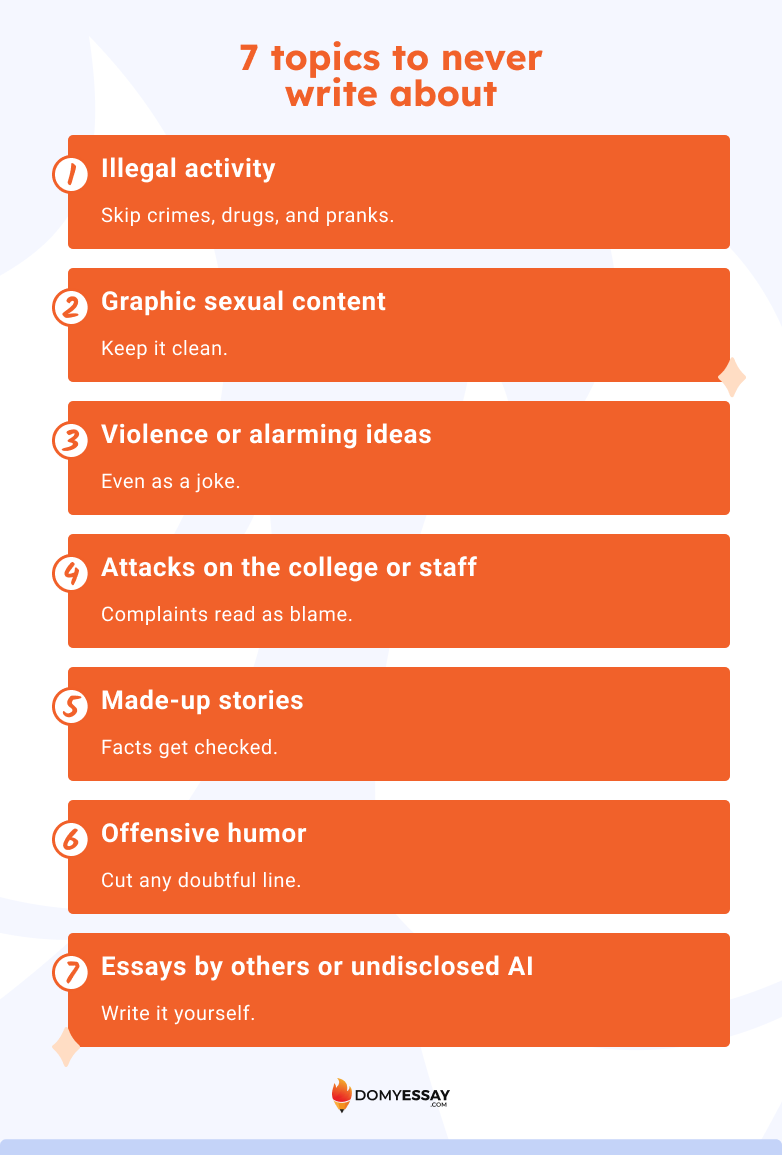
These are the topics to leave out of a college essay entirely, because they can raise a red flag no matter how well you write. If you are looking for what not to write about in a college essay, this is the short list.
- Illegal activity. Do not describe breaking the law, such as drug use, underage drinking, theft, or vandalism, especially with pride or jokes. The reader will focus on the act. If the application asks about a record, answer there, honestly and briefly.
- Graphic sexual content. Explicit detail has no place in an essay read by strangers who are judging your judgment. Even a mature subject, such as a relationship, can be written without graphic scenes. Keep the focus on what you learned.
- Violence or anything alarming. Detailed violence, threats, or dark fantasies about harming others or yourself can set off a safety concern, even as a joke. If something serious is going on, tell a counselor or someone you trust, not an admissions reader.
- Criticizing the college or its staff. Do not insult the college, its staff, or earlier teachers and coaches. A complaint sounds like blame and hints at how you might act on campus. If a school failed you, describe what you did, not who is at fault.
- Dishonest or fabricated accounts. Do not invent events, awards, or hardships. Colleges can compare details with your recommendations, activity list, and records, and a false essay can cost you an offer. A true, small story is safer and stronger.
- Offensive humor. Jokes that rely on stereotypes, insults, or shock can land badly with a reader you have never met. Humor works when you are the target and the tone is warm. If you doubt a line, cut it.
- An essay written by someone else or by AI without disclosure. Submitting work that is not yours can count as fraud, and applications usually ask you to confirm the essay is your own. Rules on AI tools differ by college, so read each policy and write the draft yourself.
Once your wording is clean, check the length and layout rules in our guide to college paper format.
Can you make a cliché college essay topic work?
Yes. A cliché topic works when you change the angle, not the subject. Narrow the time frame, move from hero to observer, and make the essay stand on its own without background. The two rewrites below show how.
Example 1: The mission trip
Example 2: The grandparent tribute
The general rule: an ordinary topic with a specific angle beats an impressive topic with a generic one. To see how writers handle ordinary subjects well, read a few outstanding college essays.
What words should you avoid in a college essay?
Avoid words that sound meaningful but show nothing. They stand in for the detail you should write, and they are among the most common college essay mistakes. Swap each one for an action, an object, or a moment.
Many of these phrases turn up in endings, so our guide on how to conclude a college essay is a good next step.
Need a fresh draft?
Our experts can write or rework your essay to avoid common mistakes.

Last words
The college essay topics to avoid fall into three groups: those that can harm an application, those that are risky, and those that are overused. Skip the first group, handle the second with distance and care, and give the third a narrow angle and a real scene. An ordinary topic with a specific angle beats an impressive one with a generic angle. If you would rather work with an expert on the draft, you can ask us to write my college essay for me.