.avif)
.webp)
Learning how to write a college application essay comes down to one focused story told in your own voice. Pick a prompt, brainstorm, draft freely, then revise and proofread until every sentence earns its place.
Quick steps:
- Read the prompts and requirements
- Brainstorm topics
- Choose one focused story
- Outline your essay
- Write a rough draft
- Revise for voice and clarity
- Edit and proofread
- Get feedback and submit
This guide covers what the essay is, how it differs from supplements, and each step for 2026–2027.
What is a college application essay?
A college application essay is your personal statement. Typically 650 words or less this is your opportunity to tell who you are as a person. Your grades and test scores can only tell so much about you. Your mindset and the unique contribution you'll make to the college community.
Build a strong essay
Get expert help with every part of your application essay.

Personal statement vs. supplemental essays
The Personal Statement is your main essay. It answers one of the 7 Common App prompts and is 250 to 650 words long. It is sent to every school you apply to through the Common App.
Supplemental essays are requested by specific schools. They have their own prompt(s) and word count. Most ask why you want to attend that school or what you would contribute. Your personal statement shows who you are. Supplementals show why you should attend that school. Some schools may not require supplemental essays, so check each school's requirements.
If you’re facing multiple application deadlines, simply request ‘write my college papers’ to strengthen your admissions materials.
How important is the college application essay in 2026?
While the essay is important, it will most likely not make or break your application. According to NACAC's most recent survey from the fall 2023 admissions cycle. 18.9% of colleges said that the essay was considered very important, and 37.3% said somewhat important. When compared to other aspects of your application, the essay ranks 5th out of 16 when looking at the percentage of colleges that consider it very important. With grades, courses and character ahead of it. Standardized test scores are only 4.9% of colleges saying they are very important, down from 46% in 2018. So the essay is one of the only opportunities you have to express who you are.
What do admissions officers look for?
Admissions officers look for a real person on the page: an authentic voice, honest reflection, and specific detail.
2026–27 Common App essay prompts
The Common App kept all seven prompts unchanged for 2026–2027. You answer one, in 250 to 650 words. Last cycle, Topic of your choice (28%) and Facing adversity (23%) led.
Tip: Choose the prompt that fits your story, not the one that sounds impressive. Start with the story you most want to tell, then see which prompt it answers. Prompt 7 stays open if none fits.
Demonstrating critical thinking in college essay responses helps admissions officers see how you analyze experiences and solve problems.
How to write a college application essay: 8 steps
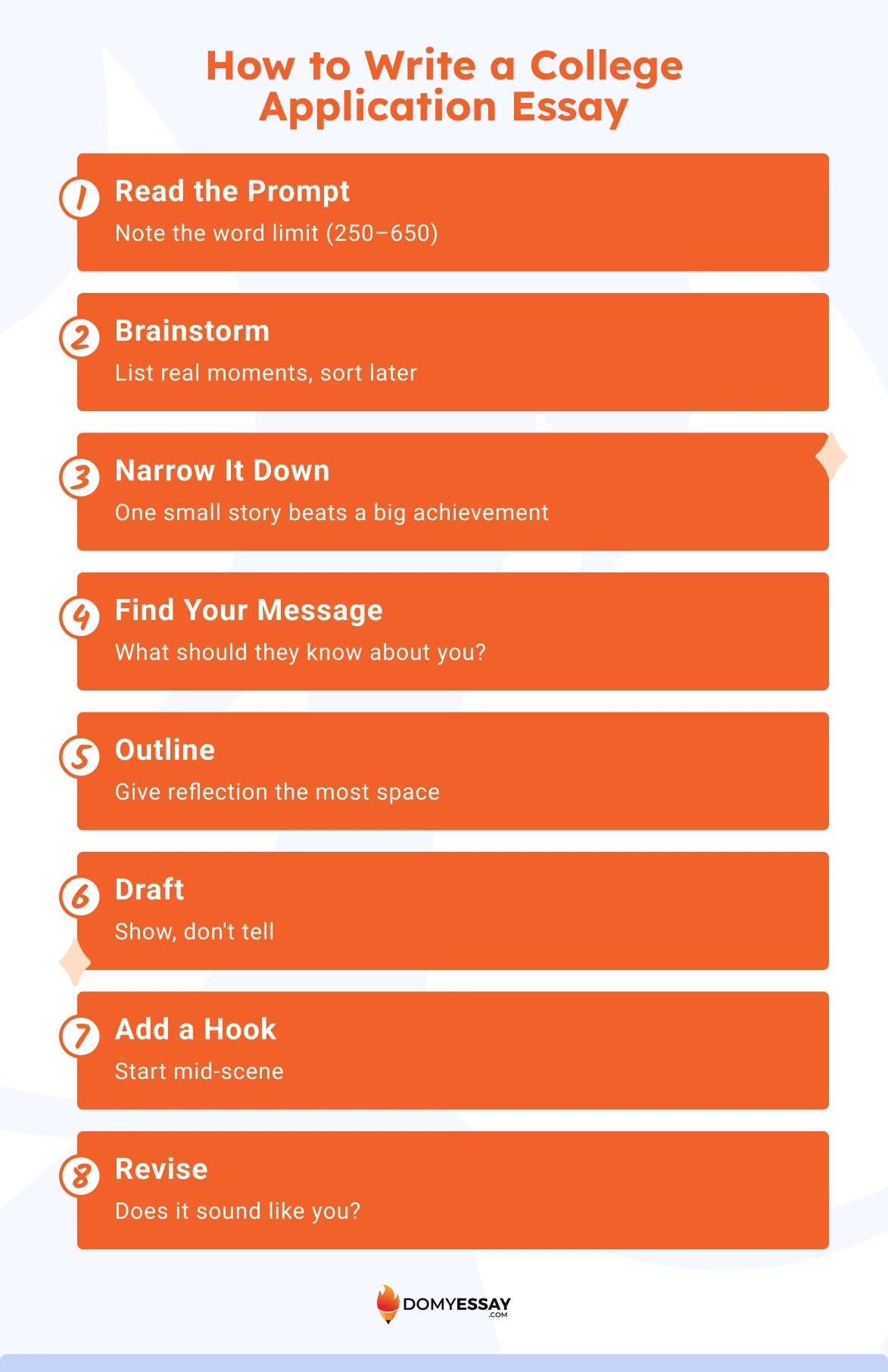
Writing a college application essay goes faster when you work in stages. Understand the prompt, brainstorm, pick one story, find your message, outline, draft, add a hook, then revise. Each step builds on the last.
Step 1: Understand the prompt
Make sure to read the prompt two times and underline what they want you to do. Whether its reflect on, tell a story about or something else. Keep in mind the word count. For the common app it's 250-650 words. They usually ask what did you learn from this experience so remember to write about why.
Step 2: Brainstorm your experiences
List real moments from your life before choosing a topic. Write fast and don't judge yet. Try these questions:
- What do you do when no one is grading you?
- When did you change your mind about something?
- What problem have you tried to fix, big or small?
- Who taught you something you didn't expect?
- What are you always doing, according to friends and family?
- Which moment would you retell if asked what changed you?
Although application essays are more personal, understanding college paper format can help you present your writing professionally.
Step 3: Choose a specific topic
Pick one small, concrete story, not a broad achievement. Specific moments show who you are.
Test your pick: could 100 other applicants write the same essay? If yes, go more specific.
Step 4: Define your central message
Decide the one thing you want the reader to know about you. Everything in the essay should support it.
Try the one-sentence test: finish this line. "After reading this, the reader will know that I ___." Example: "I learn by taking things apart, and I'm not afraid to fail while doing it." If you can't finish the sentence, you don't have a message yet. If a paragraph doesn't support it, cut it.
Reviewing successful college application essay examples can give you ideas for structure, storytelling, and tone.
Step 5: Outline your essay structure
A simple college application essay structure works for most prompts:
Hook → Context → Moment/Challenge → Action → Reflection → Forward-looking close
Here is a rough split for 650 words:
- Hook: about 50 words
- Context: about 75
- Moment/Challenge: about 125
- Action: about 125
- Reflection: about 175
- Forward-looking close: about 100
Reflection is longest because it carries the meaning.
Step 6: Write your first draft
Write quickly and don't edit as you go. A rough draft can run long, since you'll cut later. Show scenes instead of announcing feelings.
- Telling: "I was nervous before the audition." Showing: "My hands shook so hard the sheet music rattled on the stand."
- Telling: "My grandmother is generous." Showing: "She slipped a folded twenty into every guest's coat pocket on the way out."
- Telling: "I learned patience." Showing: "By the fifth failed solder joint, I stopped glaring at the board and started reading the diagram."
Step 7: Write a hook that grabs attention
Open with a small moment, not a summary. Starting a college application essay mid-scene pulls readers in fast. Try one of these:
- In-scene: "The oven timer was still beeping when I burned my third batch of the day."
- Surprising detail: "My family owns four rice cookers, and each one has a job."
- Dialogue: "'You can't fix that,' my brother said, handing me the screwdriver anyway."
- Question: "What do you do with a radio that has been silent since 1994?"
Pro tip: Write the intro last. Once you know where the essay lands, the best opening is easier to see.
Step 8: Revise and edit
Revise for meaning first, then polish sentences. Use this checklist:
Ask one or two trusted readers, such as a teacher or counselor, whether it sounds like you. Take their notes on clarity, but keep your own phrasing. If an edit makes you sound like someone else, undo it.
7 mistakes to avoid in your college application essay
Here are some pitfalls to avoid:
- A broad subject matter: Something as large as "Leadership" will leave your reader wanting more. Pick a small incident.
- Tell, don't show: Claiming you're determined means they have to take you at your word. Show what you did.
- Just listing achievements: This is already being done throughout your application. Focus on one accomplishment and explain it.
- No takeaway: Just telling a great story is not enough. Your reader will wonder why this story was told. Explain the lesson learned most clearly.
- Common story: Many people will talk about hitting a home run or going on a mission trip. You will be one of many if you choose this. Use it only if you can bring a unique perspective.
- Using words you wouldn't normally say: Go ahead and look up big words in the thesaurus, but don't overuse them. Read your essay out loud, and if it doesn't sound like you, rewrite it.
- Too much help from others/AI: Your essay will not sound like you if someone else rewrote it. Also, the Common App does not allow the use of AI. Get advice, but write your own.
Learning how to end a college essay will help you leave admissions officers with a memorable final impression.
Is it okay to use AI on your college application essay?
Not your essay. When it comes to college application essays, the expectation is that they are your personal work. Submitting "substantive content or output generated from an Artificial Intelligence Platform" as your own is categorized as cheating by the Common App’s fraud policy. Yale's policy, for instance, extends this to personal statements and any essay-style questions. Since policies differ, you'll need to check with each school to understand their stance.
Acceptable uses
Published policies will allow for some assistance. From Yale, they state using tools to check your grammar and giving general information or ideas at the beginning of your paper. Georgia Tech also states that it is okay to use AI to brainstorm ideas, but "your final product must be your work." These are considered good ways to use it.
- Come up with prompts/questions
- Check your grammar and spelling
- Ask questions about your essay (i.e., Do you think I have a good thesis?)
Risks
- Policy violations: Brown states that students should not use AI for their essays under any circumstances, except to check spelling/grammar. Caltech believes it is unethical to use an outline from AI. If you violate this, your offer can be rescinded.
- Generic voice: If your essay is generated by an AI, it will not help you get accepted. According to a UC admissions leader, "it's not going to teach us anything about you."
- Detection: UC states they check for plagiarism. They can disqualify you if they think you used AI to answer your prompts.
Tips for college application essays
Make sure you include these college application essays tips when writing your essay:
- Describe what something smells/feels/sounds like. By stating how something feels, you allow the reader to picture what you're describing. For example, the garage had a metallic stale odor.
- Show some personality. Whether your person is witty or sarcastic, show that.
- Pick one moment in time. Describe what happened during that time. Maybe only 5 minutes.
- Read it out loud. When you read it out loud, you will notice any awkward words or sentences that you may have missed when just reading it.
- Take some time off from it. At least a day. Then re-read your work.
Apply with confidence
Work with professionals to polish your college application essay.

College application essay timeline: when to start
Final thoughts
The best approach is to start your essay well in advance and select a subject that resonates with your personal experience. After you've chosen your prompt, just start writing and see where it takes you. Let AI or others assist with your edits, but don't lean too heavily on them. Your essay should allow others to get to know who you are as a person.
.webp)