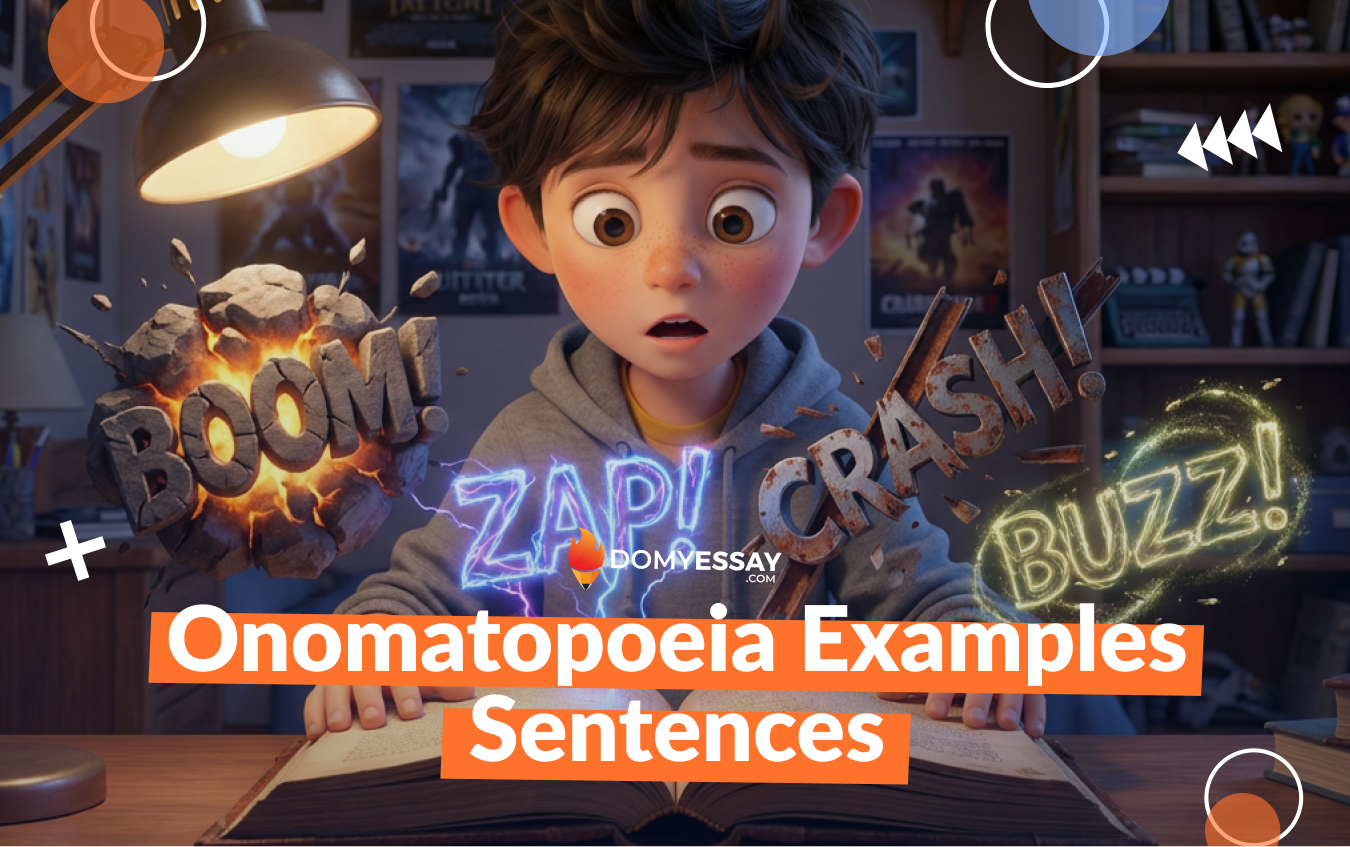
Pow! Bam! Kaboom! Recognize these from comic book pages? You might call them “sound words,” but there’s a special term for them: onomatopoeia. It refers to a particular type of word that imitates the sound it signifies.
Despite its admittedly complex name, onomatopoeia is part of your everyday life. You use it every time you describe a cat’s meow or a lion’s roar. What’s more, onomatopoeia was likely the origin for many common verbs like “beep” and “hiccup”!
Not sure how you should use onomatopoeia in your writing? DoMyEssay’s experts have brought together 100+ onomatopoeia examples sentences, from animal noises to action-driven onomatopoeic words.
Need a hand making sense of onomatopoeia? Our experts are just one short form away!
Onomatopoeia: A Fancy Term for an Everyday Occurrence
Rooted in Ancient Greek, onomatopoeia refers to a specific type of word: one that resembles the sound that it signifies. Think “meow,” “boom,” “bang,” or “kablam!” The definition of onomatopoeia can also extend to the process of creating such a word.
Note: The words themselves are called onomatopoeic or onomatopoetic. You can also refer to them as imitative or echoic.
Onomatopoeias are language-specific. For example, you might call the rooster’s crowing “cock-a-doodle-do,” but French speakers will use “cocorico” instead. Or, to describe rain, you’ll use “pitter-patter,” while a French speaker will say, “plic ploc.”
On an intuitive level, you might group onomatopoeias into two categories. Some onomatopoeic words obviously imitate the sound and don’t serve as a part of speech (“kaboom!” or “pow!”). In this case, it’s obvious that you’re dealing with an onomatopoeia.
But some common verbs and nouns originated as onomatopoeias, and you might not recognize them as such immediately because you’re used to them. For example: “the buzz of electricity,” “the crunch of the snow,” “the crash of the impact.”
Can’t Make Heads or Tails of Literary Devices?
Our experts can catch them all to write a deep literary analysis or spice up your own writing with onomatopoeia, metaphors, and more.

Why Care About Onomatopoeia?
You might know onomatopoeia as that one impossible-to-spell-right term your English or literature teacher keeps bringing up in class. But onomatopoeia isn’t some obscure literary device you’ll get tested on once and will never come across again.
In fact, onomatopoeia enriches your writing by:
- Enhancing the sensory experience
- Evoking emotion and creating an atmosphere
- Improving the flow and rhythm
That’s why your teacher will be over the moon if they see you use onomatopoeia in essays and creative assignments (not just by accident, but with purpose!). Plus, spoiler alert: you might get better grades if you incorporate onomatopoeia in your writing, too.
Check out our creative writing examples to see how onomatopoeia fits into creative assignments!
105 Onomatopoeia Examples for Your Inspiration
Considering just how diverse onomatopoeic words (and their applications) can be, we’ve decided to gather examples in seven categories. Keep scrolling to enter the world of onomatopoeia with our 105 onomatopoeia examples in a sentence.
15 Examples of Onomatopoeia in Poetry
Onomatopoeic words evoke the sound in the reader’s imagination instantaneously, which makes them a favorite among poets:
- The bees went buzzing through the golden noon.
- Rain began to pitter-patter on the tin roof.
- The door swung shut with a heavy bang.
- The bacon sizzled — sizzle, sizzle — in the pan.
- Leaves rustled in the whispering wind.
- The thunder roared boom across the hills.
- The clock ticked tick-tock in the silent room.
- Fireworks burst with a bright pop in the night.
- The stream moved softly with a gentle gurgle.
- The snake slid by with a quiet hiss.
- The shoes made a muddy squelch in the rain.
- The cat’s collar gave a tiny jingle.
- The logs in the fireplace began to crackle.
- The whip cut the air with a sharp snap.
- The bird’s wings fluttered at dawn.
Figures of speech like personification examples pair well with onomatopoeia to create vivid writing.
15 Examples of Onomatopoeia in Literature
For the same reason, you’ll come across plenty of onomatopoeic words in literary works of all kinds. For example:
- The gun fired with a sudden bang that shattered the silence.
- Raindrops hit the metal awning with a steady tat-tat-tat.
- The roller coaster climbed slowly with a rattling clink-clank.
- The logs in the hearth began to crackle as flames danced higher.
- The old wooden door slammed shut with a hollow thud.
- The bacon began to sizzle in the iron skillet.
- The wind howled whoosh through the narrow canyon.
- The cat leapt lightly onto the floor with a soft plop.
- The thunder rolled across the sky with a deep rumble.
- The ice on the pond gave a sudden crunch beneath his boots.
- Arrows flew overhead with a sharp zing through the air.
- The storm battered the shutters with a violent slam-bam.
- The spilled soda began to fizz across the counter.
- Plates fell from the shelf in a metallic clang.
- The old engine coughed to life with a rough vroom.
15 Examples of Animal Sounds
Animal sounds were among the first onomatopoeic words humans came up with. Here are some of them:
- Woof! The dog barked loudly at the mail carrier.
- Meow! The cat called from the windowsill.
- Moo! Cows echoed across the pasture.
- Oink! The pig grunted happily in the mud.
- Neigh! The horse whinnied at dawn.
- Cluck! The hen fussed over her chicks.
- Quack! Ducks splashed in the pond.
- Roar! The lion’s voice thundered through the savanna.
- Hiss! The snake warned intruders to stay back.
- Hoot! The owl called through the night.
- Bleat! The lamb cried for its mother.
- Croak! The frog sounded from the marsh.
- Caw! The crow perched high in the tree.
- Chitter! The squirrel scolded from a branch.
- Bray! The donkey let out a harsh cry.
15 Examples of Nature Sounds
Onomatopoeic words can also imitate the sounds of nature, be it wind, water, or fire. For example:
- Rain fell in a soft pitter-patter on the rooftop.
- Water echoed drip-drop from the leaves.
- Heavy drops splattered against the pavement.
- A sudden whoosh rushed through the trees.
- The wind began to whistle through the cracks.
- The pines gave a low sough in the evening air.
- Thunder rolled with a mighty boom.
- Lightning split the sky with a sharp crack.
- A distant rumble warned of the coming storm.
- The campfire began to crackle and glow.
- Sparks leapt with a sudden pop.
- Flames rose high with a fiery fwoosh.
- The stream moved in a gentle gurgle.
- Waves hit the rocks with a loud splash.
- The tide came in with a soft lapping at the shore.
15 Examples of Everyday Onomatopoeia
You can use onomatopoeia to describe everyday sounds, from the sounds your keyboard makes when you’re typing to the noise of a busy street:
- The phone echoed ring-ring across the room.
- Her cell gave a quick buzz in her pocket.
- A message arrived with a cheerful ping.
- The old door opened with a long creak.
- He left in a rush, the door going slam!
- The lock turned with a soft click.
- The clock whispered tick-tock in the silence.
- The hour rang out with a clear chime.
- The digital clock gave a sharp beep-beep.
- Fingers moved quickly with a steady tap-tap.
- The keyboard answered each thought with a clack.
- The old typewriter sang clickety-clack.
- Heavy boots hit the floor with a dull thud.
- Small feet ran down the hall in a light patter.
- Tired steps moved forward with a soft shuffle.
15 Examples of Action-Driven Onomatopoeia
Onomatopoeia makes action more dramatic with just a single word. Here’s how you can use it to illustrate movement:
- The cape moved with a dramatic swish.
- He landed on the ground with a heavy thud.
- The boxes fell with a loud crash.
- The rope broke with a sharp snap.
- The ball flew past with a fast whoosh.
- Dishes fell to the floor in a noisy clatter.
- The book hit the table with a firm smack.
- The stone dropped into the pond with a small plop.
- The bat struck the ball with a solid whack.
- The runner sped by with a quick swoosh.
- The chair moved back with a harsh scrape.
- The gate swung open with a loud bang.
- The jacket closed with a quick zip.
- The cart rolled over stones with a shaky rattle.
- The car stopped suddenly with a sharp skid.
15 Fun Onomatopoeia Examples
Finally, onomatopoeic words can add a sense of whimsy or humor to your writing. For example:
- Boing! A character jumps high into the air.
- Zap! A laser fires suddenly.
- Pow! A superhero lands a punch.
- Bam! Something hits with dramatic force.
- Kaboom! A huge explosion shakes the scene.
- Wham! A surprise collision happens.
- Zonk! Someone gets bonked on the head.
- Splat! A pie lands right on someone’s face.
- Bonk! A light but funny bump on the head.
- Kerplunk! Someone falls into the water.
- Boop! A playful press of a button or nose.
- Zoink! A startled reaction in a cartoon chase.
- Fizz! Soda bubbles over the rim.
- Pop! A balloon bursts unexpectedly.
- Gulp! A loud swallow in a nervous moment.
Onomatopoeia vs Other Figurative Language: Quick Explainer
Onomatopoeia is easy to spot, but some students might struggle to draw the distinction between it and other sound-related literary devices. So, let’s compare them:
How to Use Onomatopoeia Like a Pro
As a descriptive essay writing service, we’ve had our fair share of experience with onomatopoeias. Here’s our experts’ advice for using these sound-imitating words:
- Add them sparingly. Too many onomatopoeic words can mess with the flow or overwhelm your reader.
- Place them strategically. Starting with onomatopoeia will grab the attention, while ending with it will leave a lasting impression. For example: “Boom! The car went up in flames.” vs “The key fit perfectly. Click.”
- Strike the right tone. Make sure your choice of onomatopoeias matches your genre, tone, and audience. For example, a thriller might call for sharper words like “crackle.”
- Remember to show, not tell. Onomatopoeias enhance the “showing” through sensory details. But sound is only one of the senses, and showing involves narrative devices as much as sensory details.
Steer Clear of These 4 Common Mistakes
Onomatopoeic words can be a powerful tool; they practically make your reader hear the sound you want them to imagine. But it’s not impossible to use them incorrectly. In fact, it can be ridiculously easy.
So, avoid:
- Stuffing the text with onomatopoeias. Onomatopoeic words often create one-word sentences and interjections. Too many of them can cause pacing issues.
- Choosing the wrong tense. If you intend to use onomatopoeia as a verb, conjugate it as usual.
- Confusing the sounds. No, “thump” and “thud” aren’t referring to the same sound. So, take your pick carefully.
- Making up your own onomatopoeias. Yes, they can be quite effective sometimes. But in most cases, stick to the usuals to avoid confusing the reader.
Creative Writing Isn’t Your Cup of Tea?
We can show you how it’s done or simply take care of an urgent descriptive essay while you’re dealing with the rest of your to-do list.

In Closing
Onomatopoeia may be one of those intimidating words that make you sweat the moment you come across them on a test, but it describes a simple idea. You already use onomatopoeia in your daily life, we guarantee it — you just don’t know it.
These echoic words are a powerful tool that helps you evoke specific sounds in your reader’s mind, grab their attention, and add rhythm to your writing’s flow. So, go ahead and experiment with onomatopoeia. Just remember to use it sparingly and place it strategically!
Struggle with using evocative language in your descriptive essay? DoMyEssay’s write my essay experts can refine your draft or craft a new one from scratch; just say the word!
- What is Onomatopoeia? || Definition and Examples. (2024, September 18). College of Liberal Arts. https://liberalarts.oregonstate.edu/wlf/what-onomatopoeia
- 00.05.11: Basic Reading of Sound Words-Onomatopoeia. (n.d.). Yale-New Haven Teachers Institute. https://teachersinstitute.yale.edu/curriculum/units/2000/5/00.05.11/2
- Onomatopoeia & character development. (n.d.). UI Stanley Museum of Art Resources for Teachers. https://stanleymuseum.uiowa.edu/sites/stanleymuseum.uiowa.edu/files/2022-04/Graphic_Novels_ONOMATOPOEIA_FINAL.pdf
- Imai, M., & Akita, K. (2024). Sound symbolism. In MIT Press eBooks. https://doi.org/10.21428/e2759450.4ea61aa9
.webp)