Key Takeaways
- Students applying to 8-12 schools typically write 15-30 supplemental essays
- Supplemental word limits usually range from 100 to 650 words, with most capping around 250
- Budget roughly 2-4 hours per supplemental prompt
- Nearly 8 million Common App applications were submitted for the 2025-2026 cycle
Applying to 8-12 schools can require you to write upwards of 15-30 individual supplemental essays in addition to your personal statement. With each school having different word limits, prompts, and expectations, it’s easy to burn out. Burnout happens when you cut and paste an answer that doesn’t fit the question, braindead at 250 words, or simply don’t understand what a “Why This College” prompt is measuring.
In this article, we go over what admission officers are looking for, common pitfalls to avoid, and supplemental essay tips for writing compelling papers that can apply to dozens of prompts without sounding like a robot.
What is a supplemental essay
A supplemental essay is a short school-specific essay that some colleges ask you to write on top of your primary personal statement. It’s important to understand the difference (it’s subtler than it sounds): your personal statement is the essay you send to every college on your list, unchanged. The 650-word story you write and submit through the Common App as part of each of your applications. A supplemental essay is anything but. It’s designed for one school, answering one school’s unique prompt, and should not be repurposed for your other applications without significant revision.
Reasons colleges want supplemental essays: Your personal statement is your personal statement. Even if it’s awesome, it can only tell colleges so much about you. Supplemental essays allow admissions officers to ask more targeted questions. How well do you really know our school? Can you talk about our programs, culture, or opportunities without sounding like a brochure? How do you approach smaller questions, like your intended major or a defining experience? How would you contribute to our campus community? While your personal statement demonstrates who you are, your supplemental essays show that you belong at that school.
Strengthen Your College Application
Get expert help writing compelling supplemental essays that highlight your strengths.

How many supplemental essays do colleges require
The question of how many supplemental essays you should write depends on which schools you are applying to, but if you have a typical college list of 8-12 schools, plan to write between 15 and 30 supplemental essays throughout the application process, in addition to your Common App personal statement. Supplementals vary widely by school. Some public universities and other non-selective colleges require no supplemental essays whatsoever beyond your personal statement, transcript, and activities list.
Highly selective private colleges, on the other extreme, often ask 2-5 distinct supplemental questions per college app. On their own, supplemental essay prompts from just one school can require over 1,000 words of writing beyond the Common App essay. Current App season trivia: this list of colleges that require supplements changes year to year. Schools that have required supplemental questions in past years have been known to cancel them temporarily or altogether, just as schools that did not previously require them have added them. Don’t rely on hearsay from past applicants – double-check each school’s supplemental requirements directly on their admissions page before you start your calendar.
A strong college essay conclusion leaves admissions officers with a memorable final impression and reinforces your main message.
How long should a supplemental essay be
Supplemental essay word count ranges between 50 and 500 words. Yes, that’s a broad range. But again, it depends on the college’s prompt.
- Short answers (50-150 words): These word counts are reserved for short, direct questions. Your favorite activities. A book that influenced you. A short answer about your impact on your community. These aren’t essays where you can construct a beginning, middle, and end. You can (and should) answer the question with a single specific response.
- Mid-length (200-350 words): You’ll find this to be the most common word count for supplemental prompts. You’ll see this a lot for “Why Us” or “Why This Major” prompts. This gives you enough words to get specific with programs, courses and opportunities, but doesn’t let you ramble on.
- Longer supplements (400-650 words): These supplements will usually be required by specific universities (Cornell, UPenn, to name a few) or by longer, more involved prompts. These prompts are typically more academic and research-based, allowing you to tell your story and really dive deep. These can really be crafted as a personal statement rather than a quick answer.
No matter the word count, aim to write between 85% and 90% of the required length. Coming in significantly under shows you didn’t have much to say about that school.
Reviewing successful USC supplemental essays can help you understand how to answer school-specific prompts effectively.
Supplemental essay tips by prompt type
Different prompts test different things, and supplemental essay tips only work when they're matched to the actual archetype in front of you. A strong "why this college essay" and a strong short answer look nothing alike, because they're answering completely different questions. Here's how to approach each type.
"Why this college" essays
What it's really testing: Whether you've done genuine research into this specific school, or you're submitting a generic essay that could apply anywhere.
What readers look for:
- Named specifics, professors, courses, research centers, traditions, not vague praise like "great community"
- A clear link between those specifics and something already in your record, an interest, project, or experience
- Evidence you understand what makes this school different from its peers
Most common failure: Writing an essay that could be submitted to five other schools with just the name swapped out.
Tactic: Name at least two specific, verifiable details, a class, a professor's research, a program, and connect each one directly to something you've already done, not just something you hope to do.
"Why this major" essays
What it's really testing: Whether your interest in this field has a real trajectory, not just enthusiasm you discovered last month.
What readers look for:
- A progression: a specific moment, class, or project that sparked the interest, and what you did next
- Concrete evidence, coursework, research, competitions, self-directed projects
- A forward-looking connection to what you want to study and why at this school specifically
Most common failure: Describing passion for a subject without showing any evidence of pursuing it.
Tactic: Structure the essay around a timeline, what started the interest, what you did to develop it, and what you want to do next, so the reader sees momentum, not just a feeling.
Community and contribution prompts
What it's really testing: Whether your proposed contribution is credible, based on things you've actually done, or just aspirational.
What readers look for:
- A specific contribution tied to real prior behavior, not a hypothetical
- Concrete evidence: a club you led, a project you started, a skill you've already practiced
- Alignment between what you're offering and what that specific campus community actually needs or values
Most common failure: Promising to "bring diversity of thought" or "get involved" without any track record backing it up.
Tactic: Pick one specific thing you've already done that predicts what you'd do on campus, then describe that pattern rather than making a vague future promise.
Identity and background prompts
What it's really testing: Whether you can analyze how an experience shaped you, not just describe what happened.
What readers look for:
- Genuine reflection and insight, not just a retelling of circumstances
- Evidence of how the experience changed your thinking, values, or actions
- A connection between that reflection and who you are now, not just what happened to you
Most common failure: Spending 80% of the essay describing the circumstance and only a sentence or two on what it actually taught you.
Tactic: Write the description in a few sentences, then spend the majority of the essay on analysis, what changed in how you think or act because of it.
Extracurricular and activity prompts
What it's really testing: What you actually did and cared about, in a way the activities list can't capture through bullet points and hour counts.
What readers look for:
- A specific moment or detail, not a summary of the entire activity
- Genuine voice and personality, since this prompt often shows more of "you" than others
- Something the activities list itself undersells or leaves out entirely
Most common failure: Restating what's already visible in the activities list without adding anything new.
Tactic: Choose the activity where the real story lives in a detail the list can't show, a specific decision, a mistake, a small moment, rather than your most "impressive" listed activity.
Short answers under 150 words
What it's really testing: Whether you can communicate clearly and specifically without wasting space on setup.
What readers look for:
- One clear idea, fully developed in miniature, not multiple ideas competing for space
- A specific, concrete detail rather than a broad statement
- No wasted words on introductions or repeating the question
Most common failure: Trying to cram in a full narrative arc that needed 300 words into 100, resulting in something rushed and shallow.
Tactic: Open with the specific detail itself, skip any throat-clearing sentence, and let the one idea fill the whole space.
Optional essays and "additional information"
What it's really testing: Whether you have context genuinely worth adding, or you're just trying to fit in one more thing.
What readers look for:
- Relevant context: an explanation for a grade dip, a disrupted semester, unusual circumstances
- Concise, factual framing rather than an emotional appeal or another personal statement
- A clear reason the information couldn't fit anywhere else in the application
Most common failure: Using it as a second personal statement or forcing in extra achievements that don't need explaining.
Tactic: Only use this section if there's a genuine gap or circumstance the rest of your application doesn't already explain, if nothing needs clarifying, leave it blank rather than padding it.
You can also learn from MIT supplemental essays to see how top applicants respond to unique admissions questions.
Before and after: a weak vs. strong "Why This College" paragraph
Below are three before/after supplemental essay examples using a fictional composite applicant, "Maya," applying to Northwestern University. All program and course details referenced are genuine and verified on Northwestern's Segal Design Institute site.
1. Generic praise → specific academic connection
Before: "Northwestern's engineering program is exactly what I'm looking for. The school has a great reputation, talented faculty, and a strong sense of community. I know I would thrive there and make the most of everything it has to offer."
After: "Northwestern's Segal Design Certificate, open to undergraduates in any major, would let me formally pursue human-centered design alongside my engineering coursework, something I've been doing informally since building an accessibility-focused app my sophomore year."
What changed: The generic praise ("great reputation," "strong community") was replaced with a named, verifiable program tied directly to something Maya has already done.
2. Course-name listing → explained relevance
Before: "I'm especially interested in taking DSGN 305-0 Human-Centered Service Design, along with other courses in the Segal Design Institute's curriculum, since design is something I've always found interesting."
After: "DSGN 305-0 Human-Centered Service Design would push me to apply service-design thinking beyond the product-focused projects I've done so far, especially its emphasis on designing for connectedness and belonging, concepts I only encountered surface-level while building that accessibility app."
What changed: Simply naming the course was replaced with a specific explanation of why that course's actual content connects to Maya's existing experience.
3. Abstract passion → evidenced progression
Before: "I've always been passionate about design and how it can improve people's lives. This passion has only grown stronger over time, and I can't wait to explore it further at Northwestern."
After: "That first accessibility app taught me I liked solving problems more than writing code, which is why I spent last summer redesigning my school's club sign-up process after hearing repeated complaints from underclassmen, a much smaller fix, but the first time I treated a frustration as a design problem rather than just an annoyance."
What changed: A vague, unfalsifiable claim of passion was replaced with a concrete timeline showing what sparked the interest and what Maya did next.
Every supplemental response should complement your main college essay without repeating the same ideas.
How to research a school before writing your "Why This College" essay
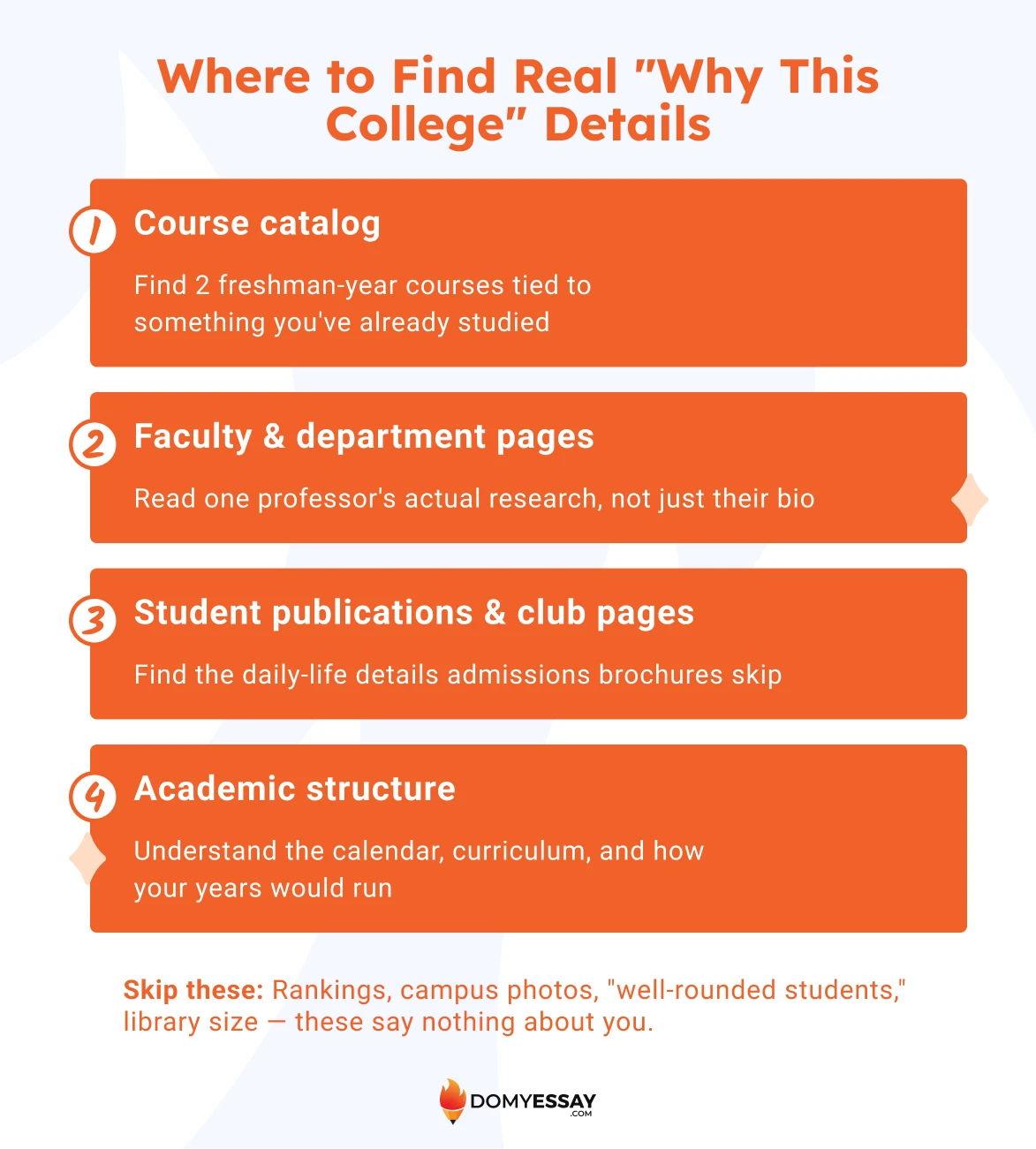
For a strong why this college essay, actual details require actual research, not a five-minute scroll of the admissions website. Spend your time on research like this.
- Course catalog: Scan the entire catalog (not just your intended major), highlight two courses you will be able to take in your freshman year that relate to something you have already studied, and understand how each course is different from a similar course at another institution.
- Departmental page/research: Read the abstract of one of a professor's recent studies or a lab website, then explain (in your own words) what problem the research is trying to tackle. Simply mentioning a professor you want to study under without any knowledge of their work will sound like you cut and pasted their bio from Google.
- Student-run publications and club pages: A school's independent newspaper, a club's meeting recap, or a subreddit thread often reveals more honest daily-life detail than any admissions brochure, look for what students complain about or celebrate, not just what exists.
- Academic structure: Learn how the school actually organizes learning, block scheduling, a mandatory gap-year program, an open curriculum with no required courses, since this shapes what your four years would genuinely look like.
- Things not to mention: US News ranking, pictures of the campus, “well-rounded students”, and the library size. Essays like these can be found in every applicant's Common App and say nothing about you as an individual.
Should you use AI to write supplemental essays
Not really, at least not for the supplemental essays themselves. The Common Application Fraud Policy includes “the substantive content or output of an artificial intelligence platform, technology, or algorithm” under the definition of application fraud; this clause was added in August 2023 and will remain in effect for the 2025-26 and 2026-27 application cycles. When you submit your Common App, you are certifying that each part of your application is “your own work, factually true, and honestly presented.” Some colleges, like Brown, have gone so far as to ban AI use outright; others require only an additional AI-specific statement along with the Common App’s baseline certification.
And if that policy risk wasn’t reason enough to avoid AI-written supplements, here’s another: admissions officers read thousands of essays per year and are trained to spot AI’s telltale patterns like homogenous word choice, vague sentence construction, artificially balanced conclusions, and prose that could describe any number of applicants. That’s the opposite of what your supplemental essay should accomplish. They’re designed specifically to show that you have something unique to say, not provide a polished but ultimately meaningless version of every other college applicant’s story.
That being said, AI can play a limited role. For example, it can help you brainstorm different angles on a particular prompt and double-check that your draft actually responds to the question. But that’s about where the helpfulness stops. AI isn’t useful for writing your actual prose; the sentences you submit need to be yours alone.
College policies on AI will vary from school to school and year to year, so double-check both the Common App’s Fraud Policy and your target schools’ admissions FAQs before you start drafting, rather than assuming every school will follow the same rules as its peers.
Students seeking professional guidance can choose to pay for college essays to improve their applications before submission.
Common supplemental essay mistakes
Here are a few supplemental essay tips and mistakes to avoid:
- Talking about the school, not the fit: Detailing your entire essay about the school instead of discussing why those details apply to you and your experiences/goals.
- Arguing without proof: Claiming you’ll “love to learn” or “help the department” without tying those assertions to concrete actions you’ve taken or will take.
- Answering multiple "why us" questions with the same story: Utilizing the same story to answer every school’s “why us” essay prompt will cause each application to fall flat, even if the prose is excellent.
- Neglecting the second part of a two-part question: Completing only what you find interesting in a two-part prompt and crossing your fingers that no one will notice. Including without explaining: Listing off classes, extracurriculars and professors without explaining why each one specifically drew you to the school.
- Exceeding or drastically undershooting the word count: Developing more to say than a stringent word limit allows or providing applicants with scant content to read.
- Copy and pasting your Common App essay's subject: Telling the admissions committee the same story you tell on your Common App personal statement deprives them of valuable insight into who you are.
- Forgetting to remove another school's name: Mentioning another university that you're also applying to (by accidentally using a previous essay draft meant for that school) is one of the quickest ways to decrease your admissions chances.
Make Every Essay Count
Work with experienced admissions writers to create standout college application essays.

Final Thoughts
Wordy doesn't mean better. Research your schools, answer the question asked and use the supplemental essay to showcase what can't elsewhere in your application. That's Rule #1. The biggest thing you can do to improve your supplemental essays is start early. You have 15-30 of them to write so don't slack on any one. Treat each essay as its own project rather than something you can cram the night before.