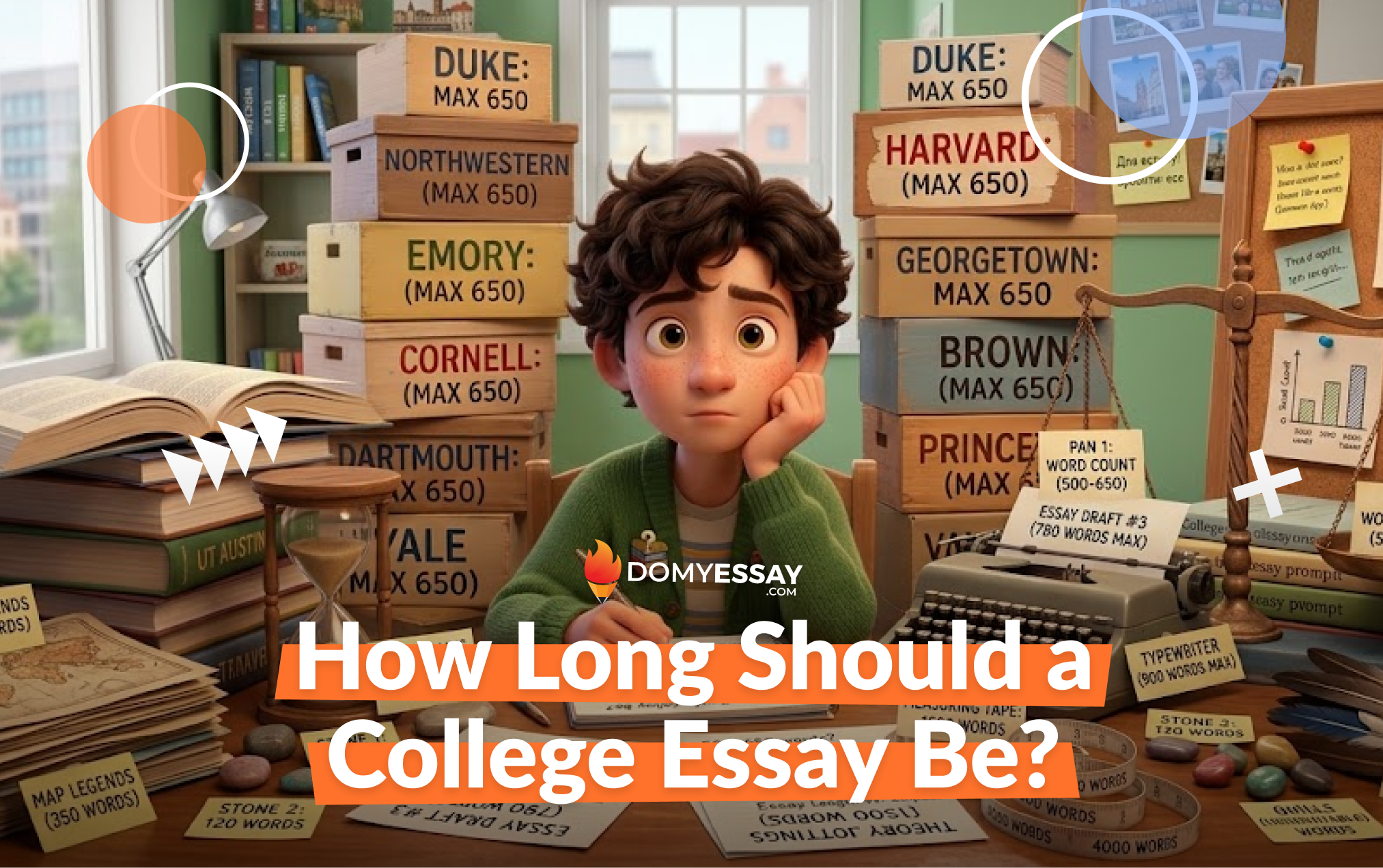
A college essay should be approximately 650 words. It’s the number most students are really after on the Common App statement. The floor is down at 250 words. But not all word counts are of the same strictness, rather they are separated into hard and soft limits. The former means that the portal itself cuts you off when you cross the line, even when you are in the middle of a sentence. The latter is closer to a suggestion than a rule and is a recommendation of how long your statement should be.
The college essay word count, obviously, varies depending on the application, and this article will guide you through those changing rules so you know how to handle every essay and statement that comes your way.
Quality You Can Trust
Every order is written from scratch, checked for originality, and delivered exactly when you need it.

College Essay Length: Guidelines for Quick Reference
Before I break each application down one at a time, here's a table worth screenshotting for later so you can reference each college essay length for quick information:
Common App Essay Length
So, how long can the common app essay be? The application won’t accept a response shorter than 250 words, and it caps you at 650, with the platform holding you to both ends. The text box will trim off the overflow without asking you about it if you go over 650 words, so an admissions officer could wind up reading a final line that cuts off mid-thought. Don’t be the person who doesn’t notice that their conclusion has disappeared. Verify the count in the portal itself.
Schools themselves keep repeating the same reminder, that 650 is your limit and not your goal. UT Austin, for one, tells applicants to land somewhere between 500 and 650 words. My own recommendation lands a touch tighter, to aim for the high 500s into the low 600s. College essay examples that dip under 400 tend to read thin, the reflection skipped, the point of the story never quite getting there. Readers catch an essay that ends before it has earned its ending, and they catch it every time.
UC Personal Insight Questions Length
The UCs do their own thing, and it pays to grasp that early, well before you're staring down a blank text box in November. No single grand personal statement here. Instead, the UC system asks first-year applicants to choose four questions out of eight, capping each answer at 350 words. Multiply that out and you land at 1,400 words total, and those divide across four distinct responses that ideally reveal four different sides of you.
The system won't stop you for writing too little. But a 140-word PIQ says almost nothing to a reader trying to picture the actual human behind the file. Use most of that 350 on each one.
The UC campuses spell out what they want in their own instructions:
- The official guidance is blunt. UCLA tells applicants to be clear, be focused, be organized, and to prove their points with written examples.
- UC PIQ word limit rewards specificity; direct voice that’s evidence-based.
- Lead with what you did, what happened, and what changed as a result. This is a slower, more literary build of the Common App personal statement.
- Hand the reader concrete details they can understand in one quick pass.
Coalition App Length
The Coalition Application runs on the Scoir platform these days. As Bucknell notes for its applicants, the Coalition recommends an essay of 500 to 650 words for the main personal statement. One thing I'd flag, though, is that The Coalition connects you with around 150 member colleges, and a good number of them tack on their own school-specific questions with their own caps. Swarthmore, for example, asks for no more than 250 words per short-answer response on top of the Coalition personal statement. So use 500 to 650 as your working default, then confirm the exact requirement for every school on your list before you call anything final.
Supplemental Essay Length
With supplementals, college application essay length is no longer one neat rule. It changes school by school, because each college writes its own prompts and sets its own caps. The good news, and there is some, is that almost all of them fall into three categories. Work out which one you're looking at, and you'll know your real limit.
Short-Answer Supplemental Essays (200-400 Words)
The most common college essay format, like a compressed personal statement. UT Austin asks for short answers of roughly 250 to 300 words each, and Swarthmore holds its short responses to 250 words. The outline of an essay still needs an opening, a middle, and a payoff, just with far less room to build them. So, one idea, fully committed. Two competing stories simply won't survive at 300 words. The temptation is always to cram more in, and I understand it. Resist anyway. Pick one clear point and the reader sees you can prioritize.
Mini-Element / Micro-Prompts (35-100 Words)
These tiny ones look easy and almost never are. Yale runs short questions capped at about 200 characters, which shakes out to roughly 35 words. At that size you get a single clean sentence, two if you're economical, and every word has to earn its place. Cut the warm-up. Don't echo the question back at them. Say the specific thing, name one real detail, keep it concrete. The students who nail these usually write a full answer first, then compress it hard, and they keep only the words that add meaning. For such a limited space, it’s necessary for any student to know how to end a college essay effectively.
"Why Us?" or "Community" Essays with No Stated Limit
Now and then a school gives you a prompt with no number attached, and that open space throws people. An empty field does not mean write 900 words. When there's no explicit cap on college application essay length, treat 250 to 400 words as your safe zone and hover there. And do the actual homework. A convincing "Why us?" essay points to specific programs, professors, or opportunities you genuinely looked up, so the reader trusts that you did your research. One more thing I've learned. Reuse the same generic paragraph across five colleges and it almost always shows, because the details never quite fit any of them.
Hand It Off Today
Tell us what you need. Our team handles the research, drafting, and editing from start to finish.

What Happens If You Don't Meet the College Essay Word Count?
The college essay max word count is there for a reason, and treating it as flexible costs you on two fronts at once. One problem is mechanical, the sort where the portal itself garbles what you submit. The other is human, the sort a worn-out reader clocks without ever mentioning it. Both are avoidable once you know they exist. Here's how each one unfolds.
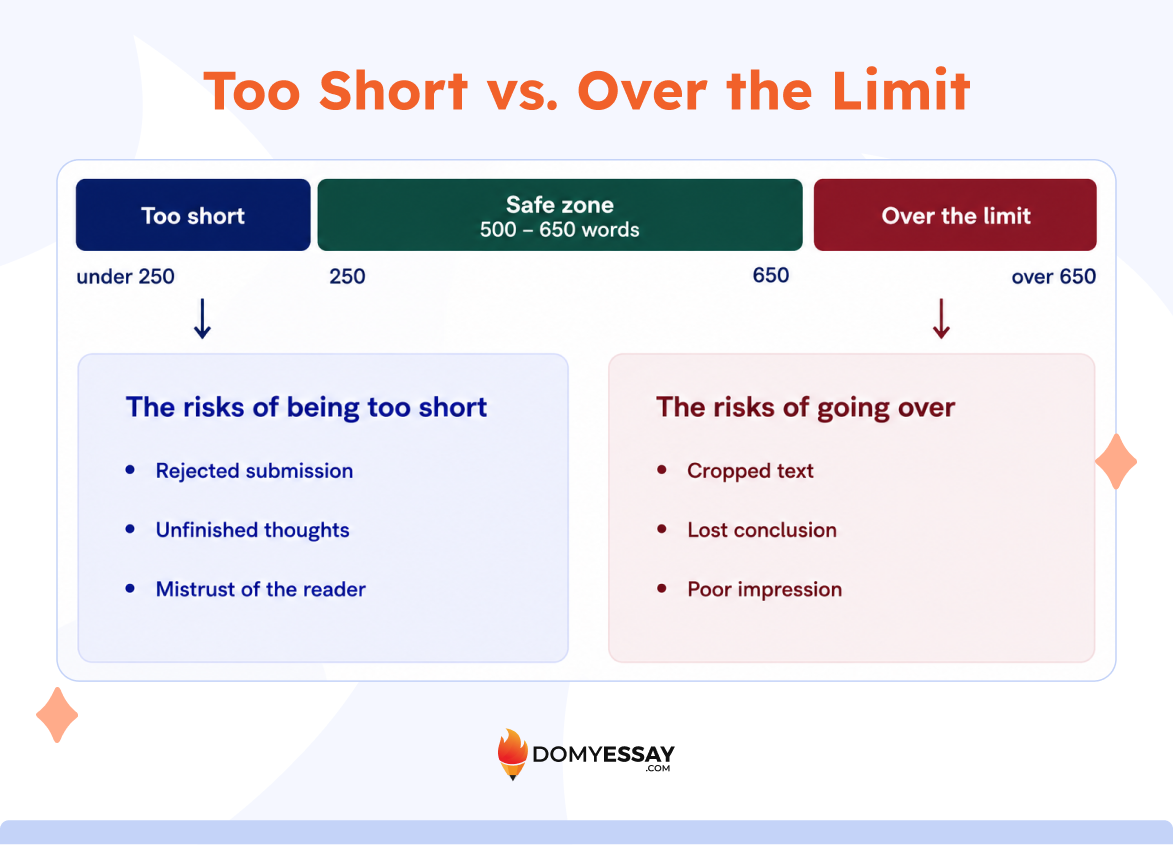
The Risks of Being Too Short
Drop below the minimum and some portals just refuse you outright. The Common App won't accept a personal statement under 250 words, full stop. And even a short essay that does squeak through plants a small doubt. It can read like you ran out of things to say, or like the prompt didn't hold your interest. Give it the attention it's owed.
The Risks of Going Over the Limit
Go over the maximum and the harm usually hides until submission is done. Text boxes crop the overflow, so your closing lines can vanish with no alert at all. There's a hidden cost, too. Admissions officers have to get through thousands of essays a season, and ignoring a stated limit tells them you didn't read the instructions, or chose to skip them. That impression lingers longer than you'd think.
How to Shorten/Lengthen Your College Essay?
Sooner or later a draft misses the word limit for college essays in one direction, and the repair job depends entirely on which way you've drifted.
When you're over and need to trim:
- "Really," "very," "just," "quite," pad the count and add nothing. UC Cincinnati flat-out recommends trading "really X" or "very Y" for one stronger word.
- Delete any sentence that repeats a point you already made. Repetition uses up your word count.
- Plenty of essays spend their first two or three sentences getting going before the story actually begins. Cut that opening.
- Combine long clauses into shorter ones. A single well-built sentence often replaces two loose ones.
When you're under and need some tips for making an essay longer:
- Filler adjectives and a repeated conclusion fool nobody, least of all a reader who does this for a living.
- The best additions come from specifics: what you noticed, what you were thinking, what you decided to do.
- A thin essay often narrates the event and forgets to say why it mattered. That "why" is usually your missing hundred words.
- A single vivid detail does two jobs at once. It adds substance and it builds trust.
Just ask one of our professionals, ‘Write my college essay for me,’ and you can instantly stop worrying about the word counts and conclusions.
Final Thoughts
So, how long should a college essay be? It hangs on which application you're completing. The Common App allows up to 650 words, the UCs hold every PIQ to 350, the Coalition points you toward 500 to 650, and supplements follow their own rules. Learn the limit for each essay on your list, then let the story decide how many of those words it truly needs.